





Between worrying about late payments, tracking down your tenants, and running checks to the bank, rent collection can be a headache. But it doesn’t have to be. How you collect rent significantly impacts your time and finances, and there may be a better option. If you're wondering how to collect rent most efficiently, this guide will help you decide.
We’ll discuss different ways you can collect rent, the pros and cons of each method, and share the most secure, reliable, and easy way to collect rent.
Key takeaways
- Methods like mail/postal service and in-person collections suffer from unpredictable lag time, high risk (especially with cash), and complicate tax tracking.
- Peer-to-peer (P2P) apps like Venmo and Zelle lack robust audit trails, the ability to block crucial partial payments, and can lead to account shutdowns.
- Specialized rent collection or banking platforms is the most secure, reliable, and automated way to streamline rent collection. These platforms offer built-in rent invoicing, late fee automation, and auto-pay features.
- Rent collection tools reduce administrative work through automation, provide clear record-keeping, and reduce human error.
- Baselane offers free rent collection for landlords, providing multiple payment options (free ACH, wire, debit/credit), fast payments (as little as two business days with QuickPay), and the ability to enroll tenants in auto-pay.
Different methods to collect rent
Before deciding on the best method to collect rent for your rental units, let’s first understand the pros and cons of all your options.
Mail/postal service
This method involves your tenant mailing a paper check, money order, or cashier's check. The tenant mails a check, and you need to deposit it manually in your bank to receive the amount.
The lag time is unpredictable, and delays require you to manually follow up with tenants or your bank. If a check bounces, you incur fees and have to restart the payment process. This method adds unnecessary friction to your rent collection system.
Physical (In-person or drop-off)
This method requires the physical transfer of funds, typically cash, a check, or a money order, either directly to the landlord or a designated drop-off location. The tenant hands the payment directly to you or drops it off at an agreed-upon location (like a bank branch or retail partner).
Handling cash is risky, tracking payments for tax purposes is complicated, and it severely limits the geographical reach for expanding your portfolio.
Online payments
Online payments are the most preferred method due to their convenience and speed. There are multiple ways to accept rent payments online.
P2P apps
Peer-to-peer (P2P) apps like Venmo and Zelle had been the gold standard, but no longer are. Even though funds are transferred instantly via phone number or email address, these apps fail to keep up with the growing needs of rental units.
They often lack a robust audit trail, give you no ability to block crucial partial payments, and can lead to account shutdowns when flagged for commercial use. This directly compromises your financial clarity and control.
ACH or wire transfers
These are direct electronic bank-to-bank transfers that are fast, secure, and reliable. Through Automated Clearing House (ACH or wire transfers, funds move directly from the tenant's bank account to yours.
ACH is one of the best ways to accept rent payments, while wire transfers are used mainly for immediate, one-time, large sums. Receiving rent by wire transfer is also costlier and less safe than using ACH.
Baselane’s survey of 400+ landlords found that nearly half of landlords use ACH/direct deposit to collect rent, and for all the good reasons. ACH payments are more common and preferred because they are safer and economical (cost $0 to $ 0.25 per transaction) than wire transfers.
Read more about how to set up ACH for rent payments.
Dedicated rent collection or banking platforms
Modern banking or rent collection platforms are gaining popularity as they solve the problems associated with traditional payment methods like P2P apps or checks.
These tools offer built-in rent collection, letting you manage the entire rent collection lifecycle–rent invoicing, rent payment, late fees, partial payments, and auto-pay. A lot of these platform offers flexible rent payment methods, including ACH, wires, debit/credit, or checks.
Benefits of collecting rent through dedicated payment software
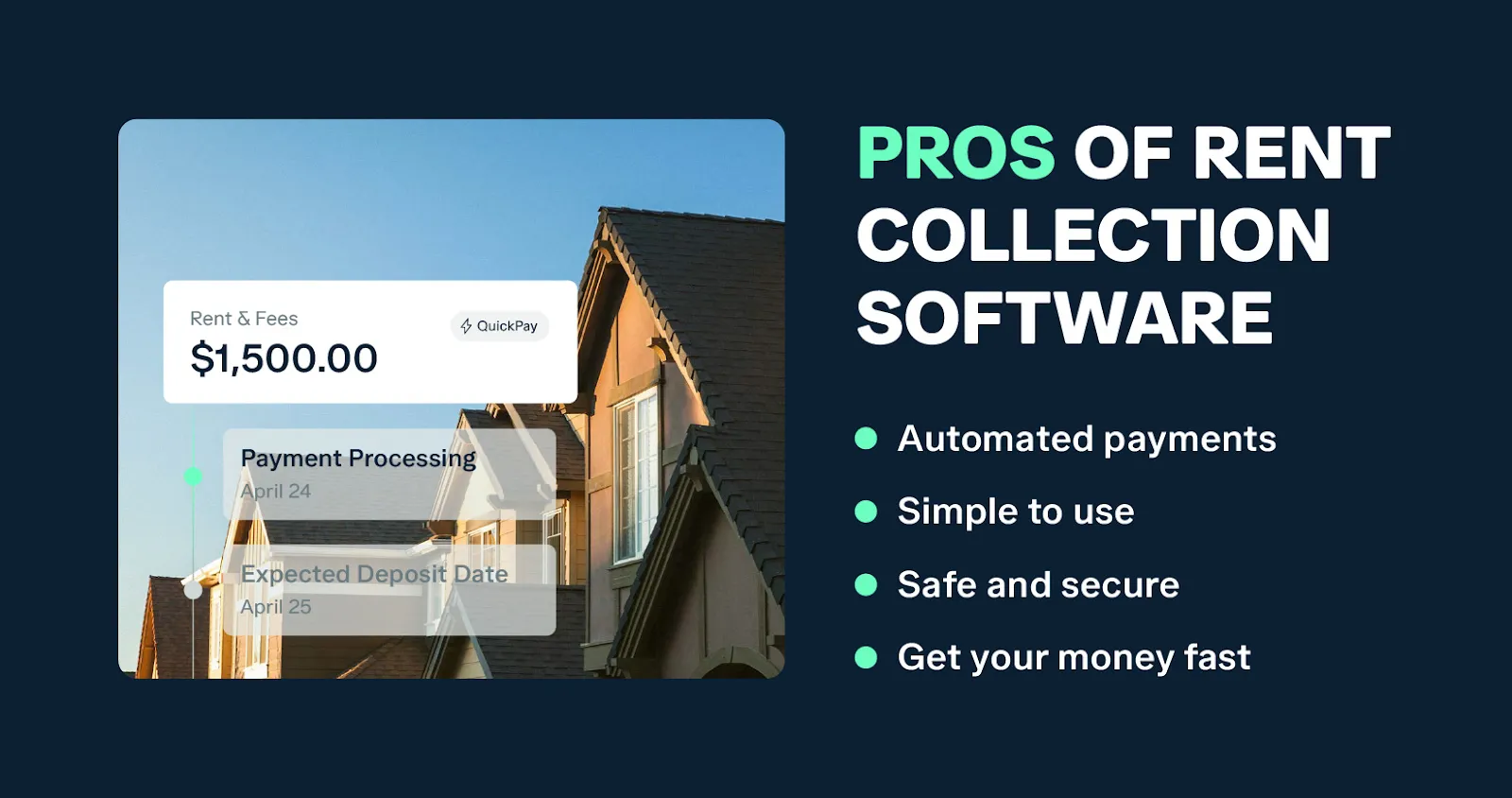
About a quarter (27%) of landlords use rent collection software to take the hassle out of things like creating manual rent receipts and constantly chasing down late payments. This number is bound to climb soon, especially with all the benefits these tools offer compared to the old-school rent collection methods.
- Faster and more reliable payments: Rent collection tools send automated payment reminders, charge late fees automatically, and allow tenants to set up recurring, automatic payments. All this ensures you get rent payments on time.
- Reduced administrative work: These tools offer built-in automation that handles tasks like processing payments, sending reminders, and applying late fees, freeing up significant time. You eliminate the manual hassle of collecting checks, going to the bank, and manually recording payments.
- Clear record-keeping and reduced human error: Many of the platform offers built-in accounting, which means your rent payments are automatically and securely recorded, creating a clear digital paper trail. This also means less room for human errors.
- Increased security and transparency: Online platforms use secure payment gateways and encryption to protect financial data, reducing the risks associated with cash or mailed checks (getting lost or stolen). Both you and the tenant have real-time visibility into payment history, which helps prevent and resolve payment disputes quickly.
5 best platforms to collect rent online
Baselane
Baselane is an integrated banking and bookkeeping platform that helps you organize property finances, collect rent, and generate reports to keep a tab on your cash flow. Our built-in rent collection helps you automate the entire rent collection lifecycle—set up rent invoices, charge late fees, collect security deposits, and collect partial rent payments.
Key features
- Auto-pay: Allow tenants to set up recurring payments so you receive on-time rent payments.
- Multiple payment options: Support free ACH transfers (with a Baselane account), wire transfers, and debit/credit cards.
- Fast payments: Get funds deposited in as little as 2 business days with QuickPay.
- Partial payments: Allow tenants to split payments with their roommates.
- Integrated banking: Open property-specific accounts and collect rent automatically for each property.
- Rent reporting: Allow tenants to build their credit by reporting their on-time payments to credit bureaus.
Pros and cons
Pricing
Baselane is free for landlords, with no monthly fees or minimum balance requirements. Tenants are charged 3.49% for debit or credit payments, but ACH payments are free when you collect money in your Baselane banking account.
Own your time,
not just your properties
Make your finances work harder, so you don’t have to.


Stessa
Stessa, a Roofstock subsidiary, is a property management software that offers online banking for landlords, focusing on expense tracking and a single, unified financial dashboard. It is a good option for investors prioritizing expense organization over the all-in-one suite.
Key features
- Online rent collection via ACH, credit/debit card.
- Supports rent payment deposits to Stessa Cash Management or an external bank account.
- Built-in late fee reminders and tenant auto-pay.
Pros and cons
Pricing
Stessa offers a free base plan, but with limited features. A lot of advanced rent collection features are available on its Pro plan, starting at $28/mo.
TurboTenant
TurboTenant is a feature-rich property management software that includes online rent collection alongside marketing and tenant screening tools. It's a good choice for landlords who need a complete front-end management solution and are willing to pay for premium features.
Key features
- Free online rent collection for landlords (ACH, credit/debit card; convenience fees for ACH/credit).
- Automated payment tracking and receipts with payment logs.
- Automated rent reminders and late fee notifications to tenants.
Pros and cons
Pricing
TurboTenant offers a free plan. Its paid plan, which includes essential features like multiple bank accounts and faster payouts, starts at $12.42/mo.
TenantCloud
TenantCloud is a property management platform known for its customizable payment options and tenant-friendly interface. It's best suited for landlords with multiple properties who need flexibility but can afford longer payment processing times.
Key features
- Automated rent reminders, autopay, and automatic late fees.
- Built-in accounting, with real-time reports and transaction activity.
- Tenant portal for rent payment tracking and reminders.
Pros and cons
Pricing
Starts at $16.50/mo for unlimited properties. There’s no free plan offered.
RentRedi
RentRedi is a rent management software that is especially useful for landlords whose tenants prefer cash payments, as it integrates with a network of retail locations.
Key features (related to rent collection)
- Accepts cash (via retail network), credit card, debit, and ACH payments.
- Tenants can set up autopay and receive payment reminders in-app.
- Automated or manual late fees, with the ability to accept/block partial payments.
Pros and cons
Pricing
RentRedi offers no free plan. Its premium plan starts at a fairly low price of $5/mo.
How to set up rent collection online with Baselane
Depends on which platform you pick; the rent collection setup might look different. As Baselane integrates banking and bookkeeping with rent collection, it truly centralizes your rental finances, making it one of the best rent collection software.
Here’s a detailed walkthrough of how you can set up rent collection in Baselane:
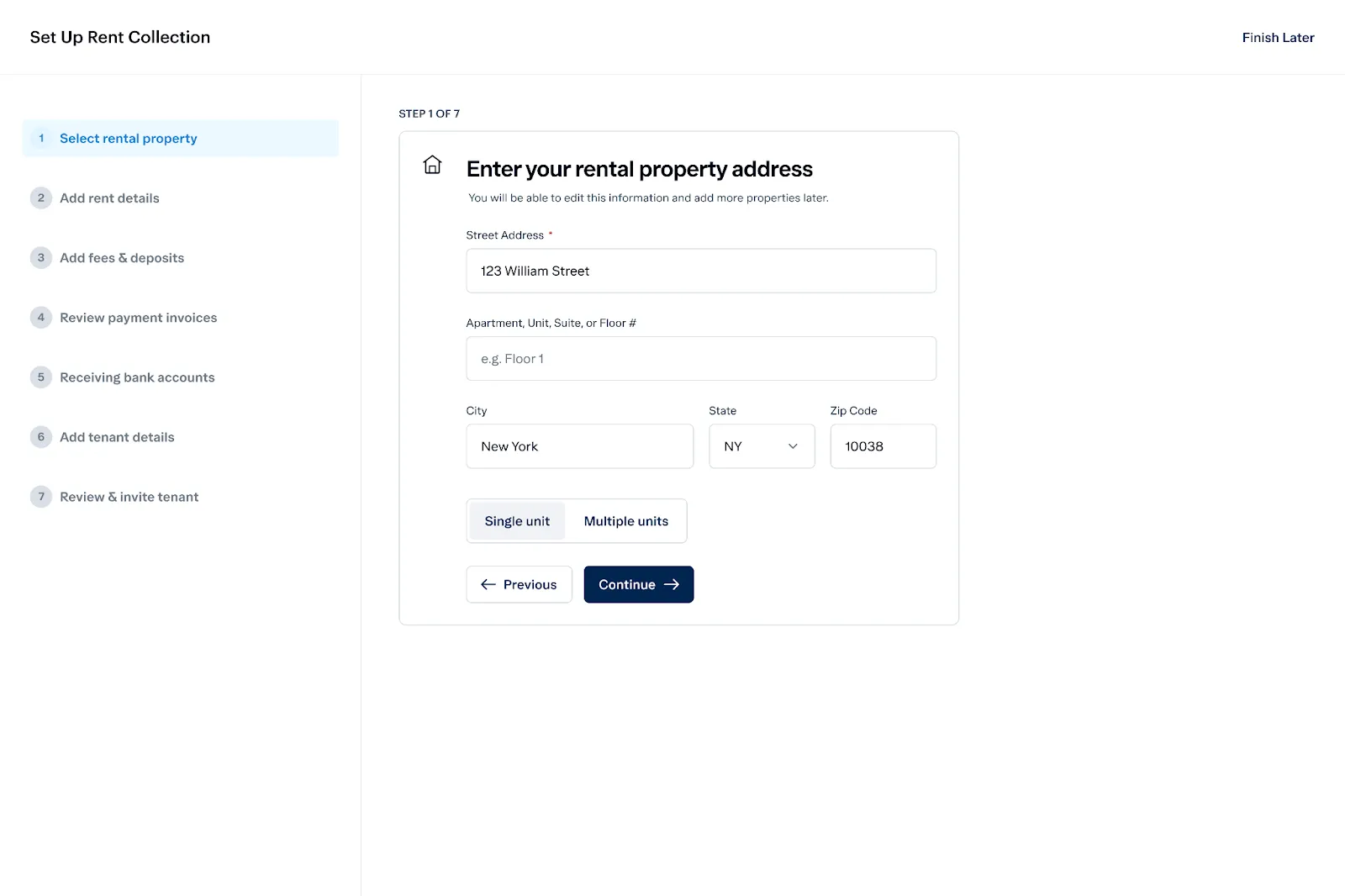
Step 1: Add our property details
Before setting up rent collection, add the property you want to collect rent for. Specify the property type (single-family, apartment, townhouse, duplex, etc.) and provide details such as address, units, and tenant areas.
If you have multiple tenants within a single property, each paying a portion of the rent (like roommates), you can add multiple units or rooms to reflect this so that rent collection can be done individually for each tenant.
Note: You can add a property when setting up rent collection, but having it already there makes the process much easier and faster.
Step 2: Start the rent collection setup
Navigate to the Rent Collection tab and select the "Set Up Rent Collection" button.
Choose the property and specific unit for which you want to set up rent collection. Units will appear if you have multiple tenants or designated units for the property.
Then, enter the rent details like lease start and end date, rent amount, due date, or any recurring fees such as utilities or pet fees. You can also add one-time fees like move-in fees or key replacement fees during this step.

Step 3: Add security deposit details and review invoices
If you’re collecting security deposits or last-month rent, add the details in this step. You can also set up prorated rent if tenants are moving in mid-month.
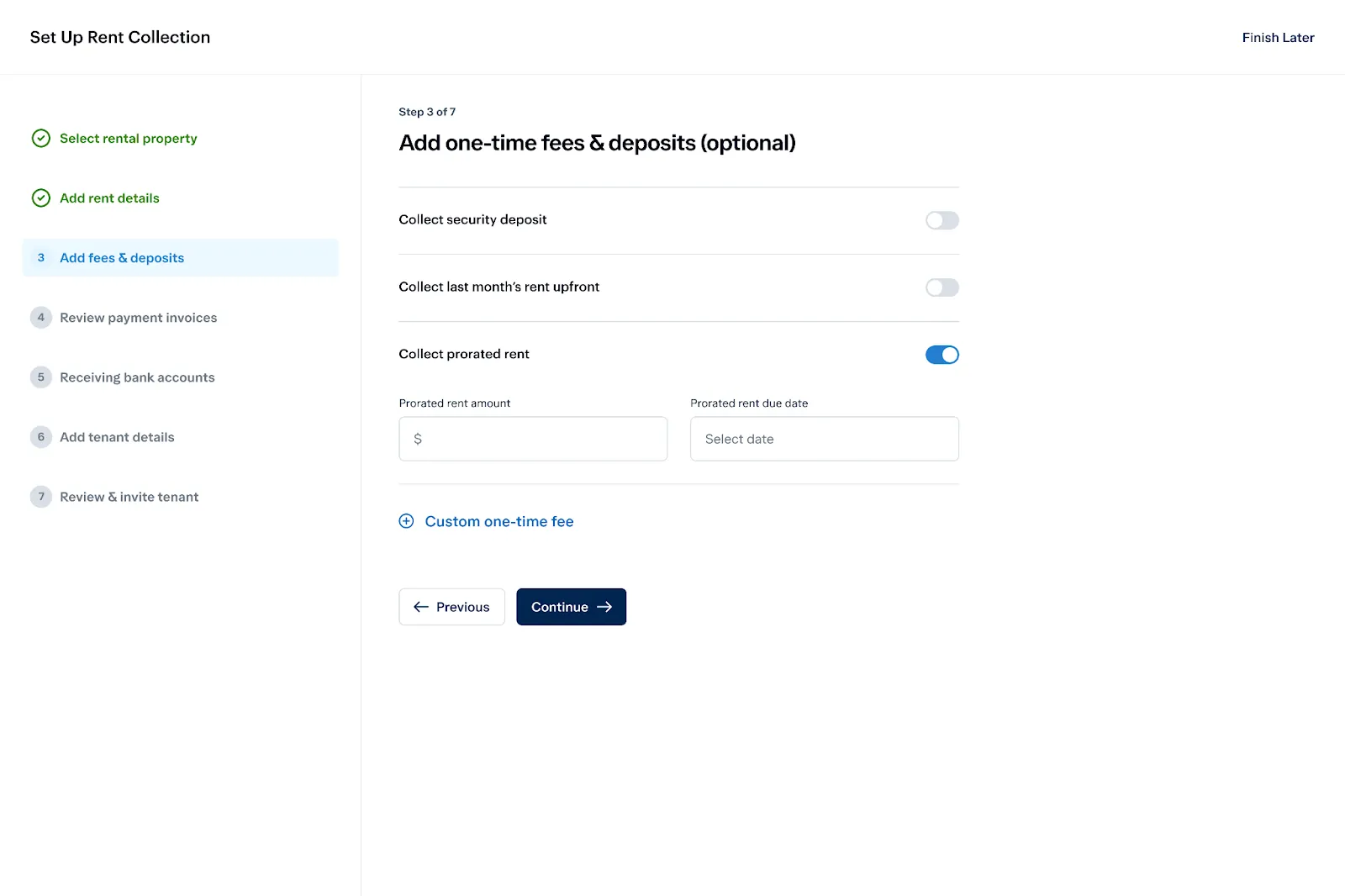
Review the invoices Baselane will generate based on the above terms; these will be what tenants see in their portals.

Step 4: Select bank account
Choose the account where you want rent payments to be deposited. If you have not connected a bank account, you will be prompted to connect an existing account or open a Baselane banking account.

Note: You can receive rent payments only in a Baselane checking account, not savings. Savings accounts only allow security deposits.
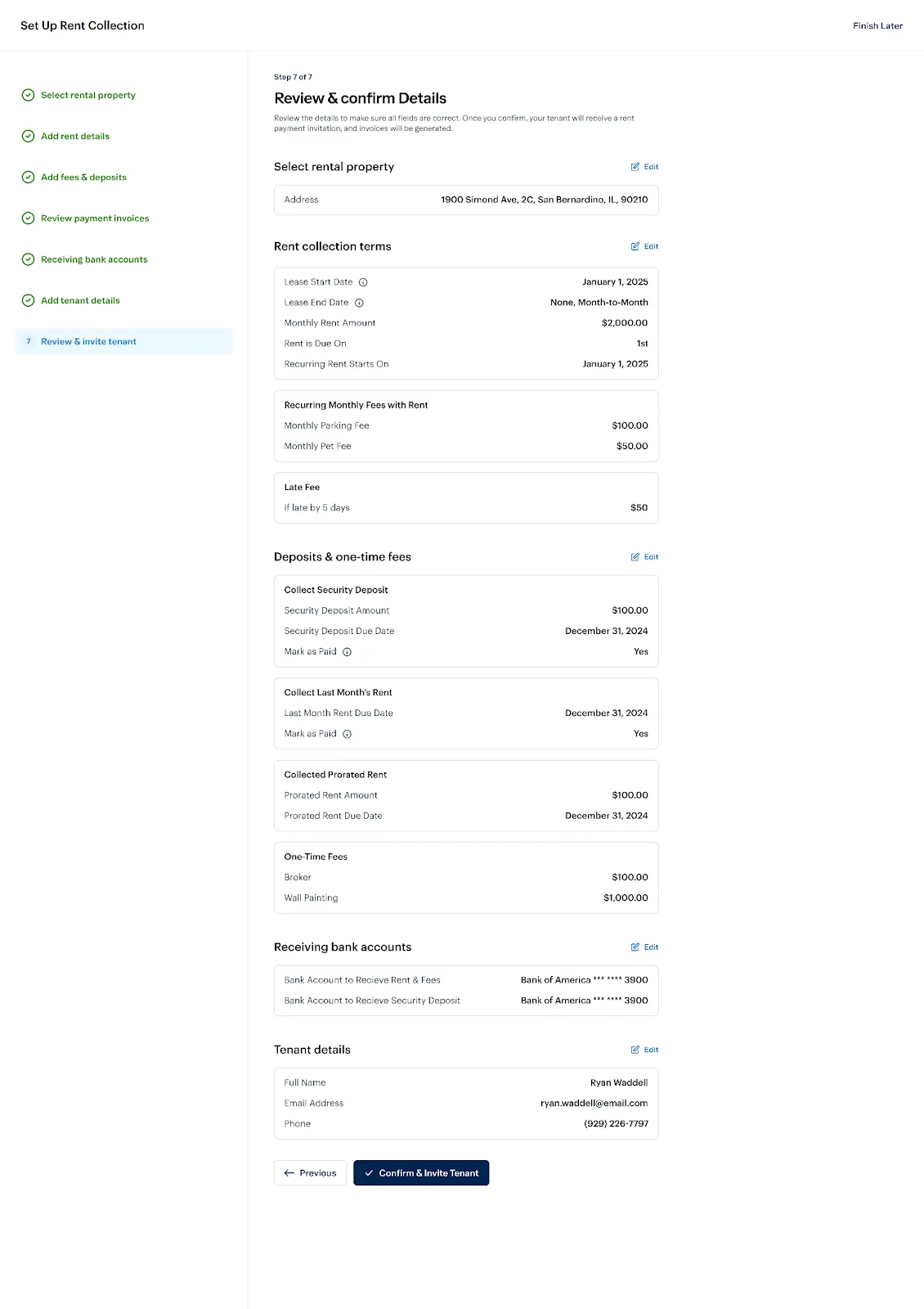
Step 5: Add tenant details
This is where you add tenants' details–their name, email, and contact information.

Step 5: Review and send an invite to the tenant
Lastly, double-check all the details and make sure they’re accurate. Once done, send the invite link to tenants to join the Baselane Tenant Platform for viewing invoices and making payments online.
Once tenants join their portal in Baselane, they can start paying you rent via ACH, debit, or credit card. They can also enroll in autopay to have rent automatically deducted each month from their account so that you receive payments on time.
You can edit rent collection terms at any time during a lease, such as adjusting rent amounts, extending lease dates, or adding fees. Any changes will update invoices and tenant notifications automatically to keep rent collection smooth and transparent.
Ready to automate rent collection and focus on finding your next deal? Open your Baselane account today!
FAQs
What is the best way to collect rent online for free?
The best way to collect rent online for free is with platforms that offer no monthly fees for landlords and free ACH transfers for tenants. With Baselane, you can collect rent for free via ACH. debit/credit cards and also allow tenants to enable auto-pay for timely payments.
What is the best way to collect rent electronically?
The best way to collect rent electronically is through a rent collection software that supports multiple payment methods, including ACH, debit card, or credit card payments.
How to collect rent as a landlord?
To set up rent collection, you’ll need a bank account or an integrated banking platform that connects with your external account. With Baselane, you can receive funds in your external or Baselane account. The setup is quick: you add all the rent collection details (rent amount, lease term, due date, etc.), choose the account, and invite tenants to start receiving rent or setup ACH auto-pay to pay rent on time..
What rent collection apps for landlords are best?
The best app for rent payment depends on your needs and portfolio size. If you’re going for convenience and fast payments, apps like Zelle and Venmo are good options, but they don’t automatically put the money in your bank account. Baselane, on the other hand, solves this pain. It not only offers a checking account to collect rent payments but also offers integrated bookkeeping to categorize your transactions automatically.
Can I use Zelle to collect rent?
Yes, you can use Zelle to collect rent. The app is simple to use, and transfers are free, but note that Zelle only pairs with certain banks and credit unions. This limitation can make addressing issues like how to collect unpaid rent more challenging if tenants don't have compatible accounts.
Can I use Cash App to collect rent?
Yes, you can collect rent via Cash App, but the app limits payment amounts, which could be an issue for certain rent payments, when searching for the best way to collect rent as a landlord, look for options that have high (or no) payment limits.





.jpg)


