


As a landlord or real estate investor, you know the importance of efficient property management. But between keeping track of finances, collecting rent, and dealing with maintenance requests, it's easy to feel overwhelmed.
Handling these tasks manually can lead to errors and wasted time, hindering your profitability. Property management software can help streamline these processes, from rent collection and lease management to financial reporting.
Whether you're dealing with Airbnb properties or a long-term rental apartment, we've rounded up the best free property management software platforms to help you focus less on routine tasks and more on maximizing your returns.
Own your time,
not just your properties
Make your finances work harder, so you don’t have to.


Key takeaways
- Property management software (PMS) helps you automate repetitive tasks, improve tenant relations, and maintain clear financial records.
- PMS platforms typically offer built-in online rent collection, tenant screening, bookkeeping, and financial reporting.
- We've analyzed Baselane, TurboTenant, Apartments.com, Buildium, Innago, Avail, RentRedi, TenantCloud, Hemlane, and Zillow Rental Manager. You can use a combination of them to manage your properties end-to-end.
- Baselane stands out by integrating banking with no monthly account maintenance fees alongside automated bookkeeping, advanced financial reporting, and online rent collection, with savings accounts earning up to [v="apyvalue"] APY² and no minimum balance requirements.
Why should you use property management software?
A dedicated property management solution acts as your centralized command center, addressing key financial and operational challenges by giving you several powerful advantages:
- Save significant time and reduce errors by automating daily tasks such as rent invoicing, payment reminders, and expense categorization.
- Gain a real-time, clear financial view of your portfolio's health through integrated tracking and reporting, helping you make smarter, data-driven investment decisions.
- Simplify your organization by centralizing all resident and lease data, payments, and work orders in one platform.
- Enable easier scaling because the automation handles the added workload of new properties or units without requiring a huge increase in your time commitment.
- Improve tenant relations through features like a dedicated portal that streamlines communication and maintenance requests, which is vital for tenant retention.
Key features to look for in a property management solution
When doing your research, run each platform's offering through these points to make sure you're getting the most for your effort.
- Automated online rent collection: Look for software that supports multiple payment methods (ACH, credit/debit cards, wire transfers, and checks), automates late fees, supports auto-pay, and sends digital receipts.
- Tenant & lease management: Check if the platform offers essential features like e-signatures, digital lease templates, and automated renewal reminders to help you stay compliant.
- Automated accounting: Check if the software helps you track income and expenses by property/unit and categorize them automatically.
- Tax preparation tools: Consider features that automatically map your transactions to Schedule E categories. This simplifies year-end tax preparation dramatically.
- Integrated banking: Look for platforms with built-in banking to manage funds across properties, organize security deposit accounts, and sync all financial data with your bookkeeping.
- Tenant screening: Prioritize tools that offer built-in screening reports to run credit, background, and eviction history checks to help you expedite the tenant qualification process.
- Maintenance management: Consider platforms where tenants can submit maintenance requests online (with photos). The software should allow you to track work orders, assign tasks to vendors, and keep a clear history of all repairs.
- Listing & syndication: Look for tools that can create vacancy listings and automatically post them (syndicate) to popular rental websites like Zillow to minimize downtime.
- Dedicated portals: Assess whether the platform offers separate portals for both tenants (for payments and requests) and owners (for real-time reporting).
We've analyzed Baselane, TurboTenant, Apartments.com, Buildium, Innago, Avail, RentRedi, TenantCloud, Hemlane, and Zillow Rental Manager. You can use a combination of them to manage your properties end-to-end.
Our best picks for property management software
Here's a detailed breakdown of the top property management software.
Baselane
We built Baselane to solve the core challenges of fragmented finances and context switching between multiple tools. Baselane is a banking and bookkeeping platform for real estate investors that integrates your banking and bookkeeping under a single login to help you keep funds separated by property or units, categorize income and expenses, and generate tax-ready reports.
With rent collection built in, you can get started on tenant screening, lease signing, and rent collection in an instant.
As your finances are automated and live in a single place, you can focus on growing your business, which is why you really got into real estate.
Key features
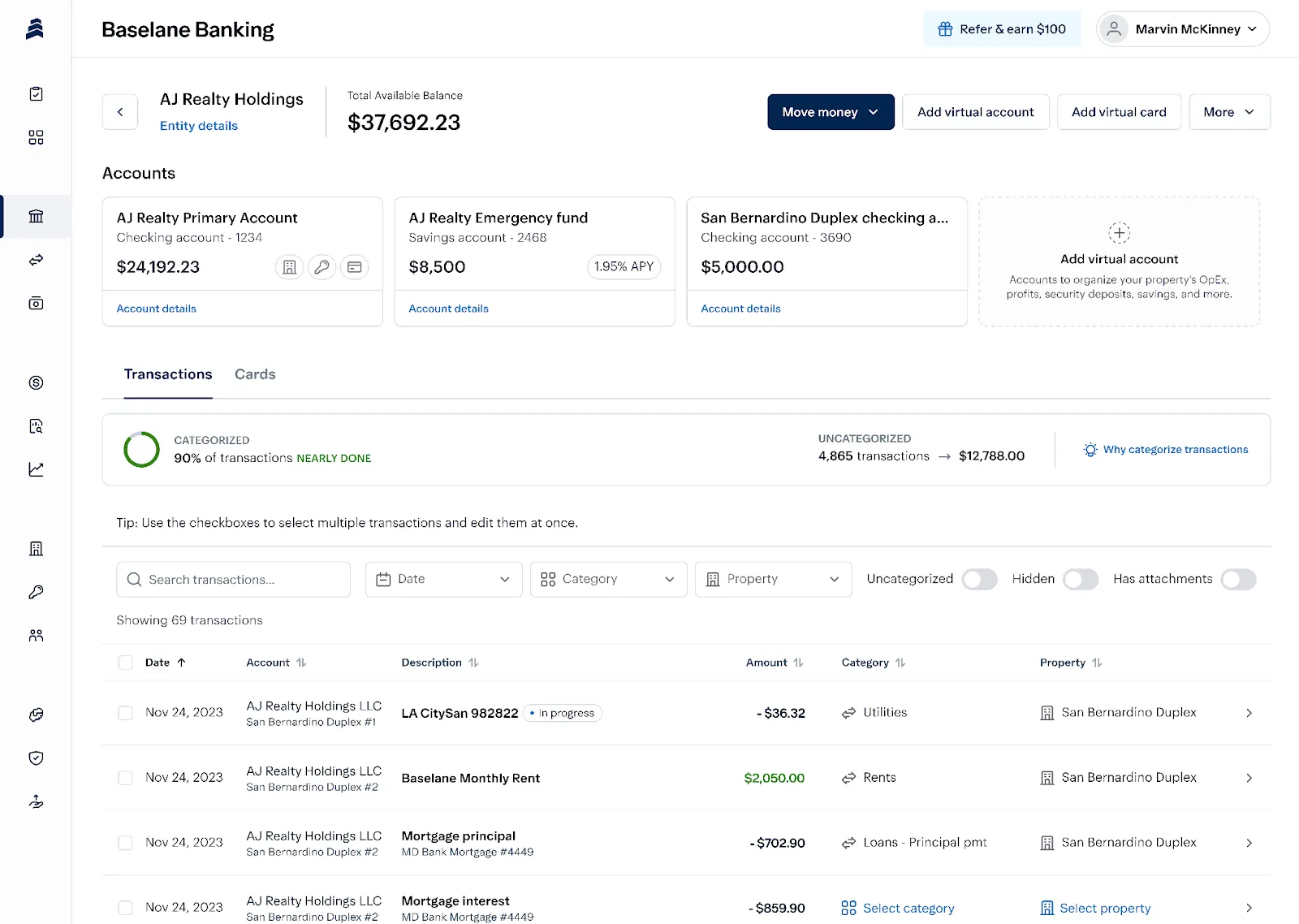
- Automated rent collection: Baselane sends rent invoices, charges late fees, collects security deposits, and sends automatic reminders to tenants.
- Automated bookkeeping: Baselane automatically synchronizes and categorizes transactions to property/unit and Schedule E categories.
- Property-specific banking: Baselane offers unlimited checking and savings accounts for each property, unit, and security deposit, each with its own account number. Savings accounts earn up to [v="apyvalue"] APY², and deposits are FDIC-insured up to [v="fdic_long"]¹ through Baselane's partner bank, Thread Bank.
- Virtual debit cards: Baselane offers multiple debit cards with custom spend controls and auto-tagging rules for seamless expense tracking and sharing with vendors.
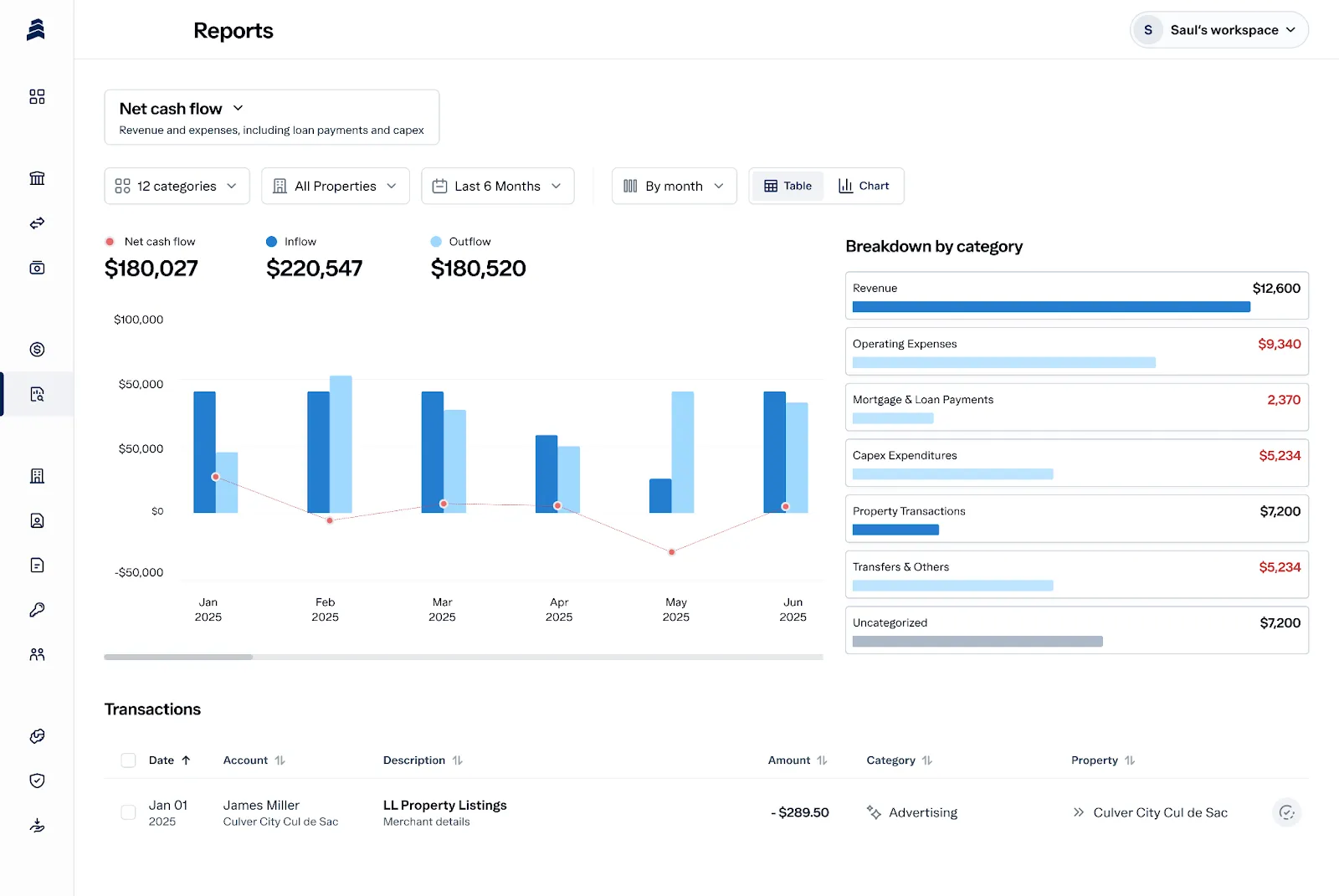
- Financial reporting: Baselane auto-generates real-time reports, including Income Statements and a downloadable Accounting Tax Package.
- Tenant screening: Screen tenants through credit, income, eviction, or identity reports and set up rent collection instantly.
- Lease signing and management: Get rental leases signed digitally and store them in a dedicated portal.
When it comes to having everything in order for all of my real-estate needs, as far as tenants, Payments, Rental agreements, and Tenant screening, Baselane has me covered. It provides me with easy and secure access to all of my properties and all of my tenant activity. ~ Eudania Burrell
Pros and cons
Pros
- Helps you centralize financial aspects of your properties, from banking to rent collection.
- No monthly account maintenance fees and no minimum balance requirements.
- Unlimited free accounts and debit cards for fund organization and expense management.
Cons
- Some features and account setup still require the web app.
Pricing
Baselane has two pricing plans.
- Baselane Core: $0. Includes banking, bookkeeping, rent collection, debit cards, and tax reporting tools with no monthly account maintenance fees or minimum balance requirements.
- Baselane Smart: $20/month billed annually. Unlock advanced auto-tagging rules, 2-day rent deposits, shared access, and more.
TurboTenant
TurboTenant is an affordable rental property management software focused on the listing and tenant acquisition process. While it handles online applications, tenant screening, and rent collection, many key financial features are siloed or require a paid plan.
TurboTenant is a useful tool for getting tenants in the door, but it lacks the financial depth needed for efficient, large-scale portfolio management.
Key features
- Rental advertising: Advertise rental property to create a pool of interested tenants across 25+ listing sites.
- Tenant screening: Run background and credit checks on qualified applicants.
- State-specific leases: Create lease agreements tailored to various states (for a fee on the free plan).
Pros and cons
Pros
- Comprehensive tools for advertising vacancies and tenant screening are available.
- Includes automatic deposits to the landlord's bank account.
Cons
- Multiple bank accounts and faster payouts (less than 5-7 days) are restricted to paid plans.
- No integrated banking; automated transaction categorization and Schedule E/Form 8825 reporting are available on the Pro plan.
Pricing
TurboTenant offers a free plan that covers basic listing, screening, and rent collection. Paid plans, which include features like multiple bank accounts and phone support, start at $149/year for the Essential Plan.
Apartments.com
Apartments.com is a property listing and tenant communication solution. It provides fundamental features like tenant screening and online rent collection, but is limited in advanced financial management and detailed reporting.
Apartments.com is better suited for the tenant-facing side of management rather than the financial engine of your growing portfolio.
Key features
- Rental listings: Advertise vacancies directly on Apartments.com.
- Online rent collection: Supports multiple payment options with automatic email reminders.
- Virtual tours: Create 360-degree tours of your property to show to tenants virtually.
Pros and cons
Pros
- Free for landlords and provides broad exposure for listings.
- Supports splitting rent payments among roommates.
Cons
- Offers lease generation and basic income and expense tracking, but lacks integrated banking and advanced portfolio-level financial reporting.
Pricing
The core Rental Manager platform is free for landlords. Applicants pay for tenant screening reports, while optional premium listing promotion carries an additional fee.
Buildium
Buildium is a comprehensive property management software that caters primarily to professional property managers and landlords with larger portfolios. It offers advanced property management features, from leasing to financial reporting, but it requires a high starting budget and lacks integrated banking solutions.
Buildium's complexity and fee structure make it an expensive choice for an independent investor.
Key features
- Online rent payments: Collects credit, debit, and ACH rent payments with automated reminders.
- Financial reporting: Provides a range of accounting and financial reports suitable for larger operations.
- Tenant communication: Provides a portal and tools to manage communication with your tenants.
Pros and cons
Pros
- Offers fast rent payment processing times of 1-2 days.
- Comprehensive suite of features ideal for property managers and large portfolios.
Cons
- Expensive, with pricing scaling based on the number of units.
- Charges a significant $99 setup fee for each bank account receiving rent payments.
- No integrated banking to streamline finances.
Pricing
Buildium does not offer a free plan, only a 14-day free trial. Pricing starts at $62/mo for the Essential plan and increases based on the number of units managed.
Innago
Innago is a simple property management solution designed for small to mid-sized landlords who want to create customizable lease agreements at scale.
While it's free for landlords and provides core features like rent collection, tenant screening, and document storage, it is not a comprehensive financial platform. It primarily focuses on operational tasks, and tenants cover the fees for rent payments, which can be a point of friction.
Key features
- Online rent collection: Tenants can set up automatic payments and receive payment reminders.
- Customizable leases: Create customizable lease agreements for each unit or tenant.
- Offline tracking: Track payments received offline to monitor outstanding balances.
Pros and cons
Pros
- Free for landlords, with no setup fees or contracts.
- Easy to use and affordable for small to growing portfolios.
Cons
- Transaction fees are typically paid by tenants, although landlords can choose to absorb online payment fees.
- Lacks integrated banking and bookkeeping features for a full financial solution.
Pricing
Innago is free to use for landlords. Fees for services like tenant screening and rent payment are charged directly to the tenant.
Avail
Avail focuses on simplifying the process of advertising vacancies and collecting rent online. It provides strong tools for the front end of property management, including listing on major sites and lease creation.
However, Avail's core financial benefit, FastPay, is locked behind a per-unit fee, making it expensive to scale, and it lacks the deep financial integration of banking and automated bookkeeping.

Key features
- Rental listing: Primarily a listing platform that posts vacancies to popular sites including Realtor.com, Redfin, and Zumper.
- Online applications & leasing: Allows you to manage the tenant application and leasing process digitally.
- Autopay and credit reporting: Includes autopay for tenants and CreditBoost to report on-time payments to credit bureaus.
Pros and cons
Pros
- Help tenants build credit, which can attract high-quality renters.
- Strong focus on getting properties listed and tenants screened.
Cons
- The essential FastPay feature for next-day deposits costs $9 per unit per month, which quickly adds up as your portfolio grows.
- Financial tools are more basic, focusing on property-specific bank accounts and income and expense tracking rather than deeper automated bookkeeping.
Pricing
Avail offers a free plan. The Unlimited Plus paid plan, which includes expedited payments and waived ACH fees, costs $9 per unit/mo.
RentRedi
RentRedi is a mobile-focused rental management platform that specializes in online rent collection and tenant screening. A notable feature is its ability to accept cash rent payments at retail locations, which can be useful for certain tenant demographics.
However, it does not offer a free plan and requires a paid subscription for even basic features, while lacking integrated financial tools.

Key features
- Online applications & lease signing: Includes a digital platform for new tenant paperwork and e-signing leases.
- Automated late fees: Automatically set up and charge recurring late fees.
- Mobile app: Dedicated mobile app available for both landlords and tenants.
Pros and cons
Pros
- Accepts cash rent payments, offering unique payment flexibility.
- Flat-fee pricing means unlimited units at one price.
Cons
- Lacks integrated banking and automated bookkeeping/tax reporting.
- Rent payments are typically deposited within 2-3 business days.
Pricing
RentRedi does not offer a free plan. Pricing is $29.95/month or $144/year for unlimited units.
TenantCloud
TenantCloud is a property management platform that offers a broad range of tools, including listing, screening, and rent collection. It supports reconciliation with external bank accounts, helping you keep track of your finances. However, its dashboards can be confusing to navigate, and payments can take up to seven days to process.

Key features
- Online payment history: Provides tracking for all rent payments in a central dashboard.
- E-signature leases: Allow for the digital signing of lease agreements.
- Customizable rules: Landlords can adjust rules for due dates, late fees, and partial payments.
Pros and cons
Pros
- Supports multiple landlord bank accounts on its paid tiers.
- Allows customizable tenant payment options.
Cons
- Rent payment processing can take as long as seven days, which is exceptionally slow.
- The user interface can be confusing to navigate.
Pricing
TenantCloud offers a 14-day free trial. Paid plans start at $25/mo, with discounted effective monthly pricing available with annual billing.
Hemlane
Hemlane is one of the best free property management software options available. It offers additional upgrades, allowing you to start with free landlord software and then add paid tools and optional support services as your needs grow. Hemlane's Starter plan is free forever and is designed to help landlords move away from spreadsheets while covering core leasing and accounting basics. However, per-unit-based pricing may make the platform expensive as your portfolio scales.

Key features
- Free Starter plan includes advertising to major listing sites, tenant screening (credit, criminal, eviction, and income reporting), and rental accounting with bank sync + reporting.
- Lease management + e-sign + rent collection available on paid plans (with $0 ACH fees listed for rent collection).
- 24/7 repair coordination available on higher tiers, including emergency support and work order + invoicing workflows.
Pros and cons
Pros
- Solid "start free" path: listing + screening + accounting included on the free tier.
- Offers optional support services (repair coordination and tenant communication support on higher tiers).
Cons
- Some of the day-to-day management tools (leases, e-sign, rent collection) are paid-tier features.
- Costs can rise based on units and plan tier (per-unit + base fee pricing on paid plans).
Pricing
The basic plan is free. Paid plans start at a $28/month platform fee plus $2 per unit, or $30/month for one unit.
Zillow Rental Manager
Zillow Rental Manager is a free tool built into the Zillow Rentals Network, specializing in listing properties and basic rent collection. It's an accessible option for DIY landlords, STR investors, and property managers. It offers core features including listing, advertising, tenant screening, and rent collection.
But that's where the Rental Manager hits the ceiling.
The primary limitation is its lack of advanced financial features like financial reporting, bookkeeping, or the ability to link multiple bank accounts, which is non-negotiable for multi-unit investors seeking clarity and control.
Key features
- Listing integration: Seamlessly lists properties on Zillow, Trulia, and HotPads.
- Online rent collection: Offers ACH and card payment options with automatic reminders.
- Payments tracking: Tracks payments in a central dashboard.
Pros and cons
Pros
- Free for landlords and simple to use for basic needs.
- Excellent for advertising listings due to integration with the Zillow network.
Cons
- Lacks integrated banking, bookkeeping, and P&L reporting.
- Only one bank account can be linked to receive payments across all properties.
Pricing
Zillow Rental Manager is free for property listings. An optional Premium listing upgrade is available for a one-time fee.
Save time and money managing your properties with Baselane
There's no single property management software that fits every investor's needs, as all of the platforms we discussed focus on particular stages of the property lifecycle.
Some solutions excel at vacancy listing and tenant acquisition, while others help manage the daily financial grind: rent, bookkeeping, banking, and reporting.
The best way forward is to assess your current portfolio size, the geographic spread of your properties, and your budget. Then, select tools that provide end-to-end management, from property listing to financial automation, without the high monthly fees that chip away at your profits.
For example, a lot of our users use Zillow to market their properties and switch over to Baselane to screen tenants, get leases signed, and set up rent collection. What's even more interesting is that you receive rent or security deposits in property-specific accounts with Baselane's integrated banking and categorize all transactions as per Schedule E categories with automated bookkeeping.
Ready to organize your property finances? Get started with Baselane today!
FAQs
What is free rental management software?
Property management or rental management software is a digital tool that helps landlords and property managers streamline operations, automate tasks, and manage rental properties more efficiently. Core functions include tenant screening, lease management, online rent collection, and financial tracking.
What's the best software for short-term rentals?
While the best software for short-term rentals (STRs) depends on specific needs, a platform like Baselane is an excellent choice. It offers core financial features like granular expense tracking using virtual cards, automated bookkeeping, and robust financial reporting that are essential for accurately monitoring the complex cash flow of STRs.
Is Baselane a free online property management software?
Baselane is a banking and bookkeeping platform designed for real estate investors and landlords. The Core plan is free to use with no monthly account maintenance fees. Baselane helps you manage your property accounts, categorize transactions based on Schedule E categories, and collect rent, all under one login. You can also screen tenants, get leases signed, and maintain a clear record throughout the tenant's rental lifecycle.
What is the best free property management software for small landlords?
The best rental property management software for small landlords is one that is free, easy to use, and scalable. Baselane is an excellent choice because it has no monthly account maintenance fees, provides unlimited accounts for easy financial organization, and offers a full suite of essential features like online rent collection and automated bookkeeping, eliminating the need for expensive third-party tools.
What is the average property management fee for rental properties?
The average property management fee typically ranges from 8% to 15% of the monthly rental income. These fees can vary significantly depending on the property's location, the scope of services provided, and whether the manager charges extra for services such as tenant placement or maintenance coordination.
How does free software for rental property management help a landlord?
Free rental property management software automates and centralizes the operational and financial tasks. It helps you track income/expenses, auto-categorize transactions, automate rent invoicing, collect late fees, run tenant screening, and communicate with your tenants.