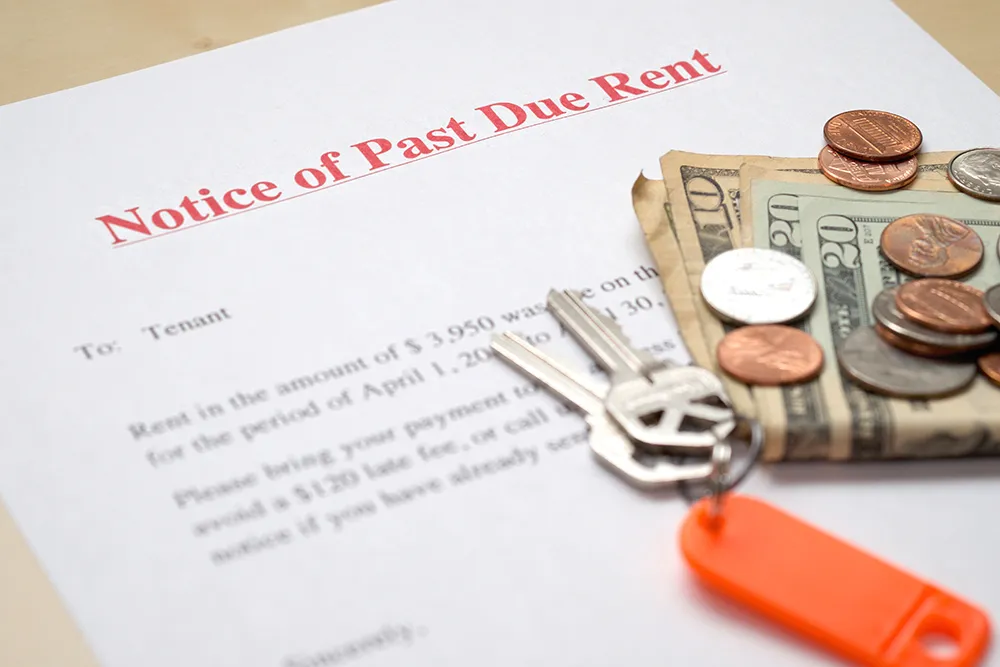


Recent and historical data on rental arrears, late payments, outstanding balances, and evictions for landlords and real estate investors.
Unpaid rent can disrupt property-level cash flow, operating reserves, and debt-service planning. According to the Federal Reserve's 2025 survey, 23% of U.S. renters reported being behind on rent at some point during the preceding year. Separately, the Consumer Financial Protection Bureau (CFPB) reported a $3,200 median outstanding balance in November 2024 among renters with positive balances in its rental-payment dataset.
These findings measure different groups and time periods. Together, they illustrate why landlords and real estate investors benefit from documented rent collection, consistent tenant communication, and property- and entity-level financial reporting. Baselane brings these workflows together through integrated banking, bookkeeping, and rent collection.
Own your time,
not just your properties
Make your finances work harder, so you don’t have to.


Key takeaways
- Rent arrears remain widespread: In the 2025 Federal Reserve survey, 23% of renters reported falling behind at least once in the preceding year, compared with 21% in the 2024 survey. These figures do not represent monthly late-payment rates.
- Outstanding balances increased among affected accounts: The CFPB analysis recorded a median positive outstanding balance of $3,200 in November 2024, compared with $2,000 in September 2021. Its dataset is not nationally representative.
- Late fees often recur: Approximately 42% of renters with a first observed late fee in the CFPB dataset incurred another in the following observed month.
- Eviction filings have approached historical levels: Pennsylvania recorded 110,490 eviction filings in 2025, equal to 95.1% of its 2019 total. A filing does not establish that an eviction was completed.
- Longer-term arrears can be substantial: In a historical University of Chicago study, approximately 50% of 5,809 selected tenancies accumulated a balance of at least one month's rent at some point between 2015 and 2019.
- Local rent levels matter: The Federal Reserve reported 2025 median monthly rent payments of $1,450 in the West and $915 in the Midwest. Regional rents are not measures of payment delinquency.
Understanding unpaid rent and rent debt: key statistics
Unpaid rent, a late fee, an outstanding balance, and an eviction filing are distinct measures. The statistics below draw on a national renter survey, a nonrepresentative payment dataset, a selected historical tenancy sample, and Pennsylvania court records. Their percentages should not be compared as if they shared the same population, denominator, or observation period.
1. About 14% of observed renters incurred a late fee within 12 months
As of November 2024, approximately 14% of active renters in the CFPB payment analysis had incurred at least one late fee during the previous 12 months. This is a trailing-year indicator from the CFPB's observed accounts, not a national monthly delinquency rate.
2. 23% of U.S. renters reported falling behind on rent in the 2025 survey
The Federal Reserve's 2025 survey found that 23% of renters reported being behind on rent at some point in the prior year. Because the measure is based on renter responses over 12 months, it does not indicate how many individual monthly payments were late.
3. 21% of renters reported rent arrears in the 2024 survey
The Federal Reserve reported that 21% of renters had been behind on rent at some point in the year preceding its 2024 survey. The corresponding share rose to 23% in its 2025 survey, a two-percentage-point change in the annual self-reported measure.
4. Median positive outstanding balances reached $3,200 in November 2024
Among observed renters with outstanding balances, the CFPB recorded a median of $2,000 in September 2021 and $3,200 in November 2024. These amounts describe accounts with positive outstanding balances and should not be presented as the median rent debt of all U.S. renters.
5. The observed outstanding-balance share fell below 3% in November 2024
The share of active renters with an outstanding-balance status in the preceding 12 months hovered near 5% through February 2024, then fell to just under 3% by November 2024 in the CFPB dataset. This is a trailing-year status measure, not a point-in-time count of unpaid rent or a nationally representative trend.
Rental affordability and housing constraints
Financial constraints help explain why households rent, although reasons for renting do not establish whether a particular tenant will pay on time. The Federal Reserve's surveys provide context for affordability alongside its separate rent-arrears findings.
6. 68% of renters cited difficulty affording a down payment in 2024
In the Federal Reserve's 2024 survey, 68% of renters selected an inability to afford a down payment as a reason for renting. Respondents could select multiple reasons, and the result is not a direct measure of their rental payment histories.
7. Nearly one-fourth of renters with family income below $100,000 reported arrears in 2024
Nearly one-fourth of renters with family income below $100,000 reported falling behind on rent during the preceding year, according to the Federal Reserve's 2024 survey. This group-level finding is not a prediction of any applicant's future payments.
8. 5% of higher-income renters reported arrears in the 2025 survey
Among renters with family income of at least $100,000, the share reporting rent arrears in the preceding year was 5% in the 2025 Federal Reserve survey, compared with 6% in the 2024 survey. Both are annual self-reported measures.
9. Median monthly rent remained at $1,200 in 2025
The Federal Reserve reported a $1,200 median monthly rent payment in 2025, unchanged from 2024 and above the $1,100 median in 2023. The calculation covers renters reporting positive monthly rent payments, not asking rents for newly advertised units.
10. 42% of renters cited mortgage qualification barriers in 2024
The Federal Reserve's 2024 survey found that 42% of renters said inability to qualify for a home mortgage was one reason they rented. The response does not establish the cause of any respondent's financing difficulty or their likelihood of paying rent late.
Managing late rent payments and recurring debt
A single late fee may reflect a short-term disruption or the beginning of a recurring pattern. The CFPB's observed payment histories show how late-fee status can persist, resolve, or recur over subsequent months.
11. About 42% incurred another late fee the month after their first observed fee
Among renters who transitioned from paid status to a first observed late fee, approximately 42% incurred another late fee in the following month in the CFPB analysis. This refers to the next observed monthly status, not necessarily a second charge exactly 30 days later.
12. Just under 60% of renters with a late fee incurred at least two in 12 months
Of active renters with at least one late fee in the trailing 12 months as of November 2024, just under 60% had two or more such fees, according to the CFPB. This describes fees within the measured year, not the probability of a fee in a future year.
13. More than 20% of renters with late fees incurred at least five in 12 months
The same CFPB payment analysis found that over 20% of renters who incurred any late fee experienced five or more fees during the trailing 12-month window ending in November 2024. The denominator is renters with at least one observed late fee.
14. Just over half returned to paid status after a first observed late fee
Just over half of renters with a first observed late fee were classified as paid in the following month, according to the CFPB. The classification means the dataset did not assign a delinquent status for that observed month; it does not independently establish the settlement of every prior obligation.
15. About 30% had late-fee status five months after their first observed fee
Among renters with a first observed late fee in the CFPB dataset, approximately 30% were classified with late-fee status five months later. This does not establish that they incurred late fees or remained delinquent in every intervening month.
16. The average observed late fee reached $84 in November 2024
The CFPB found that the average late fee increased from just over $70 in September 2021 to $84 in November 2024. These are nominal averages from the observed dataset, not a current nationwide fee benchmark or a statement about lawful fee limits.
17. Average observed NSF fees were approximately $42
Non-sufficient funds (NSF) fees averaged approximately $42 for much of the observation period in the CFPB analysis. An NSF fee is distinct from rent debt, but a returned payment can leave rent outstanding and complicate payment reconciliation.
Baselane's automated rent collection enables landlords and real estate investors to set recurring rent invoices, send reminders, configure late fees, and monitor payment activity by property and tenant. Payment activity connects with Baselane's banking and bookkeeping workflows, so rental receipts can be organized alongside property-level financial records.
Automated collection, repayment, and recordkeeping
Consistent payment records provide a factual basis for tenant communication and reserve planning. Historical tenancy research shows that some arrears are repaid, while others remain unresolved at the end of a tenancy.
18. About 50% of studied tenancies reached one month's rent in arrears
A University of Chicago study examined 5,809 tenancies in selected professionally managed, lower-rent properties from 2015 through 2019. Of those tenancies, 2,902, approximately 50%, accumulated an outstanding balance equivalent to at least one month's rent at some point. This is not a nationwide tenant delinquency rate.
19. 38.7% of first-time defaulters in the study fully repaid their balance
Among tenancies that first reached the one-month arrears threshold, 38.7% eventually repaid their accumulated balance in the historical study. The result describes observed recovery and does not attribute repayment to a particular reminder, payment arrangement, or software feature.
20. 9.1% of rent due went unpaid in the historical sample
In the University of Chicago analysis, 90.9% of rent due was collected across the selected 2015 to 2019 tenancies, leaving 9.1% uncollected. This is a rent-weighted measure that includes assumed rental assistance payments for voucher holders, not the unweighted average delinquency rate per tenant or a national loss estimate.
21. 8% of renters reported credit-bureau rent reporting in 2025
The Federal Reserve's 2025 survey found that 8% of renters had their rent payments reported to one of the three national credit bureaus. Rent reporting and successful rent collection are separate outcomes.
22. Late-fee incidence peaked at approximately 23% in February 2023
The percentage of active renters with at least one late fee in the preceding 12 months reached approximately 23% in February 2023 before declining to about 14% by November 2024 in the CFPB dataset. These are historical observations, not measurements of late fees in 2026.
Baselane's rent collection tools connect tenant invoices, payment reminders, configurable late fees, and payment tracking. Alongside Baselane banking and bookkeeping, these records help landlords and real estate investors organize rent activity by property rather than maintain separate payment spreadsheets.
The eviction process: filings and tenant outcomes
Eviction filings, court judgments, and completed removals represent different stages and outcomes. Pennsylvania's 2025 court data and a historical tenancy study illustrate why filing rates must be interpreted separately from rent arrears and completed evictions.
23. Pennsylvania recorded 110,490 eviction filings in 2025
The Housing Alliance of Pennsylvania reported 110,490 eviction filings statewide in 2025, equal to 95.1% of the number recorded in 2019. The total includes filed cases rather than only judgments or completed physical evictions.
24. Back rent was claimed in 93% of analyzed Pennsylvania eviction filings
According to the Pennsylvania eviction analysis, a back-rent claim appeared in 93% of the examined eviction filings, excluding Philadelphia. Back rent could be the sole allegation or one of several claims in a case.
25. About 28% of renters in analyzed Pennsylvania cases were over three months behind
The detailed Pennsylvania report states that approximately 28% of renters involved in the analyzed 2025 eviction cases, excluding Philadelphia, were behind by more than three months of rent. This applies to renters involved in those court cases, not to Pennsylvania renters as a whole.
26. Pennsylvania recorded 29,556 eviction filings in the third quarter of 2025
The Housing Alliance of Pennsylvania reported 29,556 eviction filings in the third quarter of 2025, its highest quarterly count that year. The report also identified a recurring third-quarter peak outside pandemic years, suggesting a seasonal pattern in observed state filings.
27. 23.9% of historical tenancies met an eviction-related indicator
In the University of Chicago sample, 23.9% of tenancies met the study's eviction indicator from 2015 to 2019. The researchers counted either an eviction court filing or a landlord's notice to an attorney to file. The figure does not represent completed removals.
28. Sample landlords generally allowed two or three months of default before filing
The historical tenancy study described landlords typically tolerating two or three months of unpaid rent before initiating an eviction filing. This is observed practice within the study sample, not a universal legal notice or waiting period.
29. 71% of relevant Pennsylvania judgments allowed a pay-and-stay opportunity
In the 2025 cases analyzed outside Philadelphia, 71% of judgments in favor of the plaintiff gave tenants an opportunity to pay the full judgment amount before legal lockout and remain in the home, according to the Pennsylvania eviction report. The proportion is specific to the studied judgments and is not a nationwide rule.
30. 2% of U.S. renters reported eviction-related moves in 2025
In the Federal Reserve's 2025 survey, 2% of renters reported moving in the previous year because of eviction or the threat of eviction. Such moves represented 16% of renters who moved during 2025. These renter-reported moves are not a count of completed court-ordered evictions.
Regional rent levels and tenant turnover benchmarks
Regional rent medians help landlords and real estate investors contextualize reserve needs and affordability. The separate historical tenancy measures below describe balances, vacancies, and tenure within selected properties. None of the regional medians is a measure of on-time rent payment.
31. Northeast median monthly rent was $1,375 in 2025
The Federal Reserve's 2025 survey recorded a $1,375 median monthly rent payment in the Northeast. The figure covers renter-reported positive monthly rent payments rather than rents advertised on vacant units.
32. Midwest median monthly rent was $915 in 2025
Renters in the Midwest reported a median monthly payment of $915 in the 2025 Federal Reserve survey. This was the lowest regional median among the four census regions reported in the survey.
33. South median monthly rent was $1,100 in 2025
The Federal Reserve found a $1,100 median monthly rent payment in the South in 2025. The amount represents an overall regional median among surveyed renters with positive monthly payments.
34. West median monthly rent was $1,450 in 2025
At $1,450, the West had the highest median monthly rent payment among the four regions in the 2025 Federal Reserve survey. A higher median rent does not independently indicate a higher risk of delinquency.
35. The historical sample's average balance at moveout was $1,252
The University of Chicago study reported a mean balance labeled "at moveout" of $1,252 across sampled tenancies, compared with an average monthly rent of $920. The measure includes tenancies with no unpaid rent. In the paper, moveout refers to the final month of observed rent charges; because some tenancies were still active at the December 2019 cutoff, this is not an average limited to completed moveouts.
36. Average observed vacancy between tenancies was 2.0 months
The historical study reported 2.0 months of average vacancy between observed tenancies. Vacancy periods lasting 12 months or longer were excluded, as were buildings that left the sample before the observation period ended. The result is not an unconditional national turnover benchmark.
37. Average observed tenancy length was 15.3 months
The University of Chicago analysis recorded a mean observed tenure of 15.3 months, ending at moveout or December 2019, whichever came first. The tenure calculation excludes buildings that left the sample early, and 1,779 tenancies were still active at the December 2019 cutoff. This is not the average length of a completed tenancy nationwide.
Mitigating rent risk through screening and lease management
Documented screening criteria, clear payment terms, and consistent tenant records can inform leasing decisions and collection workflows. Historical arrears data also illustrates the need for reserves when balances remain unpaid at moveout.
38. More than 30% of historical tenancies owed at least two months' rent at moveout
In the University of Chicago sample, over 30% of tenancies had balances equivalent to at least two months of rent in their final observed rent-charge month, which the paper labels moveout. The measure includes tenancies with and without an eviction indicator, and some remained active at the December 2019 cutoff. It is not a statistic restricted to completed moveouts.
39. Median positive non-rent write-offs reached about $1,850 in November 2024
The median positive non-rent write-off in the CFPB payment dataset increased from about $1,000 in September 2021 to approximately $1,850 in November 2024. The calculation includes only observed positive non-rent write-offs, which may involve utilities or other charges and are not necessarily property damage expenses.
Baselane offers tenant screening with an Equifax credit report, applicant identity verification, and optional criminal history, eviction history, and income verification reports. According to Baselane's screening pricing schedule, the applicant-paid basic report costs $24.99, with optional criminal reporting at $5, eviction reporting at $10, and income verification at $10. These screening charges are separate from Baselane Banking. Landlords' use of consumer reports must comply with the Fair Credit Reporting Act and applicable fair housing requirements.
Financial resilience for landlords and real estate investors
Property and entity-level banking, documented rent receipts, and organized operating reserves make it easier to evaluate the financial effects of delinquency. Eviction filing data adds another perspective on the potential frequency of collection disputes within a market.
40. Pennsylvania's eviction filing rate was 6.83% in 2025
The Housing Alliance of Pennsylvania reported a statewide eviction filing rate of 6.83% in 2025, expressed relative to renter households. The rate counts filings, not the percentage of households physically removed, and filings do not necessarily correspond one-to-one with distinct households.
Baselane is a banking and bookkeeping platform for multi-property real estate investors and operators. Its property-specific checking and savings accounts help landlords and real estate investors separate operating cash and reserves by property and entity. Baselane offers unlimited checking and savings accounts with no monthly account maintenance fees, as detailed on its pricing page. Banking services are provided by Thread Bank, Member FDIC.
Eligible savings balances can earn interest at a variable Annual Percentage Yield (APY). Baselane advertises rates of up to [v="apyvalue"] APY² on its banking page. Combined checking and savings balances determine the APY tier, while only savings balances earn interest. A rent-collection bonus can apply when rent is collected through Baselane Banking during the preceding calendar month. For deposits that Thread Bank places at program banks through its sweep program, FDIC insurance may be available up to [v="fdic_long"]¹. Pass-through coverage depends on applicable ownership and recordkeeping conditions, and other deposits at the same program bank in the same ownership capacity count toward the insurance limit, as described in the Baselane banking disclosures and FDIC coverage guidance.
For bookkeeping, Baselane supports property- and entity-level records, transaction reporting, and Schedule E exports. With the optional Baselane Smart subscription, automated tagging rules assign matching transactions to a property and tax category, while entity tagging rules support entity-level transactions. Baselane provides 120+ real-estate-specific categories and an AI auto-tag assistant for Smart bookkeeping automation. Baselane's tax preparation tools also organize income and expense reports by property and entity. This banking and bookkeeping layer centralizes information that can otherwise be spread across separate bank logins, applications, and spreadsheets, while working alongside dedicated property management tools.
FAQs
What is the average rent debt in the United States?
The cited sources do not establish a representative national average rent debt. In the CFPB dataset, the median positive outstanding balance among observed renters who owed money was $3,200 in November 2024. In a separate historical tenancy study, the mean balance at the last observed rent-charge month was $1,252 across sampled tenancies, including some still active at the study cutoff. These measures use different populations and denominators and cannot be combined into a U.S. average.
How does unpaid rent affect a landlord's finances?
Unpaid rent can reduce available cash for debt service, maintenance, insurance, and operating reserves. The University of Chicago study recorded an average 2.0 months of observed vacancy between tenancies, excluding vacancy spells of 12 months or longer. In a different dataset, the CFPB reported a median positive non-rent write-off of approximately $1,850 in November 2024. Vacancy periods, rent balances, and non-rent charges should be evaluated separately in cash flow projections.
What options exist when a tenant cannot pay rent on time?
Options can include discussing a repayment arrangement with the landlord or accessing available rental assistance, as outlined in CFPB renter guidance. In a historical tenancy study, 38.7% of tenancies that first reached one month's rent in arrears eventually repaid the accumulated balance. A separate Pennsylvania court analysis found a pay-and-stay opportunity in 71% of the specified 2025 plaintiff judgments outside Philadelphia. Actual options depend on the lease, jurisdiction, and circumstances.
Can a landlord evict a tenant immediately for late rent?
A late rent payment does not authorize a landlord to remove a tenant without the legally required process. The CFPB explains that a landlord cannot force a tenant out by changing the locks without a court order. Applicable notice and court procedures vary by state and locality. The historical tenancy study found that sampled landlords typically allowed two or three months of rent default before initiating an eviction filing, but that observation is not a legal waiting-period rule.
How can Baselane help manage unpaid rent?
Baselane combines automated rent collection, tenant payment reminders, configurable late fees, and payment records with property- and entity-level banking and bookkeeping. Baselane also offers tenant screening and tax reporting. The integrated financial workflows allow landlords and real estate investors to review rent receipts, operating balances, and categorized transactions together, with optional Smart automation for eligible advanced features.
What patterns are associated with recurring late rent payments?
In the CFPB's observed dataset, approximately 42% of renters with a first observed late fee incurred another in the following month, while just under 60% of renters who had a late fee incurred at least two within a trailing 12-month period. Separately, the Federal Reserve's 2024 survey found that nearly one-fourth of renters with family income below $100,000 had been behind on rent in the prior year. These group-level observations cannot predict an individual tenant's payment behavior and should not replace consistent, legally compliant screening.