


.webp)


You’re likely leaving thousands of dollars in tax savings on the table by sticking to standard 27.5-year depreciation schedules. The easiest way to put that money back in your pocket is to accelerate depreciation through a cost segregation study. This reclassifies parts of your property as shorter-life assets that you can depreciate faster over 5, 7, or 15 years, to claim bigger deductions earlier and free up more capital.
Here’s a quick guide on how to handle cost segregation for multiple properties without spending all your time logging assets and receipts.
How cost seg fuels multi-property growth
A cost segregation study turns non-cash tax savings into usable capital, multiplying its impact across every unit in your multi-property portfolio.
- Acquisition capital: Pulling depreciation forward frees up capital you can redeploy into the next acquisition.
- Cash flow timing: You can align studies with big expenses, renovation timelines, or tax years when you need liquidity.
- Deal underwriting: Modeling cost seg into your pro forma often reveals that a property performs better than initial cash flow suggests.
- Bridge acquisition timing: If you know a future study will yield a predictable deduction, you can time it around closings to fund the capital gap.
- Portfolio tax planning: You can manage how and when losses hit, shaping your tax position across all entities and properties.
Cost segregation isn’t something you “check off.” It becomes part of how you plan growth.
When to time cost segregation studies for maximum impact
Timing matters because the value of accelerated depreciation shifts based on when you run the study.
- Year-one (new acquisitions): Doing a cost segregation study in the first year lets you capture the highest available bonus depreciation for the largest possible first-year deduction.
- Post-renovation: After a major capital improvement (such as a full system upgrade or a major tenant build-out), a new study can reclassify new components and allow partial asset dispositions on removed components to write off their remaining value.
- Before an exchange or sale: A cost seg study will tell you exactly how much your accumulated depreciation is and the potential tax liability, helping you structure your exit.
- Retroactive studies (existing properties): If you’ve purchased a property in the last few years or own an older rental property, a retroactive study pulls missed deductions into the current tax year without amending past returns.
Not every property delivers the same return from a cost segregation study. Prioritize where the accelerated depreciation will have the largest impact. Generally, this includes properties with cost basis above $150K, renovation-heavy assets, and new acquisitions placed in service.
How to handle multiple studies
While cost segregation studies are specific to each property for tax purposes, you can ask the firm to use sampling or modeling for similar properties in your portfolio. You’ll want to work with firms that offer portfolio pricing and coordinated timelines.
Choose the right firm for a multi-property portfolio
The value of your study is directly tied to its ability to withstand an IRS audit, so choosing the right firm is essential. Look for the following factors:
- Strong IRS-accepted study track record
- Experience with owners holding 5+ properties across multiple entities
- American Society of Cost Segregation Professionals (ASCSP) certification
- Written guarantee to defend findings during an audit
- Portfolio pricing options and no contingent fees
Provide property records
Share documents that prove or record the purchase price, components, and history of your properties.
- Acquisitions: Closing statement, purchase agreement, appraisal or valuation reports, land vs. building allocation, and tax assessment records.
- Construction: Contractor payments, construction budgets and draw schedules, change orders, blueprints, site plans and surveys, and equipment list.
- Property: Square footage, unit mix, and floor plans, interior and exterior photos, property settlement statement, appraisals/purchase/lease agreements, and description of improvements and replacements.
- Financial: Depreciation schedules, fixed asset ledger, prior cost segregation studies, and information on planned disposals or renovations.
Providing this information upfront reduces back-and-forth and ensures the engineering team can accurately classify every component of the property.
Conduct the cost segregation study
The process may vary for each firm, but the steps for conducting a cost segregation study are generally the same.
- Feasibility check: A preliminary analysis to estimate the reclassification of property costs and tax savings.
- Property inspection: An on-site or virtual tele-engineering visit to inspect the property and document building components and systems.
- Component breakdown: Individual components are reclassified, and costs are allocated to each asset category to support the accelerated depreciation schedule. assets, and allocate indirect costs.
- Final report and implementation: You receive a detailed report outlining asset classifications, quantitative analysis, cost allocations, and accelerated depreciation schedules.
CPA Mike Kelly confirms that the study’s output is a definitive roadmap for acceleration:
"What a cost aggregation does is they look at the property more closely, and they provide this like a 40 or 50-page report. The report outlines all items with a life of less than 20 years. This is what allows the magic of that accelerated depreciation."
Tools to manage depreciation schedules
The biggest friction point for multi-property owners isn’t the study—it’s managing depreciation afterward. Using software like Baselane to centralize depreciation schedules makes it easier to track depreciation and ensure consistent carry forwards. Here’s how it works:
- Enter the fixed assets identified in the study (e.g., appliances, flooring, plumbing).
- Assign custom depreciation schedules and methods matching the firm's findings.
- Enter the bonus amount and year to see the immediate year-one tax benefit reflected in your books.
- Track accumulated depreciation, book value, and remaining basis automatically for each asset without manual recalculations.
- Send tax-ready financials to your CPA, including updated depreciation schedules and asset-by-asset basis details.
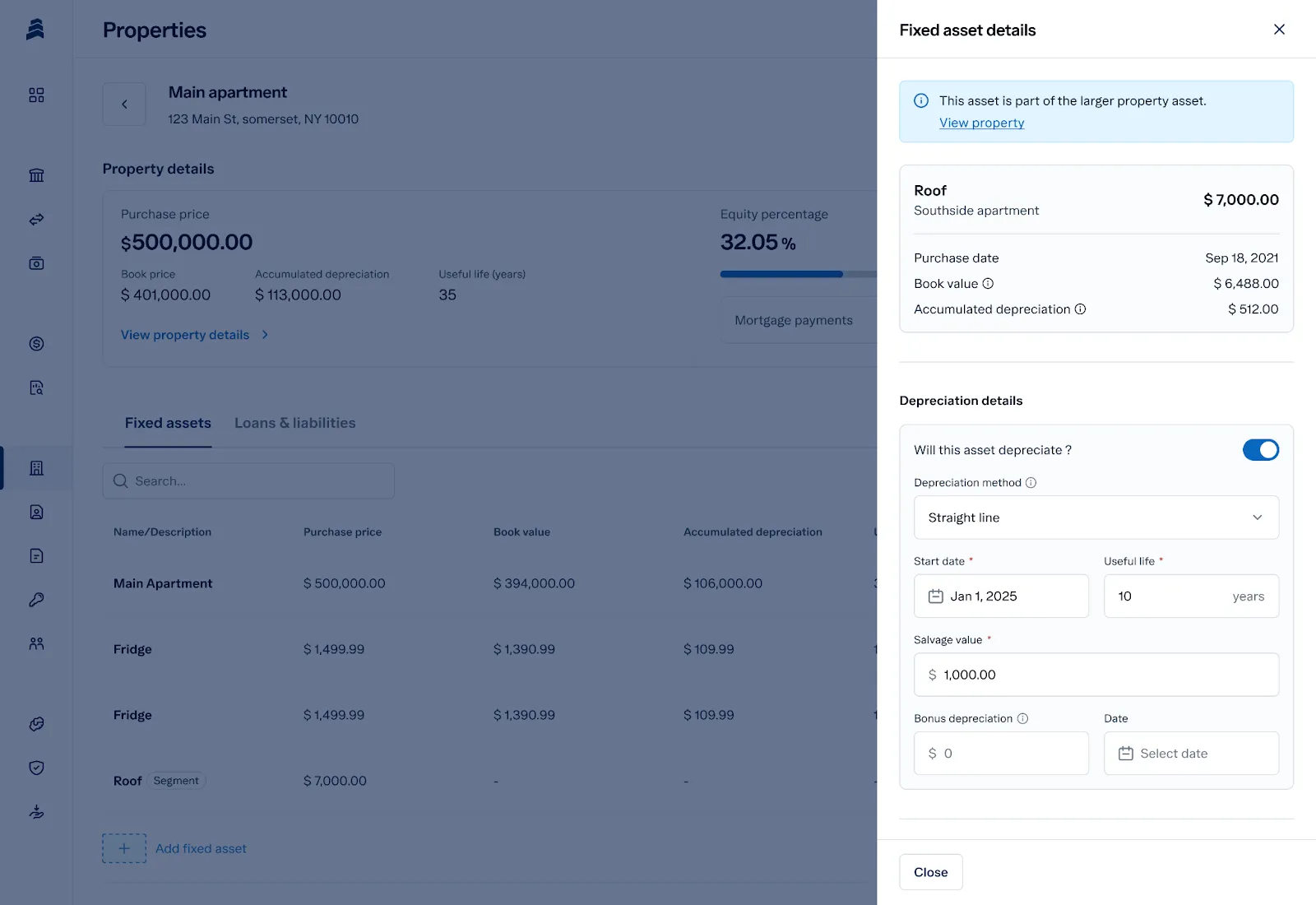
Instead of storing your cost seg report in a PDF or relying on fragmented spreadsheets, Baselane automates depreciation schedules across your portfolio. This is where owners really feel the operational lift.
Own your time,
not just your properties
Make your finances work harder, so you don’t have to.


Manage your cost segregation savings with Baselane
You can only get the benefits of a cost segregation study if you accurately track and maintain depreciation schedules every year. Baselane centralizes assets, timelines, and schedules to help you easily manage depreciation across all your properties.
FAQs
Does a cost segregation study trigger an IRS audit for my entire portfolio?
No. The IRS recognizes a detailed cost segregation study when an experienced and licensed company does it. While a complex study might sometimes be looked at closely, it's a recognized practice.
Is it better to get one study for my entire portfolio at once, or one for each new property?
For tax purposes, you should always get a study done on each property, not on an entire portfolio. But, if you own multiple properties of similar character, you can ask the firm to use sampling or modeling so that a few detailed studies can be leveraged across the portfolio.
How quickly can I access the capital generated by the cost segregation study?
You typically get your capital generated from a cost segregation study as accelerated depreciation on a filed tax return, leading to a refund or a Net Operating Loss (NOL). The timing depends on your tax filing and refund schedule, not the study date, usually resulting in a cash refund a few weeks after filing or when you utilize the NOL against future income.
How long does a cost segregation study take?
A cost segregation study typically takes 4 to 8 weeks from initial information gathering to final report delivery, depending on property complexity and documentation readiness.
.jpg)
.webp)



.webp)


