



Tax planning is critical for real estate investors. Depreciation can quietly erode your returns if not managed strategically. In 2026, legislative changes around bonus depreciation make timely action crucial. A cost segregation study allows you to accelerate depreciation, boost cash flow, and reduce your current tax burden.
This guide breaks down the strategy, eligibility, benefits, and actionable steps for rental property owners, helping you make informed decisions for your portfolio.
Key takeaways
- Bonus depreciation drops from 60% in 2024 to 40% in 2025 and 20% in 2026, making early action critical.
- Cost segregation can unlock up to $100,000 in savings for every $1 million in building costs within the first five years.
- Even properties with a cost basis as low as $200,000—including single-family rentals and short-term rentals—can benefit.
- Section 1250 depreciation recapture is capped at 25%, often making the upfront cash flow gain worth the eventual tax.
What is a cost segregation study?
A cost segregation study reclassifies components of your property into shorter depreciation schedules to accelerate tax benefits.
When you buy a property, you receive a pool of potential depreciation deductions, generally equal to the purchase price minus the land value. Normally, these deductions are spread out gradually, with roughly 3% of the total reserve taken each year.
A cost segregation study allows you to claim a larger portion—often around 30%—of your total depreciation in the first year, rather than just 3%, which reduces your taxable income more significantly upfront.
The study identifies specific assets—such as carpeting, appliances, and landscaping—that qualify for 5-, 7-, or 15-year depreciation, allowing you to front-load deductions and maximize early-year tax savings.
Note: A study does not create deductions out of thin air. Instead, it reallocates the property’s purchase price across categories to accelerate depreciation. While this increases early-year tax benefits, it naturally reduces depreciation on rental property available in later years.
Bonus depreciation & cost segregation
The One Big Beautiful Bill Act (OBBBA) makes 100% bonus depreciation permanent for eligible 5-, 7-, and 15-year property acquired and placed in service after January 19, 2025—with no scheduled phaseout in the statute. This supercharges cost segregation studies by allowing investors to immediately deduct the full cost of segregated personal property and land improvements. Assets placed in service before January 20, 2025, follow the prior TCJA phase-down schedule:
- 2024: 60%
- 2025: 40%
- 2026: 20%
- 2027: 0%
Even during this transition window, a cost segregation study remains highly valuable. While you may not get the full 100% immediate write-off for early 2025 assets, claiming 40% or 60% upfront is still vastly superior to waiting 27.5 years.
Furthermore, accurately segregating costs now ensures you maximize the permanent 100% bonus rate for property placed in service after January 19, 2025. This creates a strategic imperative to act immediately—identifying and accelerating short-life assets into the post-January window while locking in transitional elections where optimal.
Why conduct a cost segregation study?
When done right, a cost segregation study benefits you in multiple ways—from boosting your cash flow to helping you plan your portfolio growth.
- Minimize rental property tax burden by reducing taxable income upfront, freeing up more cash to reinvest in your properties, pay down debt, or fund renovations.
- Recover missed depreciation on older properties, adding more money into your pockets.
- Shows which properties give you the most benefit, helping you target studies where they’ll make the biggest impact.
- Reclassified assets improve your balance sheet, making it easier to track property values and present accurate numbers to lenders or investors.
- Front-loading depreciation supports smarter decisions about sales, 1031 exchanges, or future acquisitions.
As your portfolio grows, having the right financial tools in place becomes essential. Explore the best accounting software for rental properties to find one that scales with your units.
Who should consider a cost segregation study?
Deciding whether a cost segregation study makes sense is less about eligibility and more about strategic value. A study is most effective when it meaningfully accelerates depreciation, improves cash flow, and aligns with your portfolio management goals.
Here’s what to consider:
Property type
Cost segregation studies are best suited for properties that contain reclassifiable components. Some of the best property types are:
- Multi-unit residential buildings: Apartments, condos, and townhome complexes
- Short-term rentals (STRs): Furnished units, vacation rentals, or Airbnb properties
- Mixed-use buildings: Residential properties with commercial spaces
Property value and basis
- Properties valued at $150,000 or higher are generally the most cost-effective candidates for a study.
- Applying studies to higher-basis buildings first often yields the greatest immediate benefit.
Timing considerations
Cost segregation studies aren’t just for newly purchased properties—they’re also valuable for:
- Recent acquisitions: Applying a study soon after purchase ensures you capture maximum depreciation in the first year.
- Reacquisitions or refinancings: Major capital expenditures or refinancing events may change asset basis and trigger an opportunity for reclassification.
- Properties never previously studied: Older holdings that were depreciated under standard schedules can often benefit from catch-up depreciation using Form 3115.
- Major renovations or capital improvements: Upgrades to kitchens, HVAC, flooring, or electrical systems can create new classifiable assets for accelerated depreciation.
Note: Not every building in the portfolio needs a study. Focus on properties that are high-basis, high-value, or recently upgraded. A study can also inform future acquisition strategy, showing which types of properties will generate the most early depreciation.
To assess if cost segregation on your rental property makes sense, check out this cost segregation calculator to estimate potential tax savings.
How much does a cost segregation study cost?
Cost segregation study pricing varies between $2,500 and $20,000 for most properties, with averages of $5,000–$15,000, depending on size and complexity.
For rental properties like single-family homes or small multifamily units, fees often start at $2,500–$4,500, while larger commercial buildings exceed $10,000. ROI frequently exceeds 5:1 through accelerated depreciation savings.
Common cost segregation study methods
There are three main methods for conducting a cost segregation study:
Engineering-based cost segregation study
This approach involves a thorough on-site evaluation of the property. The firm review all the components—from flooring and cabinetry to plumbing, take measurements,and categorize each assets according to IRS-approved depreciation schedules.
Then they create a detailed report that reflects the property’s actual composition and assigns precise, useful lives to all assets.
Pros:
- Highest accuracy and IRS defensibility
- Maximizes accelerated depreciation for high-basis and complex properties
- Full documentation suitable for audits
Cons:
- Higher upfront cost
- Longer completion time compared to software-based methods
Desktop or software-based study
A cost segregation firm reviews property records, blueprints, and cost estimates remotely, assigning assets to depreciation categories using software or spreadsheet tools. They rely on available documentation and assumptions rather than performing an on-site inspection.
Pros:
- Lower cost and faster turnaround
- Suitable for smaller, less complex properties
- Can produce a usable depreciation schedule with minimal effort
Cons:
- Lower accuracy and potential for missed assets
- Higher risk of IRS challenges during audits
- May not capture the full depreciation potential
Hybrid study (Desk + targeted site inspection)
A cost segregation specialist conducts a combination of document review and selective on-site inspection, focusing on key or high-value assets. They inspect critical systems and areas in person, while categorizing less complex components using property records and estimates.
Pros:
- Balanced approach between cost and accuracy
- Captures significant assets that contribute most to accelerated depreciation
- Shorter turnaround than a full engineering study
Cons:
- Some audit risk remains due to partial reliance on estimates
- Lower-value or obscure assets may be overlooked
- Not as comprehensive as a full engineering-based study
How to complete an engineering-based cost segregation study
Choose a cost segregation specialist
Selecting a qualified firm is the most critical step in ensuring your study meets IRS standards. To ensure your engineering-based report is fully defensible and maximizes your tax savings, we recommend working with a specialized provider like Engineered Tax Services, who can handle the complex asset classification and documentation required for high-value rental portfolios. Here are some key factors you should look at.
- Ask about their methodology: Do they follow the IRS Audit Techniques Guide?
- Verify their experience: Check what kind of properties they have evaluated in the past.
- Check their credentials: Make sure they hold engineering licenses issued by the state authorities and are recognized by the IRS.
- Check for audit support: Will they defend their study if you are audited?
- Confirm the fee structure: A flat fee is standard. Avoid firms charging a percentage of tax savings, as this can be flagged by the IRS.
Share the necessary documents with the provider
Once you have the provider, give them access for on-site inspection and send over complete and accurate property information.
- Purchase agreements and closing statements to establish the property basis.
- Construction plans or blueprints to identify structural and personal property components.
- Invoices and receipts for renovations or capital improvements.
- Previous depreciation schedules, if the property has been in service for several years.
The study process
Once you’ve selected the specialist, they’ll oversee the entire process as long as you deliver the required documents.
- Feasibility assessment:The firm performs a preliminary review to determine if the study is financially worthwhile, assessing property type, size, basis, and potential accelerated depreciation.
- Document review: Examine purchase agreements, blueprints, invoices, prior depreciation schedules, and renovation records to understand property structure and improvements.
- On-site inspection: Engineers visit the property to measure, document, and photograph all assets, verifying information from documents and identifying reclassifiable components.
- Asset categorization: Assign each component to IRS-approved depreciation classes, including short-lived personal property, land improvements, and structural property.
- Cost allocation: Determine the value of each asset using construction costs, invoices, and engineering estimates, ensuring the total basis matches the property’s depreciable value.
- Depreciation schedule preparation: Create the schedule showing accelerated depreciation for short-lived assets and long-term schedules for structural components, including catch-up if applicable.
- Documentation and reporting: Prepare a detailed report with asset lists, categories, values, inspection notes, and methodology to support IRS compliance.
Post-cost segregation study
Once the cost segregation firm has handed over the full report, that’s when the work shifts from the specialists to you and your CPA.
The report tells you exactly how your property’s assets have been reclassified, what each component is worth, and the timeline for depreciation. The next step is making sure this information actually impacts your taxes and accounting in the right way.
Work with your CPA to update the new depreciation schedules for your properties. This ensures your tax filings reflect the accelerated depreciation from the study, and you’re capturing all of the landlord deductions you’re entitled to.
Tools to use to manage depreciation schedules
To make this process easier and ensure you have clear visibility and accurately add the reclassified values of your assets, it’s best to use real estate accounting software or integrated banking and bookkeeping software.
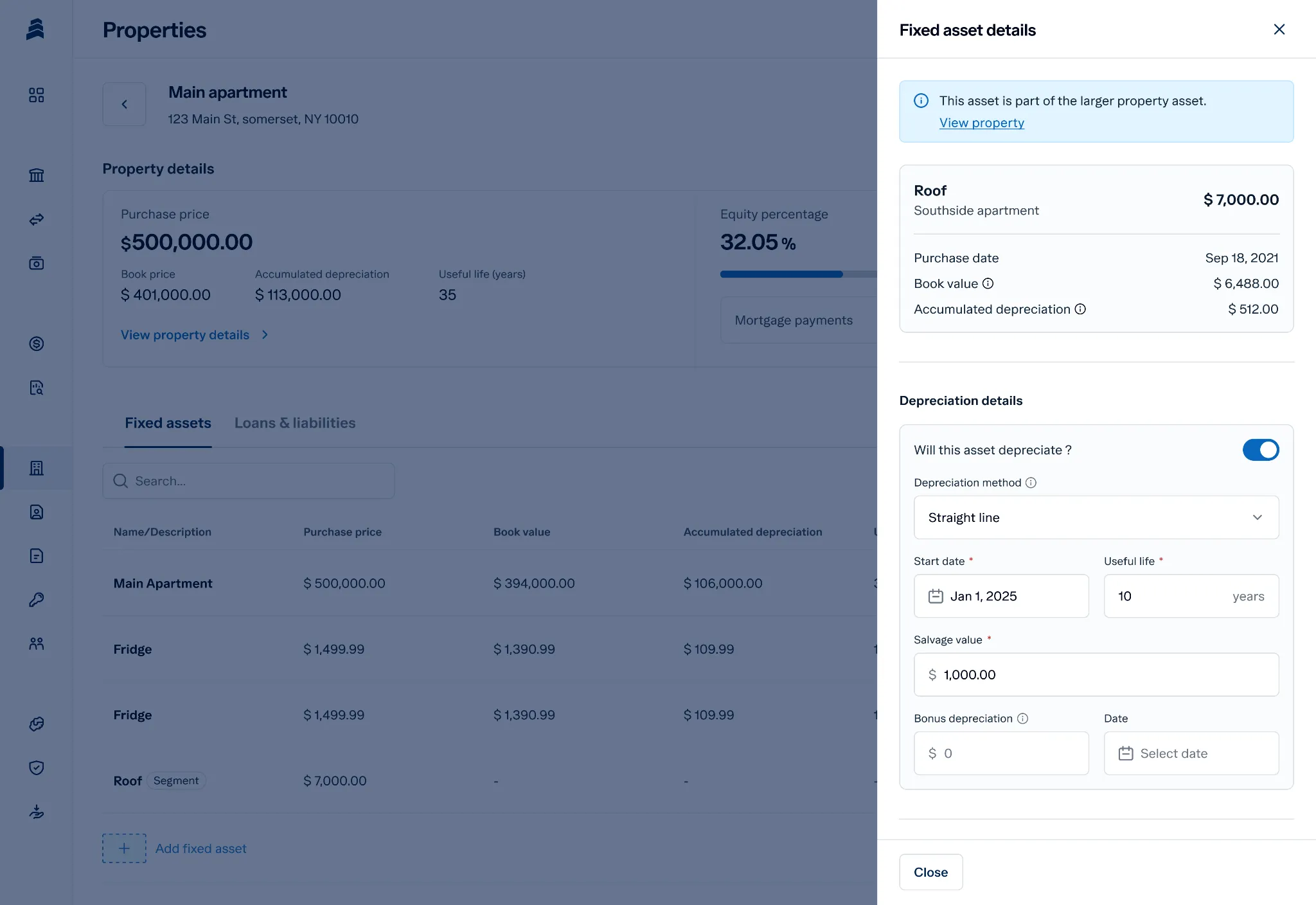
This is exactly where Baselane can make the process easier. Once you have your cost segregation study:
- You add the reclassified asset values, useful life, directly into Baselane at a property level.
- Set custom depreciation timelines based on the study’s categories.
- See the updated property value reflected instantly in the balance sheet.
- Share the report with your CPA, or even invite them directly into Baselane so they can update the schedules on your behalf through shared access.
Own your time,
not just your properties
Make your finances work harder, so you don’t have to.


Common cost segregation misconceptions and objections
Many investors hesitate to commission a cost segregation study or real estate analysis due to persistent myths. Let’s clarify reality versus fiction.
Myth 1: It increases IRS audit risk
Reality: The IRS acknowledges cost segregation as a legitimate method. In fact, the IRS publishes the "Cost Segregation Audit Techniques Guide", which provides examiners with instructions on how to evaluate these studies. A well-documented, engineering-based study that follows these guidelines is defensible.
Myth 2: Depreciation recapture ruins the study benefit
Reality: While you do have to pay back some depreciation when you sell, it is often at a different rate. Section 1250 real property recapture is capped at 25%, which may be lower than your ordinary income tax rate. Furthermore, thanks to the time value of money, a dollar saved today is worth more than a dollar paid in tax five years from now.
Myth 3: Study is too expensive for small properties
Reality: While a full engineering study might cost $5,000+, newer "virtual" or algorithm-based options for residential properties can cost as little as $750. We will explore the cost segregation study cost details later in this guide.
Reclassify asserts value after study with Baselane
Cost segregation is one of the most effective tax strategies for accelerating rental property tax deductions, boosting cash flow, and scaling your rental portfolio. But, only if you use the study results properly.
Manually adding assets, reclassifying value, and setting depreciation timelines is bound to create errors. You eliminate that by using Baselane’s cost seg feature (coming soon). Add assets to each property, set custom depreciation timelines and values, and generate CPA-ready balance sheets. So, when the tax time arrives, you can make the most deductions without missing anything.
Get the most out of a cost segregation study with Baselane. Open your account today!
FAQs
When is the best time to conduct a cost segregation study?
The best time is usually the year the property is placed in service to maximize immediate cash flow. However, because "look-back" studies allow you to catch up on missed depreciation from prior years without amending returns, you can conduct a study at any time during your ownership.
How much does a cost segregation study typically cost?
Costs vary by property size and complexity. The average cost of a cost segregation study ranges from $2,500 to $15,000. However, for smaller residential properties, modern virtual or data-modeled studies can cost as little as $750 to $2,500.
Can I do a cost segregation study on my own?
While not prohibited, a DIY cost segregation study is highly risky and generally discouraged. The IRS requires a "quality study" based on engineering principles and specific documentation standards. Without expert knowledge of construction and tax law, a self-made study is likely to be rejected during an audit.
Is it worth it for single-family rentals?
Yes, especially for properties with a cost basis over $200,000. With affordable virtual study options now available, the tax savings on single-family rentals often exceed the cost of the study by 10x or more in the first few years.
What happens if I sell my property after a study?
If you sell, you may be subject to depreciation recapture, meaning you pay taxes on the depreciation you claimed. However, recapture on real property is capped at 25%, and personal property is taxed at ordinary income rates. Many investors still find that the upfront cash flow benefit outweighs the eventual recapture cost.
.webp)