




Managing multiple Airbnb properties can feel like juggling numbers, forms, and deadlines. Between gross payouts, service fees, and the IRS watching your tax ID, it’s easy to misreport income or miss deductions.
This guide cuts through the confusion and shows exactly how Airbnb tax reporting works, how to reconcile income, and strategies to maximize deductions across your portfolio.
Key takeaways
- Airbnb reports gross income by tax ID, not per property—even if no 1099 is issued, all income must be reported.
- Form 1099-K and 1099-MISC cover different types of income; 1099-K now starts at $600 for 2026.
- Reconcile income per property or entity to avoid misreporting and ensure deductions aren’t missed.
- Track expenses, depreciation, and qualifying business activity to reduce taxable income.
- Baselane simplifies Airbnb income tax reporting by tracking and reconciling across multiple properties and entities, making tax prep easier and more accurate.
What Airbnb actually reports to the IRS (And what it doesn’t)
Airbnb reports gross earnings by tax ID, not profit, not per property, and not per entity unless you configure it that way. Even if no tax form is issued, the income is still reportable.
The tax forms Airbnb issues
Airbnb may issue multiple forms depending on your activity and payouts.
- Form 1099-K: Reports gross rental earnings processed through Airbnb once IRS thresholds are met. The amount shown is gross revenue—before Airbnb service fees, cleaning costs, co-host payouts, and other expenses.
- Form 1099-MISC: Used for bonuses, referral incentives, or other non-rental payments.
Each form is tied to the tax ID on your Airbnb account, not to individual listings or properties.
How the IRS sees multiple Airbnb listings
If multiple Airbnb listings are tied to the same tax identification number, Airbnb treats them as a single reporting stream. That means you receive a single consolidated 1099 that shows the total gross income from all those listings.
From the IRS’s perspective, this does not mean you have one property. It means you have one taxpayer earning that income. You might think of your properties as separate units, or even as separate businesses. The IRS doesn’t see any of that unless your tax filings reflect it.
If different listings are tied to different TINs (for example, different legal entities), Airbnb can issue separate 1099s, each of which is matched to a specific taxpayer. Due to different forms, your income is already segmented before it reaches the IRS.
In this case, the IRS still doesn’t see individual properties—but it does see separate taxpayers, which reduces the need for post-reporting allocation.
How the IRS classifies Airbnb income for multi-unit landlords
To report income to the IRS, you need to fill out one of the following forms based on how you treat Airbnb income. Here’s how to report Airbnb income on a tax return.
Schedule E: For passive rental income
Most real estate investors and hosts will file using Schedule E (Supplemental Income and Loss). This form is generally for "passive" rental activity, where you provide space for occupancy but do not offer substantial services.
If your hosting duties are limited to cleaning between stays, providing essential utilities, and handling maintenance, your income is likely passive. Reporting on Schedule E means you are not subject to the 15.3% self-employment tax. This is the preferred classification for most landlords looking to preserve cash flow.
Schedule C: For active business income
If you treat your Airbnb more like a hotel, you may need to file Schedule C (Profit or Loss from Business). This applies if you provide "substantial services" to your guests.
Substantial services include:
- Daily cleaning or maid service while the guest is staying.
- Concierge services (booking tours, transportation).
- Providing meals or breakfast.
- Conducting guided tours.
With Schedule C, you may owe self-employment taxes (15.3%). While this increases your tax burden, it can also unlock different deductions typically available to active businesses.
If your portfolio includes both types of rentals, it’s possible to use both schedules in the same year. The key is accurately classifying each property or rental activity based on the level of services provided.
How different entities affect Airbnb income reporting
Even if the Airbnb account aggregates multiple properties, the IRS expects reporting to match the entity structure on your tax return. Proper separation of TINs per entity simplifies reconciliation, supports deductions, and reduces risk.
- Single-Member LLC (disregarded entity)
- Airbnb income flows directly to your personal return.
- Schedule E or C applies depending on services and rental type.
- One TIN per account → one consolidated 1099.
- Partnership or Multi-Member LLC
- Income flows to Form 1065; each member receives a Schedule K-1.
- Airbnb reporting may still fall under a single account/TIN, requiring allocation in the partnership return.
- Multi-property setups often need internal allocation per unit to match K-1 distributions.
- S Corporation
- Airbnb income flows to Form 1120-S, then to shareholders via K-1.
- S Corps are rarely optimal for passive short-term rentals because self-employment tax treatment may not apply, but active service income can trigger Schedule C analogs.
- C Corporation
- Airbnb income is taxed at the corporate level; shareholders pay on distributions.
- Rarely used for typical rental portfolios due to double taxation, but sometimes used in mixed business setups.
From tracking property-level expenses to managing entity-specific books, the right software keeps your finances organized. Explore accounting software for real estate management or find the best bookkeeping software for sole proprietors for your setup.
Reconciling Airbnb 1099s with your books in 2026
Airbnb reports gross income, including service fees, refunds, and co-host payouts, which means if you just copy numbers into your books, you’re leaving landlord tax deductions unclaimed and creating unnecessary audit risk.
Here’s what you need to do:
- You compare the 1099 generated by Airbnb to your actual payouts per property.
- You subtract Airbnb fees, allocate income per property or entity, and record all expenses correctly. This ensures the numbers you report on your tax return match both IRS expectations and your internal accounting.
For multiple Airbnb units, make sure to reconcile property by property, as 1099 lump all the units together, and it’s easy to misreport income or miss deductions.
Baselane helps you track Airbnb income and expenses in real time, per property or entity, so you don’t have to wait until the end of the year to see where you stand. You can feed in transactions as they happenand see your gross and net income per property.
At the end of the year, when Airbnb issues the 1099, you can compare the form directly against your Baselane records. This gives you a real-time reconciliation of gross vs net income, and ensures that your reported income aligns with both the IRS expectations and your internal accounting.
You don’t have to pull spreadsheets, match payouts, or guess at fees. Baselane does the heavy lifting and keeps finances organized by property and entity.
Own your time,
not just your properties
Make your finances work harder, so you don’t have to.


Strategies to maximize Airbnb tax deductions for multi-unit owners
You can reduce tax on rental income by aligning entity setup, expenses, and rental activity—especially when managing multiple units. The right strategies help ensure deductions are captured fully and efficiently.
Organize income by entity or TIN
Make sure your rental income is properly tied to the right legal entity.
If you manage multiple properties, consider assigning different groups of listings to separate LLCs or TINs. Airbnb issues 1099s based on the account’s tax ID, not by property, so keeping entities aligned ensures each 1099 matches the properties and expenses it should.
This simplifies reconciliation, ensures deductions are allocated correctly, and avoids the risk of mixing income from multiple units under one entity.
Track all property-level expenses
Good bookkeeping for Airbnb goes a long way. Avoid recording all expenses and income in a single account for multiple vacation rentals. That’s a recipe for disaster and not in adherence with IRS guidelines.
Every cost directly associated with the property—cleaning fees, maintenance, property management, and supplies—can reduce your taxable income if recorded accurately.
Open dedicated property-level accounts to keep funds separated and organized. You can use Airbnb tax reporting and accounting software to automate this process. Baselane, for example, is one of the best all-in-one financial software that can help you manage your Airbnb accounts. You can open primary checking accounts for each property and sub-accounts for specific expenses or income within that.
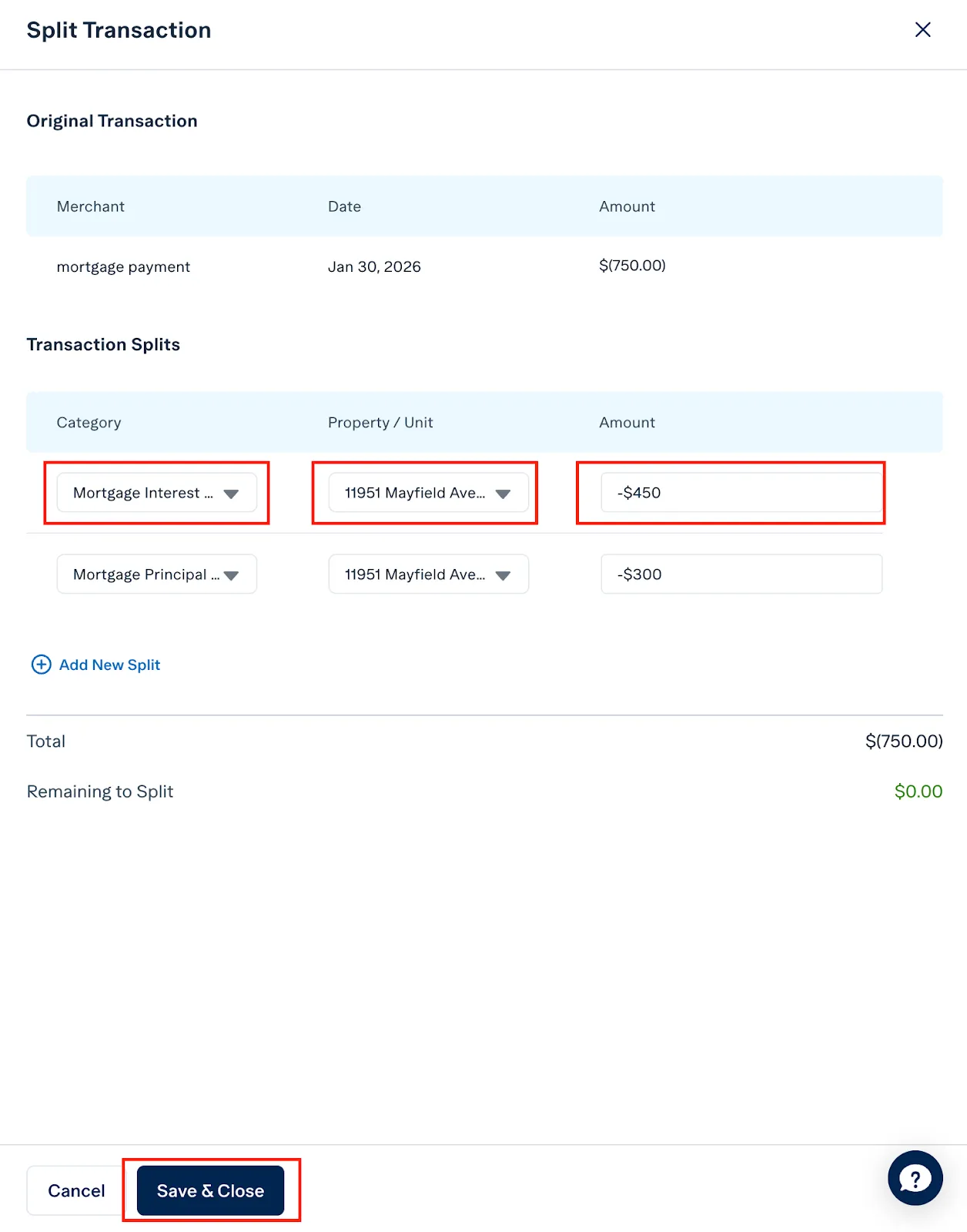
If you incur expenses shared across multiple units, such as utilities, insurance, or software subscriptions, you can split them proportionally using Baselane’s built-in bookkeeping.
Use depreciation and cost segregation
Depreciation is one of the most powerful deductions available to you. Through cost segregation studies for STRs, you break down a building’s assets into separate components, accelerate depreciation, and reduce taxable income earlier in the year of ownership.
By accelerating depreciation across multiple rentals, you can drastically reduce taxable income by front-loading depreciation from a 39.5-year to a 5-, 7-, or 19-year schedule.
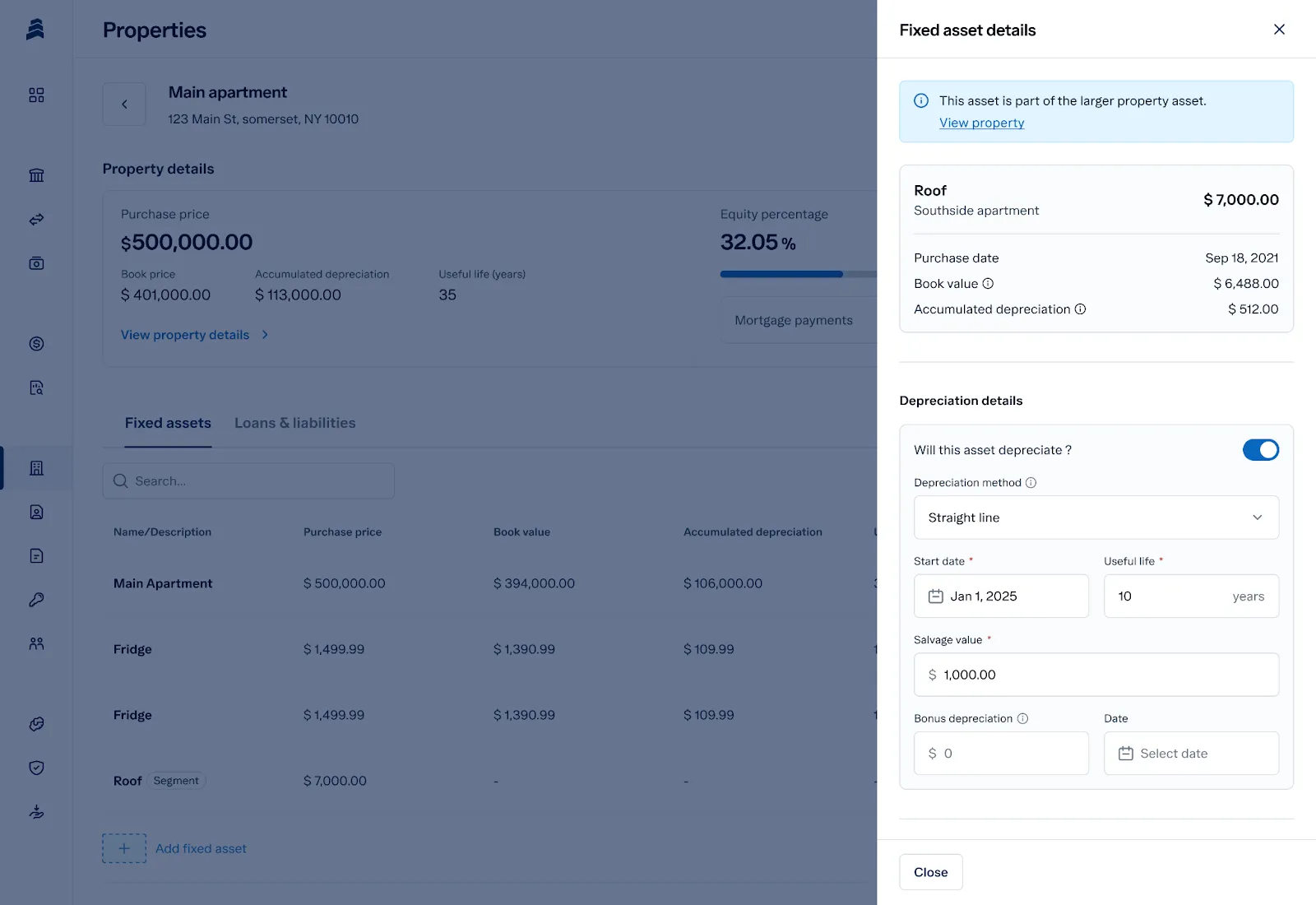
With Baselane, you can track each asset's depreciation value and timeline, customize it, and keep it all in one place without much manual work. When the tax season comes around, you’ll have a clear idea of your cash flow and deductions.
Read more about calculating depreciation on rental property through our in-depth guide.
Identify property income that qualifies under QBI
Units where you offer active services—like daily cleaning, concierge support, or guest interaction—may qualify as a trade or business and make you eligible for the Qualified Business Income (QBI) deduction.
To claim this deduction, track material participation per property carefully, including hours spent managing, cleaning, and servicing guests. By documenting which units meet these criteria, you can optimize the way deductions are applied across your portfolio without changing how you operate the properties.
Streamline Airbnb tax prep with Baselane
Vacation rental tax reporting isn’t complicated if you have a system in place—but once your portfolio grows, manual tracking and spreadsheets fall apart. Baselane gives you real-time visibility into income, expenses, and deductions across every property, entity, and state.
With Baselane, you can reconcile Airbnb payouts, track property-level expenses, calculate depreciation, and prepare for tax filing—all in one place. Open your account today!
FAQs
What is the Airbnb 1099-K threshold for 2026?
For 2026, Airbnb is required to issue Form 1099-K if your gross transaction payments exceed $600. This applies regardless of the total number of transactions you completed during the year.
How does the 14-day rule work for Airbnb income?
If you rent your personal residence for fewer than 15 days in a tax year and use it yourself for more than 14 days, you do not have to report the rental income. However, you also cannot claim any rental expenses or deductions for that period.
Can I deduct cleaning fees if I charge them to the guest?
Yes, you can deduct cleaning fees. You must report the cleaning fee collected from the guest as part of your gross income, and then you deduct the amount you paid to the cleaner (or cleaning service) as a business expense.
Do I report Airbnb income on Schedule E or Schedule C?
If you treat Airbnb as passive income, you report it on Schedule E. If you provide active services like daily cleaning, meals, or concierge services, you use Schedule C for Airbnb rental tax reporting and pay self-employment tax. Use accounting software for real estate or rental property accounting software to keep track of your cash flow.
Does Airbnb withhold taxes for me?
Generally, no. Airbnb does not withhold federal or state income taxes on vacation rental income. You are responsible for calculating and paying your own income taxes, which may require making quarterly estimated tax payments to avoid penalties.
.webp)
.webp)
.webp)
.jpg)

.jpg)


