
%20(1).webp)


Does my rental income qualify?
How do I prove it’s a real business?
If you’re asking yourself the same question, we’ve got the answers for you.
If you actively manage your rentals, track hours, and maintain proper records, you can confidently claim 20% QBI deduction and keep more of your hard-earned income.
This guide will show you exactly how to determine eligibility, calculate your deduction, and use practical strategies to maximize QBI, so you don’t leave money on the table.
Key takeaways
- Landlords may deduct up to 20% of net rental income if the rental activities qualify as a trade or business or meet the Safe Harbor rules.
- Meeting the 250-hour threshold and maintaining separate records can make claiming the QBI deduction more straightforward, especially with a Rental Real Estate Enterprise (RREE).
- Larger portfolios and thoughtful planning around basis, wages, payroll, and property grouping can protect and enhance your deduction, even at higher income levels.
- Accurate logs, separate accounts, and proper bookkeeping (platforms like Baselane can help) ensure your QBI deduction is reliable and audit-ready.
What is the QBI deduction for landlords?
The Qualified Business Income deduction, introduced under Section 199A of the tax code, allows eligible real estate owners to deduct up to 20% of their net qualified business income.
For QBI purposes, the IRS does not ask whether your rental income is passive under Section 469. Instead, it asks a different question: Does your rental activity rise to the level of a Section 162 trade or business?
Does rental income qualify for the QBI deduction?
Yes, rental income can qualify for the QBI deduction, provided your rental operations constitute a trade or business under Section 162. The IRS defines a trade or business as an activity conducted with continuity, regularity, and a profit motive.
Another way to qualify for QBI deduction is to fulfill the safe harbor requirements—a set of guidelines the IRS created to classify businesses with utmost certainty.
The rental real estate Safe Harbor
Under the QBI Safe Harbor, a rental activity is presumed to be a trade or business if certain conditions are met. These conditions are as follows.
- Maintain separate books and records for the rental enterprise
- Perform at least 250 hours of rental services per year (Services performed by owners, employees, agents, or contractors)
- Keep contemporaneous records of hours and activities
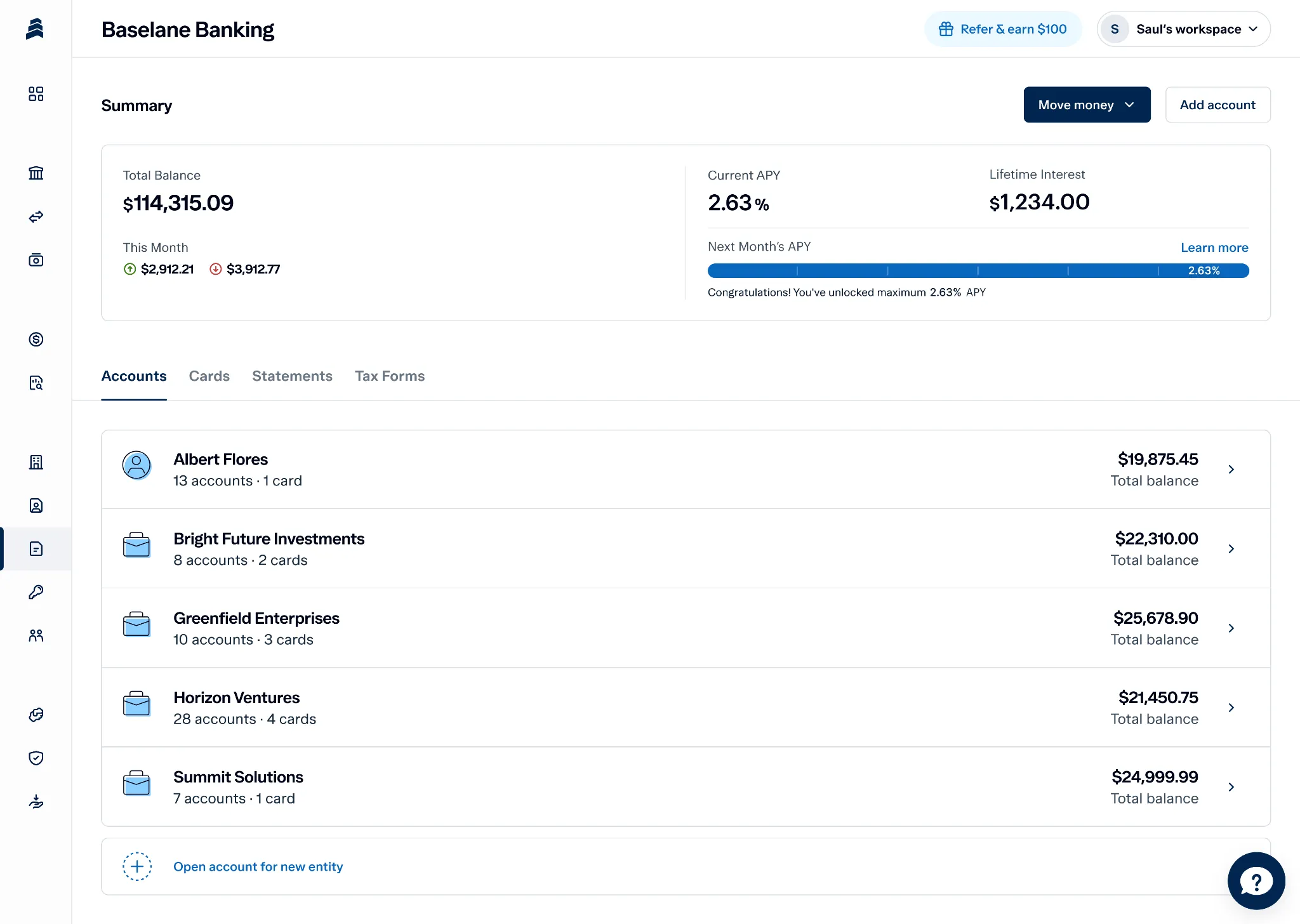
To manage your finances and ensure you are ready for tax season, use Baselane for banking and bookkeeping. It helps segregate funds per property, track transactions automatically, categorize expenses, and generate tax-ready reports. With the right system in place, QBI qualification becomes easier and more defensible. Open your account today and start streamlining your rental operations.
But, there’s a catch. Safe Harbor rules apply only to Rental Real Estate Enterprises (RREEs), not to individual properties. A RREE can consist of a single property or multiple properties grouped together. Once you choose to group properties, you generally must continue to do so in future tax years unless there is a significant change in circumstances.
Forming an RREE is especially helpful when you own multiple properties. For example, hitting 250 hours with one duplex can feel unrealistic. But, if you own 10, 20, or 50 units, those hours accumulate quickly through ordinary operations.
Own your time,
not just your properties
Make your finances work harder, so you don’t have to.


What counts as rental services under Safe Harbor?
Eligible activities include:
- Advertising, negotiating, and executing leases.
- Verifying tenant applications and collecting rent.
- Daily operation, maintenance, and repair of the property.
- Real estate management.
- Purchasing materials.
- Supervising employees and independent contractors.
What services don’t count?
You cannot count hours spent on financial or investment management tasks, such as arranging financing, procuring property, strictly reviewing financial statements or reports on operations, or planning long-term capital improvements. Additionally, travel time to and from the property does not count.
To keep your financial operations organized across properties, compare the top rental property accounting software options or discover ways to minimize your rental property taxes as your portfolio scales.
QBI deduction qualification across rental types
Your portfolio structure influences your eligibility for QBI deductions. Here are some of the most common scenarios
Single actively managed rental
By managing your single-family rental home (tenant screening, repairs, rent collection) and logging 260 hours, you satisfy the 250-hour test and maintain separate books. This allows you to use the safe harbor, securing your rental income's eligibility for the QBI deduction.
Multiple rentals grouped as an RREE
Owning three duplexes with 100 annual hours spent on each totals 300 hours. Grouping these properties into a single Rental Real Estate Enterprise meets the 250-hour minimum. You must file an election statement with your tax return to treat them as one enterprise and claim the deduction.
Small commercial property
Even if you don't meet the safe harbor's 250-hour requirement for your retail strip center because you use a property manager, the manager's hours count for the Section 162 trade or business test. Substantial activity under the general "facts and circumstances" rule can still qualify the rental income for the QBI deduction.
Self-rental for your own business
A "related-party" rule automatically qualifies rental to a 50%+ owned business as a QBI trade or business, bypassing the 250-hour rule, provided the tenant is an operating business (not a C-corp). Use accounting software for real estate management to properly track inter-entity payments.
Short-term vacation rental
Short-term rentals (with an average stay of 7 days or less) typically don't meet the "rental real estate" safe harbor, but often qualify as a Section 162 trade or business due to the high level of services provided. Substantial services (cleaning, meals, concierge) may result in self-employment tax. Understanding vacation rental income taxes and tracking Airbnb expenses is vital. Proper Airbnb bookkeeping is necessary to prove the business's active nature.
When rental income does not qualify for QBI
Not every rental arrangement is eligible. The IRS has established clear exclusions that prevent passive rental income from qualifying for QBI in specific situations.
- Personal use and residence exception: Property used personally for more than 14 days, or for more than 10% of total rented days at fair value (whichever is greater), is generally ineligible for QBI.
- Triple-net NNN leases: Minimal landlord involvement is viewed as passive investment income, making a Section 162 "trade or business" argument difficult.
- Pure investment activity: Income is unlikely to qualify for QBI if the property is held strictly for appreciation with minimal oversight (relying solely on a management company).
- Capital gains exclusions: QBI calculations exclude capital gains from property sales.
How to calculate QBI deduction
Here’s a walkthrough of calculating QBI deductions.
Step 1: Determine QBI
Begin with your net rental income (rental income minus operating expenses of the rental property and depreciation on the rental property). If you’re using cost segregation or bonus depreciation, that's already reflected in this number.
Follow this simple rule of thumb: if it shows up as net income on your rental P&L, it’s part of QBI. Once you have that number, multiply it by 20%. That’s your tentative QBI deduction.
Step 2: Apply the taxable income limitation
Your QBI deduction can never exceed 20% of your taxable income (excluding capital gains). In most profitable multi-unit portfolios, this doesn’t reduce the deduction, but it matters in years with heavy depreciation or losses elsewhere.
If your taxable income comfortably exceeds your rental profits, you can usually move on.
Step 3: Consider the income thresholds
Above the income threshold, QBI becomes less about wages and more about building a basis.
Ask yourself: how much depreciable property do I own?
Take 2.5% of that depreciable basis (excluding land). If that number is greater than your tentative QBI deduction, you’re effectively in the clear—even if you don’t pay W-2 wages.
This is why it’s often easier to qualify for high-income loans when you own multiple units.
Step 4: Account for grouping and losses
If your properties are grouped into one rental enterprise, QBI is calculated on the net result.
Common QBI deduction mistakes & how to avoid them
Despite the advantages of scale, mistakes still happen.
Poor record-keeping
Mixing personal and rental finances violates the separate books requirement, while retroactive year-end logs fail "contemporaneous" tests, tanking safe harbor claims.
How to Fix: Set up dedicated business accounts and use software like Baselane for automated separation; maintain time-stamped calendars for all rental services.
Ignoring income thresholds and UBIA limits
If you fall in the high-income category (over ~$190K single/$380K joint in 2026) skip wage/UBIA caps and underclaim by failing to factor in the unadjusted property basis (original cost excluding land).
Netting losses incorrectly across the portfolio
Losses from one underperforming building offset group QBI, but many landlords often confuse this with passive loss rules, carrying them incorrectly or improperly.
How to fix: Net at the enterprise level before 20% calc; carry forward unused losses to future years, modeling with cost seg to balance early losses and later profits.
Including non-qualifying income or exclusions
Capital gains, interest, or triple-net/personal-use rentals sneak into QBI, inflating claims auditably.
How to fix: Exclude gains and §280A properties; segment short-term rentals separately if services-heavy.
Managing tax obligations and bookkeeping across multiple properties gets more efficient with the right property tax management software and dedicated accounting software for real estate investors.
Tips to maximize your QBI deduction
To ensure you receive the full benefit of the QBI deduction on rental income, proactive management is key.
Use management fees strategically
If you pay property management fees—especially to a related entity—those fees are doing more than reducing taxable income. They are shaping where QBI lives.
When fees are higher, rental QBI goes down. But if those fees are paid to a properly structured management company with payroll, QBI may increase on the service side. If you bump into wage or UBIA limits, this shift can materially improve total QBI across the portfolio.
This only works when pricing is arm’s-length and defensible, but at scale, management fees stop being a pure expense and start becoming a planning tool. Instead of asking, “How much does management cost?” ask, “Where do I want my QBI to sit?”
Protect QBI with a building basis
Depreciable basis is your safety net once income rises. Above the income thresholds, QBI isn’t limited by how active you are; it’s limited by wages and UBIA. UBIA is often the easier lever. Larger buildings, longer holds, and fresh acquisitions all increase the basis that supports your deduction.
Take the following actions to preserve QBI as your income grows.
- Delay selling low-basis properties during peak earning years
- Acquire new assets before income spikes to refresh UBIA
- Avoid fully depreciating every building at once when QBI is a priority
The key mindset shift is this: depreciation decisions don’t just affect cash flow. They affect whether QBI survives at higher income levels. Treat depreciation and QBI as one strategy, not two separate ones.
Add payroll before you’re forced to
As portfolios grow, income often increases faster than basis. When that happens, you might find QBI capped without wages. Adding even modest W-2 payroll—maintenance staff, admin support, or shared employees—can create a wage floor that protects the deduction.
Track hours religiously across the portfolio
If you clearly exceed the 250-hour safe harbor, it’s tempting to stop tracking. That’s short-sighted. Contemporaneous logs support QBI qualification, strengthen audit defense, and justify grouping elections. Systematize hour tracking through property management platforms, vendor invoices, and shared calendars.
Use entity structure to control where QBI shows up
Rental income passing through the wrong entity—especially one with mixed activities or poor documentation—can weaken QBI claims. That’s why it’s crucial to separate rental operations, property management, and development or construction activity. This separation clarifies which income qualifies for QBI, which doesn’t, and why.
Time major income events around QBI constraints
QBI is calculated annually. That makes timing a powerful but underused tool. Large lease-ups, refinance proceeds that increase taxable income, or business income outside real estate, can push you into limitation territory unexpectedly.
To get out of this, coordinate asset sales, cost segregation studies, major acquisitions, and income recognition from other businesses. The goal isn’t to avoid income—it’s to avoid wasting QBI in years when it can’t be fully used.
Lock in QBI deductions with confidence
Don’t treat QBI deduction as a one-year tax break. Make it a part of a broader operating and acquisition strategy.
Review your grouping elections. Track your hours. Align your systems with the IRS's definition of a business. And have a proactive conversation with your CPA.
To manage your finances and ensure you are ready for tax season, use Baselane’d banking and bookkeeping. Segregate funds per property, track transactions and categorize them automatically, and get tax-ready reports. Having a system in place makes QBI qualification a lot easier. Open your account today!
FAQs
Can I claim QBI on rental income if I have a single rental property?
Yes, a single rental property can qualify for the QBI deduction if it meets the criteria of a "trade or business" under IRC Section 162 or satisfies the safe harbor requirements.
What if I manage my property myself?
Self-management actually supports your case for the QBI deduction because your hours count toward the 250-hour safe harbor. Activities such as tenant screening, collecting rent, and maintenance are eligible services that show your rental is an active business.
Do passive rental losses affect QBI?
Yes, if your rental activity generates a loss, that loss is carried forward and reduces your QBI from that same trade or business in the future. You cannot claim a QBI deduction on a business that has zero or negative net income for the tax year.
How long do I need to keep records for the safe harbor?
You should keep contemporaneous records, including time logs and financial reports, for at least the statute of limitations for tax returns, which is generally three years from the date of filing. However, keeping records for up to seven years is often recommended to be safe in case of an audit.
Are REIT dividends considered QBI?
Yes, qualified REIT (Real Estate Investment Trust) dividends are eligible for the 20% QBI deduction. Unlike rental income, REIT dividends do not need to meet the W-2 wage or UBIA limitation tests, making them a more straightforward deduction for investors.