
.webp)


On paper, your portfolio looks solid.
Rent payments are coming in, expenses seem under control, and net operating income (NOI) looks healthy. Then one large bill hits—a roof replacement or a major plumbing issue—and suddenly your cash flow tells a very different story.
The confusion usually starts with one question: Is this a capital expense or an operating expense? Get it wrong, and the ripple effects show up everywhere—cash flow planning, tax filings, and even property value.
In his guide, we’ll walk you through capital expenditure vs operating expense in real estate, how to classify and manage them at scale.
Key takeaways
- CapEx) are large, infrequent investments that improve or extend a property’s life. OpEx are recurring costs to run the property day-to-day.
- OpEx reduces Net Operating Income immediately, affecting property value. CapEx hits cash flow upfront but depreciates over time.
- Use the BAR tests—Betterment, Adaptation, Restoration—to determine if an expense is capital. The De Minimis Safe Harbor ($2,500 rule) allows small expenses to be deducted immediately as OpEx.
- Centralize expense tracking, stagger CapEx projects, and set reserves by property or percentage of NOI to avoid cash flow surprises.
- Use Baselane to track CapEx vs OpEx, manage depreciation schedules, automate bookkeeping, and generate tax reports.
What are capital expenses
A capital expense, or CapEx, is money you spend to improve a property in a lasting way. These costs usually increase the property’s value, extend its useful life, or upgrade it beyond its original condition. They don’t happen every month, and they’re often large enough to affect cash reserves.
CapEx creates a long-term benefit that lasts beyond the current tax year. Instead of deducting the cost immediately, you capitalize the asset and depreciate it over its useful life (typically 27.5 years).
What are operating expenses
Rental property operating expense, or OpEx, is the cost of keeping the property running day to day. These expenses repeat regularly and don’t materially change the property itself. You deduct these fully in the year you pay them, reducing current taxable income.
Capital expense vs operating expenses
The distinction sounds simple, but real life makes it messy. Replacing a broken part might feel routine, but replacing an entire system crosses into CapEx territory. That gray area is where the confusion lies.
Here’s a quick comparison to ground the rest of the discussion.
Why does this difference change your numbers
The reason capital expenditure vs operating expense matters so much isn’t academic. It directly changes how your portfolio performs on paper and in reality. Understanding how CapEx and OpEx affect your portfolio’s performance is easier when you model them side‑by‑side. Use a rental property analysis spreadsheet to see how different expenses impact cash flow, reserves, and valuation across multiple properties.
Operating expenses reduce your NOI immediately. Since NOI drives property value, higher OpEx lowers valuation. This matters when refinancing, selling, or reporting to partners.
Capital expenses don’t reduce NOI in the same way, but they hit cash flow upfront. A large CapEx project can wipe out months of profit if you’re not prepared.
For multi-property landlords, the danger isn’t just one expense. It’s several large CapEx events hitting across properties in the same year. Without planning, this creates uneven returns and stress on reserves. Using the best accounting software for real estate investing or landlord accounting software, you can automate this separation.
How to classify capital and operating property expenses
IRS-based classification tests
The IRS shares the BAR test (Betterment, Adaptation, Restoration) to help you determine when to capitalize vs expense for tax purposes. If an expenditure falls into any of these three categories, it is likely a capital improvement.
- Betterment: Does this expense improve the property beyond its original condition, or just fix what’s broken? These include installing a new roof to replace an old one, adding a deck, or upgrading an HVAC system to a more efficient model. These increase the property’s value or extend its useful life.
- Adaptation: Does this cost make the property usable in a new way? For example, converting a storage area into a rentable apartment, or adding an elevator in a commercial building to meet accessibility requirements.
- Restoration: Does this cost restore the property to like-new condition after wear or damage? Rebuilding a deck after storm damage, replacing a fire-damaged roof, or renovating a flooded basement. These are substantial projects that return the property to its original state.
Common real-world expense classifications
Here’s a practical list to help you make rental property expense vs capitalize decisions:
Common gray areas involve more strategic capitalize vs expense repairs decisions. Painting is usually OpEx but can be CapEx if part of a major renovation. Like-for-like appliance swaps are OpEx; full upgrades are CapEx.
When in doubt, look at intent and impact. Are you restoring function, or are you improving the asset?
Tax treatment and depreciation
Proper handling of capital vs operating expense isn’t just about cash flow—it’s also about staying on the right side of the IRS.
Common IRS misclassification triggers
Misclassification is a common source of audit risk. Watch out for these traps:
- Repairs vs. improvements: Swapping a few cabinets? Treat as OpEx. Replacing all kitchen cabinets or upgrading countertops? CapEx.
- Cosmetic vs. structural work: Painting is usually OpEx; reinforcing walls or adding structural features is CapEx.
- Aggregating multiple small improvements: Even if individual small purchases are under the $2,500 limit, you might still need to capitalize them if their total effect improves the property.
Keeping these distinctions in mind helps prevent lost deductions or unexpected reclassification during IRS reviews.
How to report operating vs capital expenses for tax purposes
Operating expenses are simple. You pay them and deduct them in the same year on Schedule E of your tax return (Form 1040). This lowers your taxable rental income by the same amount in the current year.
You capitalize and depreciate capital expenses over time, typically reporting them on Form 4562 (Depreciation and Amortization). This creates a timing mismatch—the cash leaves immediately, but the tax benefit arrives gradually.
For larger capital expenses, bonus depreciation or cost segregation studies can speed up deductions. This may allow you to deduct a large part in the first year.
You can use manual spreadsheets, such as a rental property expenses spreadsheet to keep track of immediate expenses vs capital expenditures, or automate this process by using landlord tax software or property management tax software to track depreciation on rental property and avoid missed deductions.
Own your time,
not just your properties
Make your finances work harder, so you don’t have to.


CapEx reserves and strategic planning
Plan capex as a portfolio investment
Review each property and set aside reserves based on age, property type, and expected lifecycle costs. Older buildings generally need more capital planning, while value-add or recently renovated properties may require smaller, predictable reserves. Using historical expenses, create a CapEx calendar to anticipate costs rather than react to them.
- Percentage of NOI: Set aside 10–15% of your Net Operating Income each year. Your reserve grows as your rents grow, keeping pace with repairs and replacements.
- Per-Unit amount: Reserve $250–$600 per unit per year (or $3,000–$7,000 for single-family homes). This ensures older or low-rent properties get the funds they need for big repairs, like roofs or HVAC systems.
Leverage the De Minimis Safe Harbor
The IRS’s De Minimis Safe Harbor rule allows you to deduct up to $2,500 per invoice as an operating expense, even for a physical asset. For example, you can deduct the cost of replacing 3 windows for $2,000 in the current year instead of depreciating it over 27.5 years.
This rule makes it easy to handle routine, low-cost items across the entire portfolio without overcomplicating your bookkeeping and ensures small expenses don’t trigger unnecessary capitalization.
Note: You can’t split a $10,000 roof project into multiple invoices to game the system. Each invoice must represent distinct items or services, and you must file the election statement with your tax return.
Stagger projects across properties
Plan CapEx across the entire portfolio, not property by property. Stagger large projects—like roof replacements, HVAC upgrades, and unit remodels—so they don’t hit all at once. This smooths cash flow and keeps your NOI predictable.
Centralize your portfolio for easy tracking
Managing multiple doors means juggling multiple roofs, HVACs, and water heaters. The trick is centralized planning
- Map the expected useful lives of all major systems using Baselane to anticipate replacements rather than react to failures.
- Consolidate upcoming projects to negotiate volume discounts. Contractors are more likely to offer 10–15% savings if you present a pipeline of work instead of one-off jobs.
Use a ledger app that integrates with your accounting so every repair, upgrade, and routine cost is tagged correctly as CapEx or OpEx without manual sorting.
Track expenses consistently across properties
Tracking rental expenses accurately ensures you can report capital vs operating expense correctly and avoid IRS capital improvement vs repair expense issues.
Use a system that separates CapEx from OpEx tagging them by property. This way, you can see everything in one place instead of searching through individual property files. Baselane simplifies tracking with its integrated banking and bookkeeping.
- Property-level banking: Unlimited accounts for each property to keep funds organized.
- Automated bookkeeping: AI and custom rules tag transactions to the right property and tax category.
- Monitor income & expenses: Gain real-time insights into your cash flow to analyze income and expenses easily.
- Auto-generate tax reports: Download tax packages including an income statement, transaction ledger, and captured receipts.
- Manage depreciation schedules: Set custom depreciation schedules for fixed assets across multiple properties in one central location.
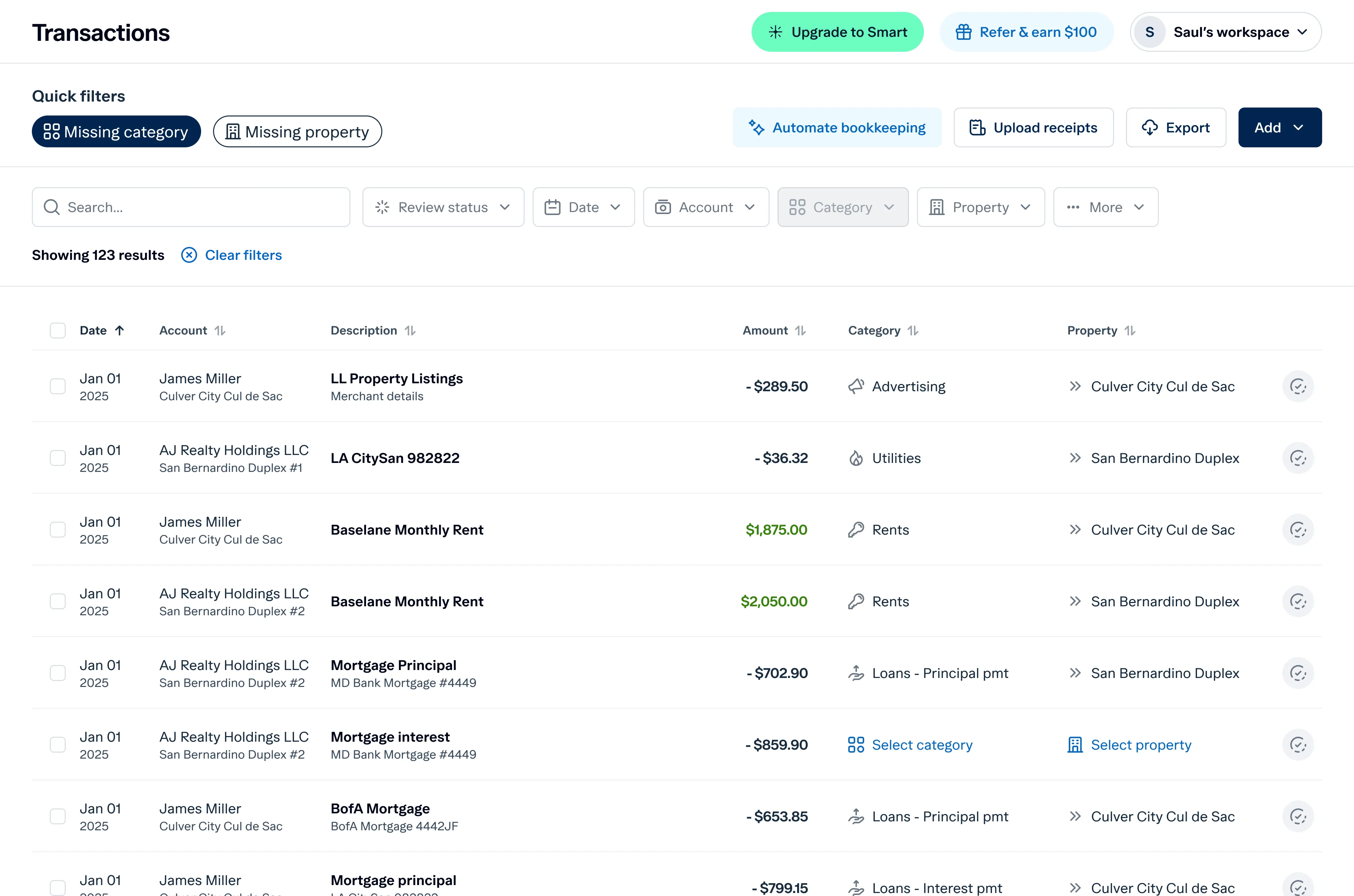
When you classify expenses correctly, you avoid tax issues, communicate clearly with lenders, and protect your cash flow. With multiple properties, that clarity compounds over time. Start tracking expenses the right way with Baselane!
FAQs
What is the De Minimis Safe Harbor?
The De Minimis Safe Harbor allows you to deduct expenses of up to $2,500 per invoice/item as operating expenses, even if they are technically capital improvements. This simplifies accounting by avoiding depreciation schedules for smaller purchases.
Can I deduct a roof replacement all at once?
No, replacing an entire roof is a restoration (CapEx) and you must depreciate it over 27.5 years. However, you can deduct repairing a small section of a roof (patching leaks) as an operating expense.
How much should I reserve annually?
Use either 10–15% of Net Operating Income for stabilized multifamily properties, or $250–$600 per unit per year for older or single-family properties. Adjust based on property age, condition, and expected lifecycle costs.
What happens if I misclassify?
Misclassifying expenses can cause IRS reclassification, lost deductions, penalties, or audit triggers. OpEx reported as CapEx may miss immediate tax benefits; CapEx reported as OpEx may be disallowed on audit. To avoid misclassification use property management accounting software for automating capital vs expense accounting.
Can the IRS reclassify past expenses?
Yes. If the IRS determines you incorrectly classified a capital improvement as a repair (or vice versa), they can adjust deductions, leading to tax liabilities, interest, or penalties. Keep thorough documentation and use IRS operating expense vs capital expenditure classification rules.

.jpg)
.jpg)

%20vs%20General%20Ledger%20for%20Landlords%202026%20.webp)