


.webp)


If a tenant pays you six months—or even a full year—of rent upfront, it feels like income you can use right away. The cash is in your account, after all. But your accounting method defines whether it is an asset or a liability.
Understanding this distinction keeps your books clean, your taxes accurate, and your cash flow under control—especially if you manage multiple properties.
Key takeaways
- Cash basis landlords usually record it as income when received, while accrual basis landlords treat it as a liability until it’s earned.
- Advance rent represents your obligation to provide the property for future months. You record it as “unearned rent” and move it to income gradually as each month passes.
- Cash basis landlords report all prepaid rent in the year they receive it. Accrual landlords recognize it over the rental period.
- Prepaid rent is for future rent; security deposits are held for potential damages and usually must be kept separate.
- Use clear records, separate accounts, or automated tools to monitor prepaid rent and ensure it’s applied to the right months.
What is prepaid rent?
Prepaid rent happens when a tenant pays for future rental periods before they occur. This is common when:
- A tenant wants to secure a unit
- A tenant lacks credit history
- You negotiate an upfront annual rent in exchange for better terms
- You lease commercial or short-term furnished properties
Prepaid rent vs. security deposits
A security deposit is money held to ensure the tenant performs their obligations under the lease. It is a liability for the landlord but is not revenue (unless forfeited). You need to know how to determine a security deposit and often keep it in a completely separate interest-bearing account, depending on state laws.
If you charge a security deposit fee or manage multiple security deposits, keeping these distinct from your "Prepaid Rent" or "Unearned Revenue" accounts is mandatory for legal compliance.
Is prepaid rent an asset or a liability?
Rent paid in advance can be an asset or a liability depending on your accounting method.
Cash basis accounting
In cash basis accounting, you record income when you receive the money, regardless of the rental period timing. Under this method, prepaid rent is an asset as you treat it as your rental income on the day it hits your account.
IRS allows cash basis accounting for rental activities under $25 million in annual gross receipts. This approach keeps bookkeeping simple and works well with Schedule E reporting.
Accrual basis accounting
In accrual basis, you don’t recognize rental property operating expenses or income when money moves—you recognize them when the rent period actually happens.
Accrual accounting follows the matching principle, which means prepaid rent is initially treated as a liability. As each month passes, you move the portfolio of one month’s rent off the balance sheet and add it to your rental income on the profit and loss statement.
Is prepaid rent a current or long-term item?
In most cases, advance rent relates to the upcoming months, not years. For that reason, it is typically classified as a current item on the balance sheet.
The 12-month rule
Current items are those expected to be used or earned within one year. Since most advance rent covers a month, a quarter, or up to a year, it falls squarely into this category.
Rare long-term exceptions
In uncommon cases—such as commercial leases where rent is prepaid for multiple years—the portion that applies beyond the next 12 months is classified separately as a long-term item. This keeps liquidity and cash flow metrics accurate.
How to record prepaid rent in your financial books
How you record prepaid rent depends on your accounting method.
Cash-basis accounting is most widely adopted because it’s simpler and aligns with how the IRS taxes rental income. Usually, commercial property or complex portfolio owners use the accrual basis to better match income to occupancy.
This choice affects:
- When rent shows up as income
- Whether prepaid rent appears as a liability
- How numbers flow through your balance sheet, income statement, and Schedule E
Prepaid rent journal entry for cash basis
Record prepaid rent entirely as rental income when you receive it, regardless of the period it covers.
For example, if you receive $2,000 on December 1 for December and January rent, debit Cash $2,000 and Credit Rental Income $2,000.
The full amount appears as taxable income on Schedule E for the receipt year, with no balance sheet liability; document the covered periods in receipts for tracking tenant payments. Use a fillable rent ledger to keep track of prepaid rent.
Own your time,
not just your properties
Make your finances work harder, so you don’t have to.


Prepaid rent accounting entry for accrual basis
With the accrual basis, you don’t recognize rent as income until it’s earned, and thus, prepaid rent starts as unearned rent (a liability)
If a tenant pays $2,000 in advance for two future months, record prepaid rent onthe balance sheet
as a liability
- Debit Cash: $2,000
- Credit Unearned Rent Revenue (current liability): $2,000
As each month passes, you claim a portion of the rent paid in advance as your income for that month.
- Debit Unearned rent revenue: $1,000
- Credit Rental income: $1,000
Income is recognized and taxed only as the rental period elapses, matching revenue to occupancy on financial statements.
Key differences at a glance
When managing multiple units with varying lease start dates, knowing how to figure out prorated rent ensures accurate billing for every tenant. If tenants pay in cash, having a clear process for how to record cash paid for rent keeps your books audit-ready across all your properties.
Prepaid rent tax implications
To understand when a rental advance is taxable, you need to consider your accounting method.
- Cash basis accounting: Prepaid rent is taxable when received, regardless of the period it covers.
- Accrual accounting: Prepaid rent is recognized as income in the period it applies to.
Accurately track prepaid rent with Baselane
With Baselane, you can tag prepaid rent automatically to a specific property and Schedule E category to ensure accurate tax filing and balance sheet positioning.
- Set up rent collection: Start by sending invoices for prepaid rent (like 3 months upfront) to tenants through Baselane. Tenants pay online (ACH, wire, cards), and you get funds into your Baselane banking account.
- Categorize rent transactions: Tag the fund as prepaid rent to a specific property to keep a record of the payment. You can see exactly what's prepaid versus regular rent in a single dashboard.
- See real-time reports: Upfront rent shows up in your P&L, cash flow statement, and rent roll in the right position, depending on how you categorize it.
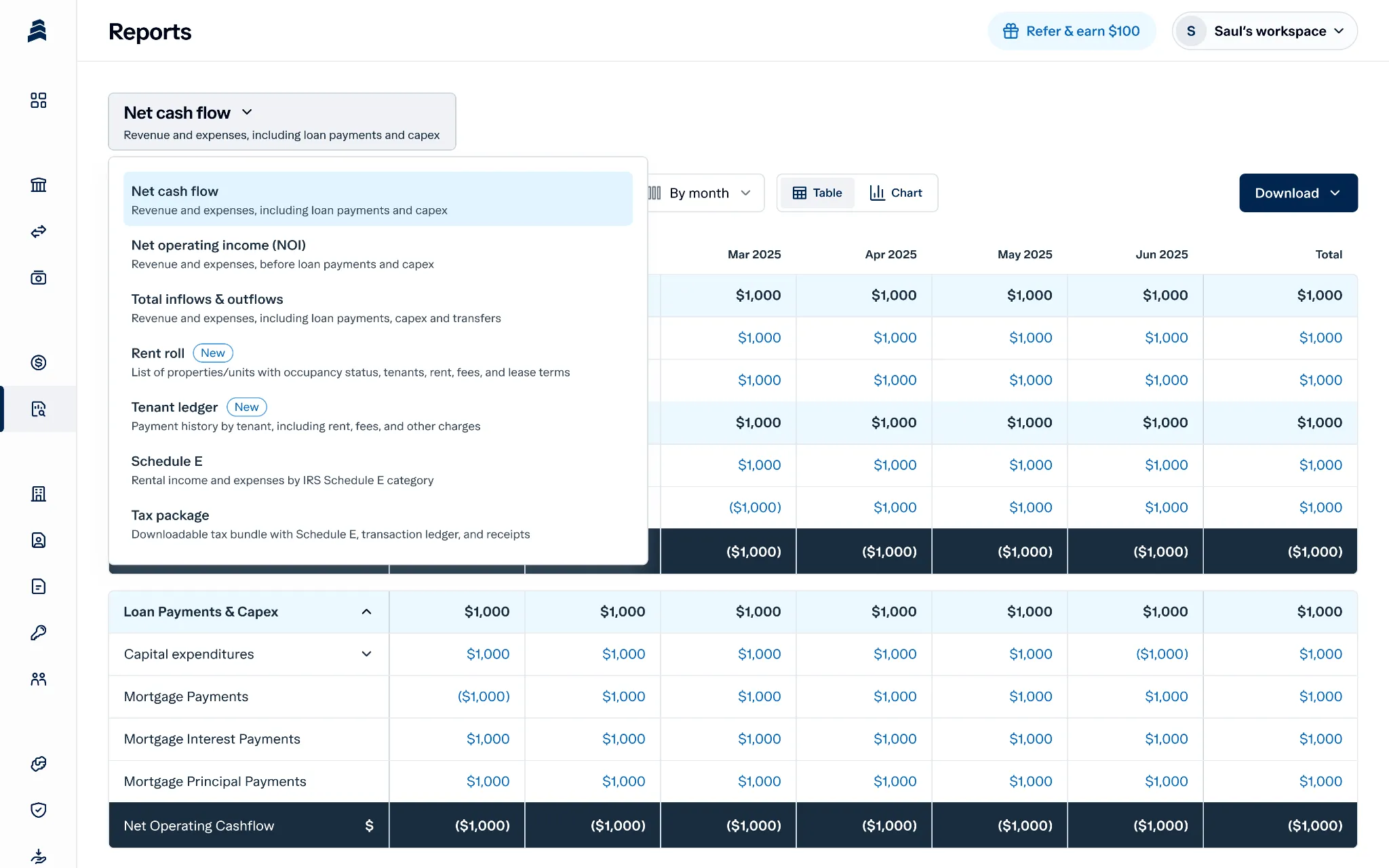
Automate bookkeeping and manage prepaid rent accurately with Baselane. Open your account today!
FAQs
What is prepaid rent?
Prepaid rent is money you receive from tenant before the rental period begins. Under cash basis accounting, it is considered an asset while a liability under accrual basis.
Is prepaid rent a debit or credit balance?
It depends on your accounting method. Under cash basis accounting you record it by debiting Cash and crediting Rental Income immediately. On accrual basis, it starts as a credit to Unearned Rent Revenue—a current liability—until amortized monthly to income as earned.
Is prepaid rent a current asset?
No, prepaid rent is not a current asset for landlords. On your balance sheet, it carries a credit balance and gets treated as income (cash basis) or a liability like unearned revenue (accrual basis).
Where does prepaid rent go on the cash flow statement?
For tenants, paying prepaid rent is an operating activity outflow. The initial payment reduces cash flow from operations. When prepaid rent is later expensed, it is a non-cash adjustment on the cash flow statement under the indirect method, but the initial cash hit occurs when the check is written.
How does prepaid rent differ from a security deposit?
Prepaid rent in accounting is money paid in advance to you by tenants to use your property which is recorded as an expense eventually. A security deposit is money held for possible damages and is usually returned. Learn more about in our guide on how to manage rental property finances.
Can I spend prepaid rent immediately as a landlord?
Legally, yes, unless lease terms or local laws specify otherwise (unlike security deposits). However, financially, it is unwise. You should reserve those funds to cover depreciation on rental property, maintenance costs, and taxes that will occur during the months the rent covers.
.webp)

.jpg)


.webp)


