




A growing portfolio creates a growing gap between what your bank balance says and what your properties actually produce. Without a structured real estate cash flow statement that separates operating, investing, and financing activity across each entity and property, you risk misallocating capital, underestimating reserves, and filing inaccurate tax returns. This guide breaks down how to build and use a cash flow statement for rental property investments, and includes a free template built for 2026 planning.
Key takeaways
- A real estate cash flow statement tracks operating, investing, and financing activities separately, giving you property-level and portfolio-level liquidity visibility that a P&L alone cannot provide.
- Investors targeting 8–12% Cash-on-Cash Return and a Debt Service Coverage Ratio (DSCR) above 1.25 use cash flow statements to validate performance before reinvesting or refinancing.
- Tracking each entity's cash position independently helps prevent commingling across LLCs, reduces audit risk, and supports accurate Schedule E reporting.
- Shifting from manual spreadsheets to integrated banking and bookkeeping reduces reconciliation errors and frees up hours each month for portfolio strategy.
- Proper cash flow management includes setting aside reserves for vacancy (5–10%) and CapEx at the per-unit level, preventing surprise expenses from eroding returns.
What is a cash flow statement for rental properties?
A cash flow statement for rental property is a financial report that tracks the net cash inflows and outflows of your real estate business over a specific period. With a statement of cash flow, real estate investors can focus strictly on liquidity — the actual money available to pay bills, cover debt, and reinvest.
For investors managing properties across multiple entities, this statement is a critical decision-making tool. It tells you whether each property and each LLC can sustain itself without cross-entity capital infusions. While your P&L might show a profit on paper due to non-cash deductions like depreciation, your rental property cash flow statement reveals whether you actually have the funds to cover a major repair or make next month's mortgage payment.
Key sources of cash flow for a rental property
A typical cash flow statement for real estate divides transactions into three distinct categories. This structure aligns with formal accounting principles and provides deeper insight into where capital is moving across your portfolio.
Cash flow from operating activities
This section tracks the day-to-day cash effects of your core business: collecting rent and maintaining properties. It captures all cash inflows from tenants and all outflows required to keep your properties operational.
Common inflows:
- Monthly rent collections across all properties and units
- Application fees, late fees, and pet fees
- Laundry, parking, or storage income
- Inflows from security deposit accounting (though these are often liabilities, they represent cash entering your accounts)
Common outflows:
- Property management fees (typically 8–12% of gross monthly rent)
- Repairs and routine maintenance (often estimated at 10% of monthly rent)
- Utilities, insurance, and HOA fees
- Marketing and professional services (legal, accounting)
- Cash returned to tenants or used for repairs upon move-out. Read our guide on security deposit deductions list to find what all you can deduct
It is important to distinguish between cash and non-cash items. While depreciation reduces your taxable income, it does not reduce your cash balance. A cash flow statement in real estate analysis often adds depreciation back to net income to reflect true liquidity — a nuance that matters significantly when evaluating whether a property is self-sustaining.
Cash flow from investing activities
This section captures cash used to acquire or dispose of assets. This involves purchasing new properties or making major improvements that add long-term value.
Key transactions:
- Outflows: Down payments for new property acquisitions, renovation costs, and major system replacements (roof, HVAC, plumbing infrastructure)
- Inflows: Proceeds from selling a property, including 1031 exchange proceeds routed into replacement assets
Understanding the difference between a repair (operating expense) and a capital improvement (investing activity) is crucial for accurate financial reporting and tax treatment. If you need clarity on classifying these costs, read our guide on capital expense vs operating expense to maintain accurate books across your portfolio.
Cash flow from financing activities
Financing activities track changes in debt and equity. This section shows how your real estate business is funded and how capital is returned to owners.
Key transactions:
- Inflows: Proceeds from new mortgages, refinance cash-outs, or capital contributions from owners or partners
- Outflows: Principal repayment on loans (mortgage payments), distributions to owners, or dividends
Properly tracking the principal portion of your mortgage payment here — separate from the interest — is a nuance that many manual spreadsheets miss, especially when tracking multiple loans across several entities. Understanding the mortgage interest deduction on rental property is essential, as interest is typically an operating expense, while principal repayment is a financing outflow.
Reconciling cash accounts
The statement reconciles your beginning cash balance with your ending balance. If the net cash flow from all three sections matches the actual change in your bank accounts, your records are accurate. This reconciliation becomes considerably more reliable when using dedicated banking accounts for each property or LLC — a core feature of Baselane's banking platform, which prevents commingling of funds across entities and personal accounts.
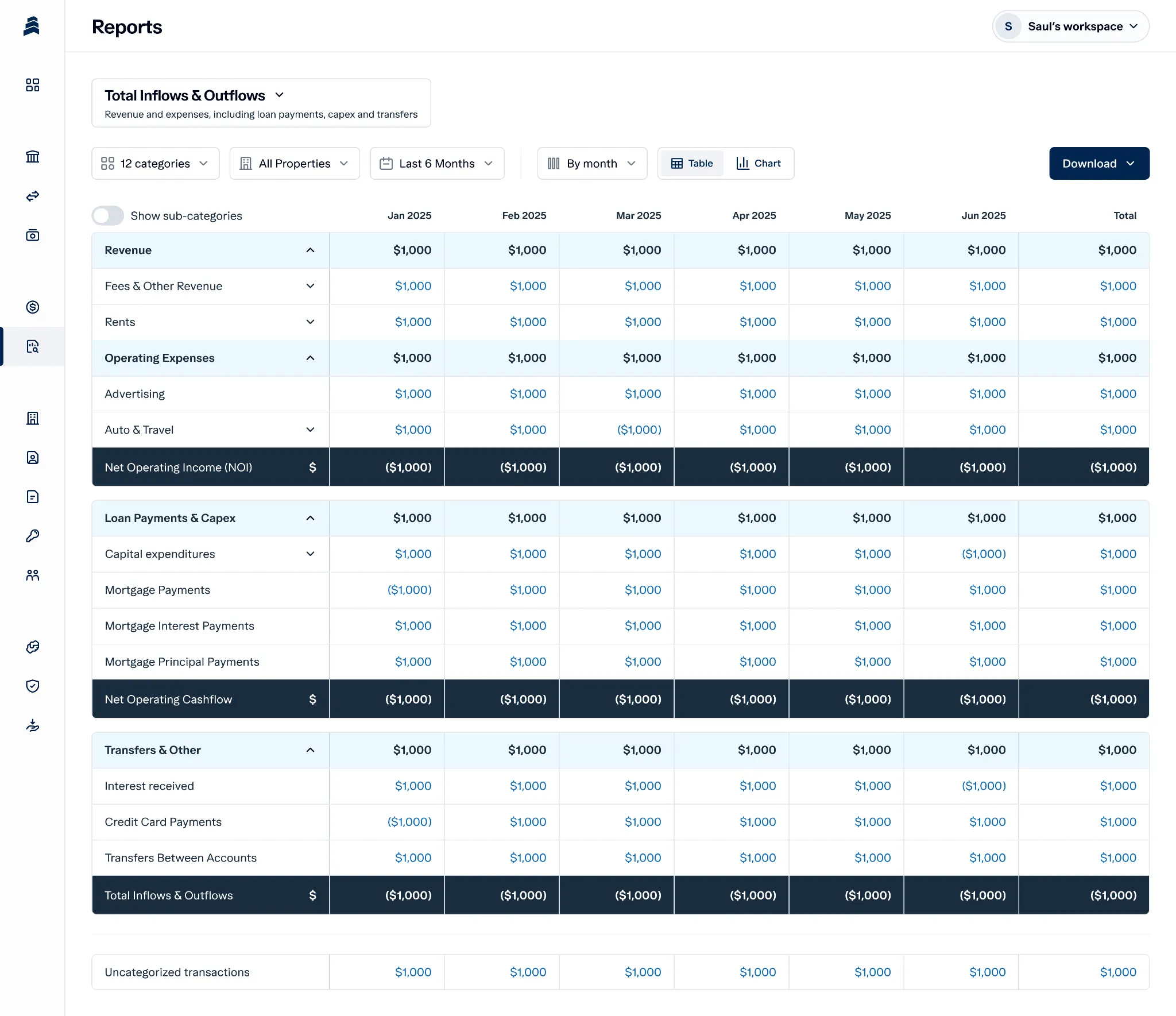
Here’s how a sample real estate cash flow statement looks like in Baselane.
Own your time,
not just your properties
Make your finances work harder, so you don’t have to.


How to create a rental property cash flow statement
Building an accurate cash flow statement for real estate investments follows a structured process. These seven steps apply whether you are preparing an annual report for a single property or generating consolidated statements across your entire portfolio.
Step 1: Gather your financial data
Collect all relevant financial documents for the period you are analyzing. You will need your current rent roll, bank statements showing all deposits and withdrawals for each entity, credit card statements for property expenses, and mortgage amortization schedules for every financed property. If you are preparing an annual property cash flow statement, ensure you have twelve full months of data across all accounts.
Step 2: Project your effective gross income (EGI)
Start with your Gross Potential Rent — the maximum income if every unit were occupied at market rates. Projected rent growth for 2026 is expected to range from 3–5% nationally, though this varies significantly by market.
- Subtract vacancy losses. A standard vacancy allowance is 5–10% of gross income, though your actual rate depends on market conditions, tenant retention strategy, and property class.
- Add other income sources like pet fees, parking, storage, or laundry.
Benchmark: The "1% Rule" provides a baseline check. If your monthly rent is at least 1% of the purchase price, you are starting with strong revenue potential relative to acquisition cost.
Step 3: Identify and forecast all operating expenses
List every expense required to operate each property. Use actual bank data and historical actuals rather than estimates wherever possible.
- Management fees: 8–12% of collected rent
- Repairs: ~10% of collected rent
- Vacancy reserve: ~5% of annual income
The "50% Rule" offers a useful reality check: assume that approximately 50% of your rental income will go toward operating expenses (excluding mortgage). To confirm you are not missing line items, cross-reference your list with a detailed guide on rental property operating expenses or a broader list of rental property expenses.
Step 4: Account for capital expenditures (CapEx)
CapEx refers to major expenses that extend the life of the property, such as replacing a roof or HVAC system. These are not operating costs but significant investing outflows on your cash flow statement format for real estate.
- Budgeting: Industry guidance suggests setting aside reserves such as $150 per month per unit, specifically for future capital expenditures. Across a portfolio, this reserve strategy becomes a significant line item that must be tracked at the entity level.
- Tax strategy: While these are cash outflows, they are often depreciated over time. Strategies like cost segregation can accelerate this depreciation, improving near-term cash position.
- Advanced analysis: A cost segregation study may allow you to leverage cost segregation and bonus depreciation, significantly reducing your taxable income and preserving cash — though you should account for the depreciation recapture tax upon sale.
Step 5: Calculate Net Operating Income (NOI)
Subtract your total operating expenses (Step 3) from your Effective Gross Income (Step 2).
Formula: NOI = EGI – Operating Expenses
NOI does not include mortgage payments or CapEx. It is a measure of the property's operational efficiency and serves as the foundation for cap rate calculations and lender underwriting across your portfolio.
Step 6: Factor in debt service for net cash flow
To find your net cash flow, subtract your total annual debt service (principal and interest) and any CapEx reserves from your NOI. This is the core output of any cash flow statement real estate investment analysis.
Formula: Net Cash Flow = NOI – Debt Service – CapEx Reserves
Healthy benchmark: A Debt Service Coverage Ratio (DSCR) above 1.25 indicates your cash flow is sufficient to cover debt with a 25% safety margin — a threshold that most lenders also require for refinancing.
For example, in a BRRRR case study cited by Kiavi, an investor achieved $662 in monthly cash flow and a 21.17% cash-on-cash return after refinancing. This demonstrates how accurate calculation and leverage can transform an investment property cash flow statement from a reporting tool into a reinvestment strategy.
Step 7: Analyze and refine
Review your statement across all properties. Is cash flow positive at each entity level? If not, investigate where expenses are exceeding benchmarks. Regular analysis allows you to spot trends — creeping maintenance costs, rising insurance premiums, or increasing vacancy — before they erode returns across your portfolio.
Free rental property cash flow template
To put this process into action, download our free real estate cash flow statement template that includes sections for operating, investing, and financing activities. This’ll help you to enter property-specific data and automatically calculate key metrics such as NOI and net cash flow.
- Customizable fields: Tailor income and expense categories to each property or entity
- Auto-calculation: Instantly see your Cash-on-Cash return and DSCR
- Format flexibility: Works as an Excel file or Google Sheets
Key financial metrics beyond cash flow
While net cash flow is the primary output of your real estate statement of cash flow, additional metrics help you evaluate capital efficiency and portfolio performance.
- Cash-on-cash return: Measures the annual pre-tax cash flow divided by the total cash invested. Experienced investors typically target 8–12%, though acceptable thresholds depend on market and strategy.
- Capitalization rate (Cap rate): Measures the rate of return on the property based on the income it generates, independent of financing. Useful for comparing assets across your portfolio.
- Debt service coverage ratio (DSCR): A DSCR below 1.0 means the property requires outside cash to service its debt — a red flag that demands immediate attention.
- Gross rent multiplier (GRM): The ratio of the property's price to its gross rental income. A useful screening metric during acquisition.
Common misconceptions and how to avoid them
Even experienced investors can fall into traps when analyzing a sample cash flow statement real estate report.
Misconception 1: Cash flow equals profit
You can have positive cash flow but negative taxable income due to depreciation. Conversely, you can be profitable on paper but have negative cash flow due to heavy principal payments. Reviewing your P&L and cash flow statement together — ideally consolidated at the entity level — gives you the complete financial picture.
Misconception 2: Negative cash flow is always bad
A property may be cash flow negative in year one due to initial repairs or lease-up vacancy. However, chronic negative cash flow is a portfolio risk, especially when it requires cross-entity subsidies that mask the underperformance. Investors in high-appreciation markets sometimes accept lower initial cash flow, but this strategy demands adequate capital reserves and a clear exit plan.
Misconception 3: I don't need to track every receipt
Underestimating expenses is the most common cash flow error. Small, uncategorized expenses compound across a portfolio. To capture every write-off, use a rental property tax deductions checklist and review the complete guide on landlord tax deductions.
Emerging trends and strategies for 2026
The management landscape is shifting. Relying solely on a manual cash flow statement investment property spreadsheet is becoming a competitive disadvantage for investors with multiple properties and entities. Here’s where we are headed:
Digital rent payments
Over 50% of renters now use digital platforms to pay rent. Renters who pay offline are 23% more likely to pay late, creating cash flow unpredictability that compounds across a portfolio. Adopting a flexible rent collection approach improves cash flow consistency and reduces the administrative burden of tracking payments across properties and entities.
Data-driven portfolio decisions
With rental fraud increasing by 75%, modern real estate investors use automated tools to screen tenants and track property-level financials. Specialized cash flow management software helps detect anomalies and stress-test portfolios against rising costs — replacing the manual spreadsheet reviews that fail to scale.
Automated bookkeeping
2026 trends point toward fully integrated systems in which banking and bookkeeping operate as a single, connected workflow. Using dedicated best accounting software for rental properties ensures that every transaction is auto-categorized to the correct property and Schedule E category, providing real-time visibility into your cash position without end-of-month reconciliation.
Maximizing your rental property cash flow
To improve returns across your portfolio in 2026, consider these strategies:
- Optimize rent pricing: Review market rates regularly using comp data and rent estimation tools. Even small per-unit increases compound across a portfolio.
- Reduce turnover: Vacancy is one of the largest controllable drags on cash flow. Proactive lease renewal strategies and resident retention programs protect your income stream.
- Maximize tax efficiency: Strategies like cost segregation and disciplined deduction tracking can substantially reduce your tax burden, effectively increasing available cash. Explore how to pay no taxes on rental income legally through depreciation and deductions, or evaluate a 1031 exchange guide when repositioning assets.
Automate cash flow statement with Baselane
A structured cash flow statement for rental property investments is the foundation of informed portfolio management. Centralized property-level accounting for rental property gives you the clarity and control to make confident capital allocation decisions.
Baselane's integrated banking and bookkeeping platform automatically generates cash flow reports for every property and entity. Open your account today and take control of your financing decisions.
FAQs
What is a cash flow statement for a rental property?
A cash flow statement tracks the actual money entering and leaving your rental business over a specific period. It helps investors decide whether each property generates enough cash to cover operating expenses and debt service independently.
How does depreciation for real estate affect the income statement and cash flow?
Depreciation is a non-cash expense, meaning it lowers your taxable income on paper but doesn't reduce cash. On an income statement, depreciation reduces reported profit. On a cash flow statement, it is added back to net income to show the actual cash available for operations or reinvestment.
Can I use a spreadsheet to track cash flow for multiple properties?
You can, but spreadsheets become error-pronem especially when tracking multiple entities, amortization schedules, and Schedule E categories. Real estate accounting software like Baselane automates data entry and segregates transactions by property and entity, reducing manual workload and errors. It delivers specific real estate reporting that QuickBooks for landlords cannot, and is considered one of the top QuickBooks alternatives.
What are the adjustments on a real estate cash flow statement?
Common adjustments include adding back non-cash charges like depreciation and amortization, accounting for changes in working capital, and reclassifying security deposit transfers between accounts. These adjustments reconcile your accrual-basis income to actual cash received and spent.
What does a typical cash flow statement for real estate include?
A typical cash flow statement for real estate includes operating activities, investing activities, and financing activities. The statement reconciles these three sections to show your net change in cash for the period.
.webp)
.webp)
.jpg)


.jpg)


