
.jpg)


Managing multiple properties can get messy—manual data entry, missed deductions, and stressful tax season are all too common. The right real estate software with built-in accounting puts everything in one place.
In this guide, we share the top real estate software with integrated accounting for 2026 to help you take control of your finances.
Key takeaways
- Integrated accounting reduces errors by automating data flow between banking, rent collection, and bookkeeping systems.
- Native solutions often outperform integrations by housing banking and accounting under one roof, eliminating sync issues entirely.
- Automation saves significant time, allowing investors to focus on scaling their portfolios rather than on administrative tasks.
- Choosing the right software depends on your portfolio size, budget, and goals.
Why integrated accounting is non-negotiable for real estate
According to Dataintelo, the real estate accounting software market is projected to reach over USD 28 billion by 2032, driven by surging demand for real-time data and automated compliance.
Integrated accounting software does more than just track income. It creates a seamless system that automatically organizes your financial data across properties, reconciles transactions from your bank accounts, and generates tax-ready reports.
Why is this shift happening?
- Efficiency: Integrated systems remove duplicate data entry, saving property teams a lot of time. Instead of manually reconciling bank statements with rent rolls, the system matches transactions automatically. This reduces mistakes and keeps your records audit-ready.
- Financial visibility: Integrated accounting gives investors real-time views of cash flow and profitability, allowing faster, data-driven decisions—something that’s much harder when relying on end-of-month reports from separate systems.
In short, integrated accounting software makes real estate finance management easier, faster, and more accurate.
Key features to look for in an integrated real estate accounting software
- Property and unit-level accounting: Track income, expenses, and profitability for each property and unit to identify each property’s performance.
- Banking integration: Connect your bank accounts to the accounting software for real-time reconciliation.
- Automated rent collection: Collect rent electronically and automatically calculate late fees, reducing manual work.
- Schedule E categorization: Automatically categorize property-related expenses according to IRS rules, ensuring no missed deductions.
- Financial reporting: Access real-time cash flow, profit/loss, and balance sheet reports for your entire portfolio or individual properties.
- Automated journal entries & ledger management: Reduce manual bookkeeping by automating recurring entries like mortgage payments, utility bills, and property taxes.
- Tax management: Store tax documents and schedule payments directly in the system.
- Secure cloud access & data protection: Protect sensitive financial information with strong encryption, two-way API syncs, and cloud security.
- Scalability for growing portfolios: Support multiple properties, units, and accounts without slowing you down.
Top real estate software with integrated accounting (2026 picks)
Below are our top 5 picks for software offering integrated accounting for real estate finances.
Baselane
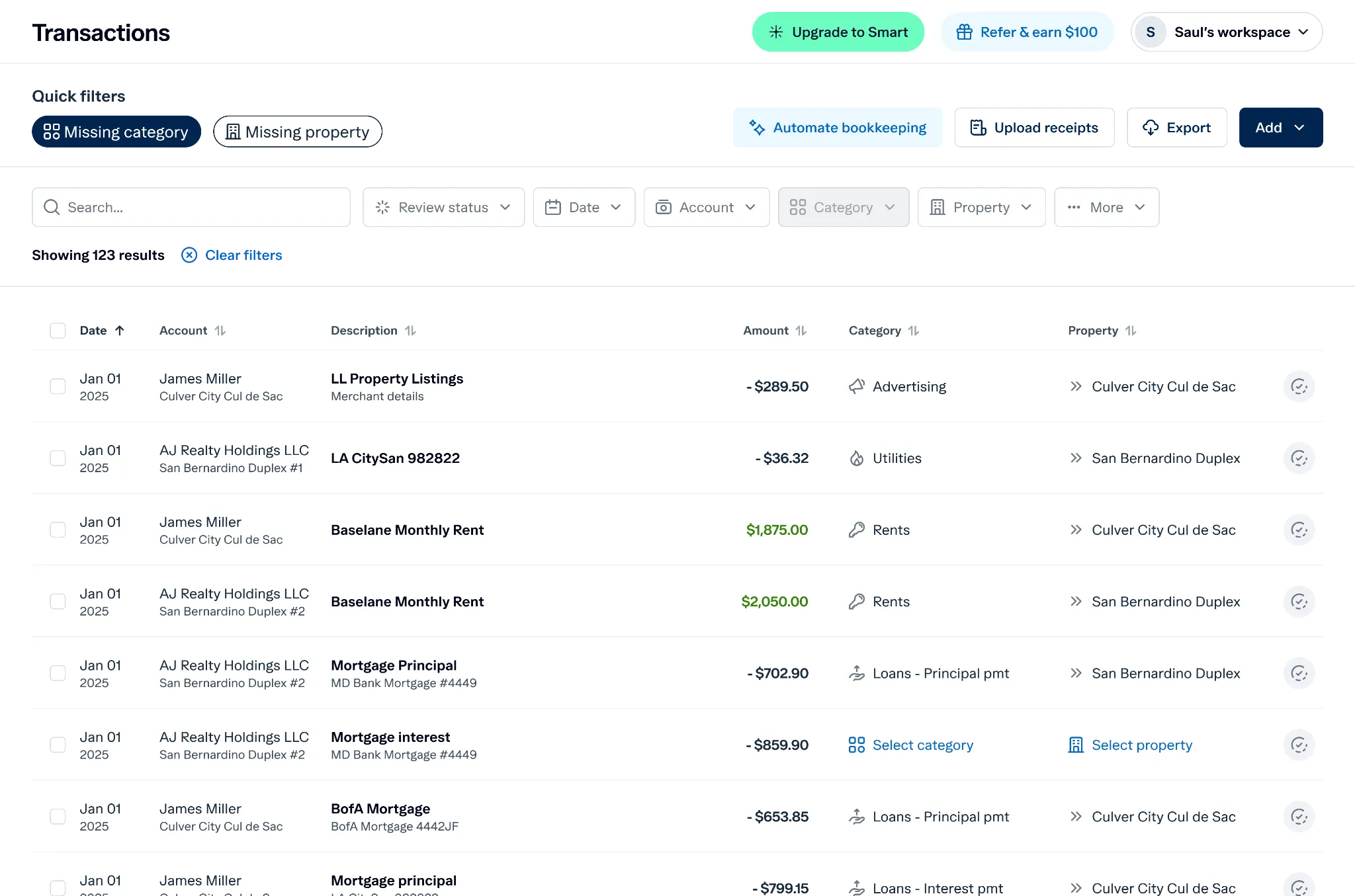
Baselane stands out as an all-in-one banking platform for real estate investors and landlords. It offers native banking with automated accounting, ensuring you can manage your finances without toggling between multiple apps.
From your property-level rent payments to tax prep, everything happens within Baselane, saving you hours of manual work. You get a real-time view of each property’s financial performance that helps you file taxes with confidence and gain clarity to make financial decisions.
Key features
- Automatically imports, categorizes, and tags all transactions by property and over 120 Schedule E categories, ensuring you never miss a rental property tax deduction.
- Offers unlimited property-level checking and high-yield savings accounts, providing clear fund separation and preventing commingling with no extra fees.
- Sync rent payments directly into your accounts, auto-tag them as income, and eliminate the need for third-party rent apps.
- Offers instant P&L statements, Net Cash Flow reports, a rent roll, and a consolidated ledger of all banking activity.
Pricing
- Core Plan: $0/month, includes banking, bookkeeping, and free rent collection.
- Smart Plan: $20/month offering advanced automations, 2-day rent payouts, and custom categories.
I've been using Baselane for over a year for all of my banking and accounting in my midterm rental business. I love that I can do banking and accounting in one step, in one account. I have also used the rent collection feature, which simplifies the process even further. With the number of transactions in my business for each property, a solution like Baselane is a must. ~ Jillyan MacMorris
Own your time,
not just your properties
Make your finances work harder, so you don’t have to.


Stessa
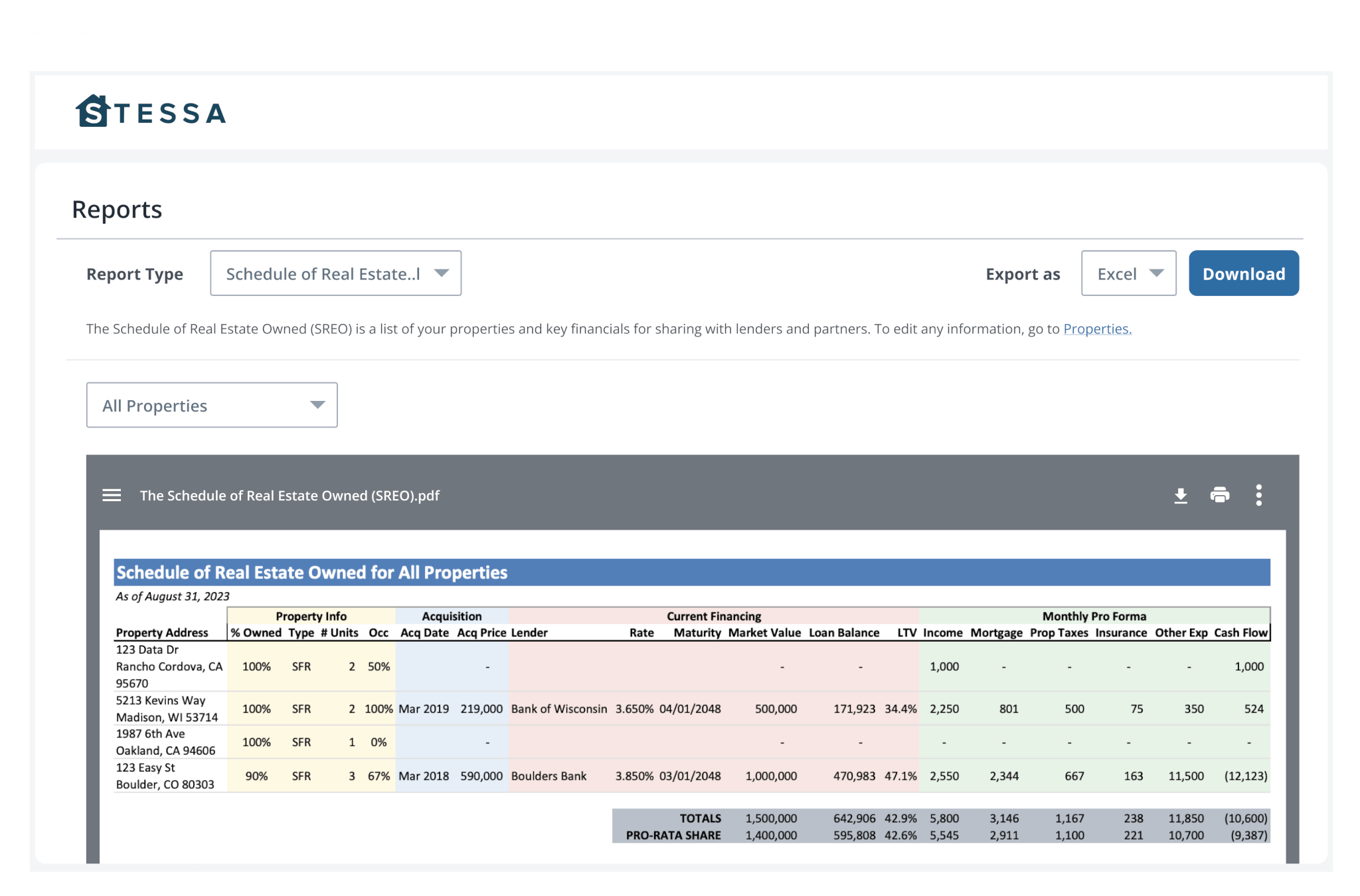
Stessa is a popular choice for investors focused on asset performance and portfolio tracking. It excels at providing a dashboard view of your portfolio's value and equity. While it offers strong accounting capabilities, it often comes with a slight learning curve for new or scaling investors.
Key features
- Automated transaction import and categorization for rental income and expenses.
- Portfolio dashboards, metrics, and tax‑ready reports.
- Optional cash‑management accounts and rent collection integrations.
Pricing
Offers a free plan with limited accounting features. Paid plan starts at $12 per month.
Rentec Direct
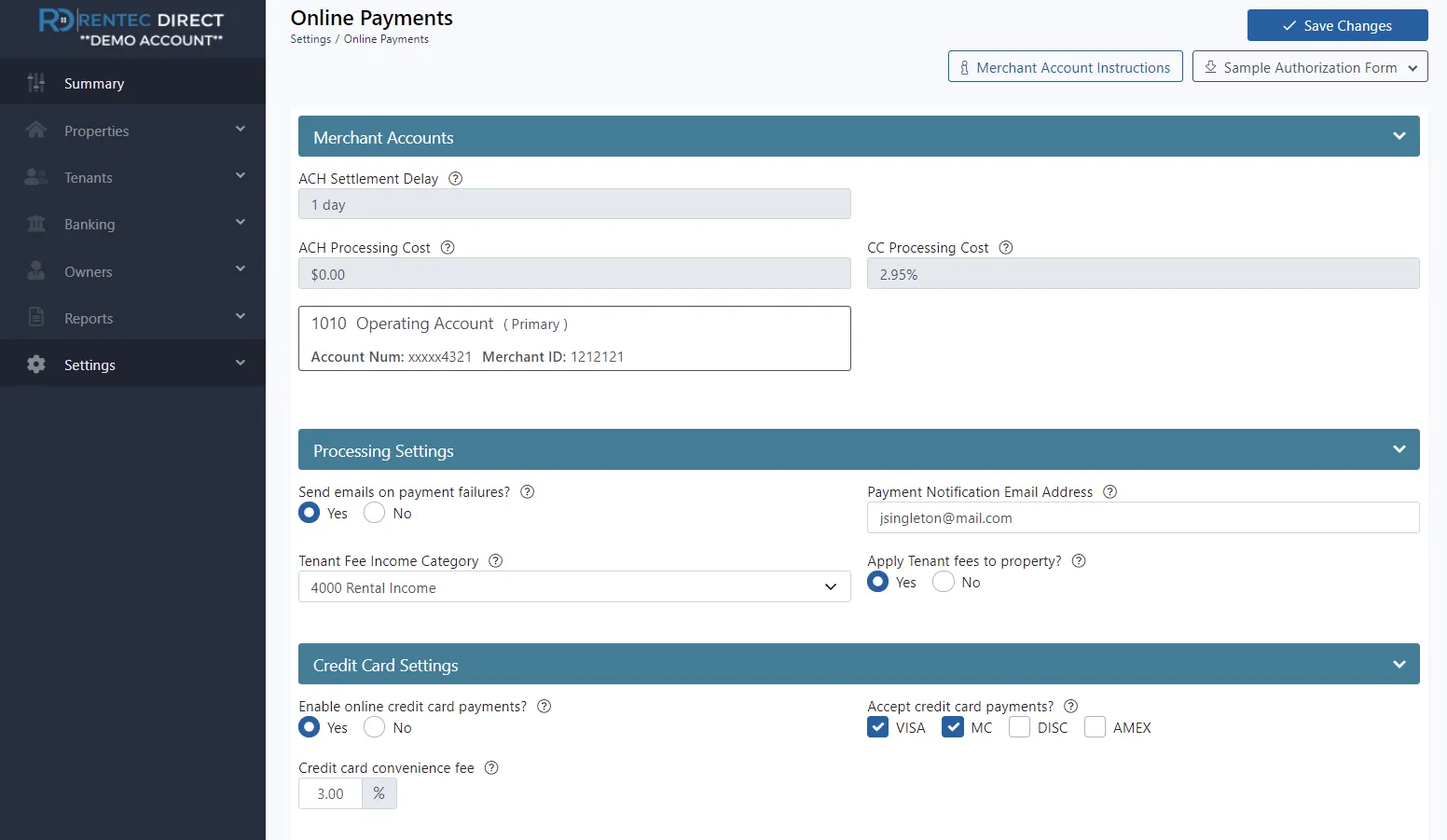
Rentec Direct is a solid option for investors who need regulated accounting for rental properties. However, for smaller investors, the interface can feel dated, and some advanced banking features may require third-party integrations.
Key features
- Supports QuickBooks sync, automated ACH/credit card payment processing, and custom rent reports.
- Secure portals for rent payments, balance checks, reporting, and online rental applications.
- Tracks overdue payments, late fees, recurring invoicing, and electronic tax filings.
Pricing
Starts at $45/month for up to 25 units. Offers a 14-day free trial, no free plan.
DoorLoop
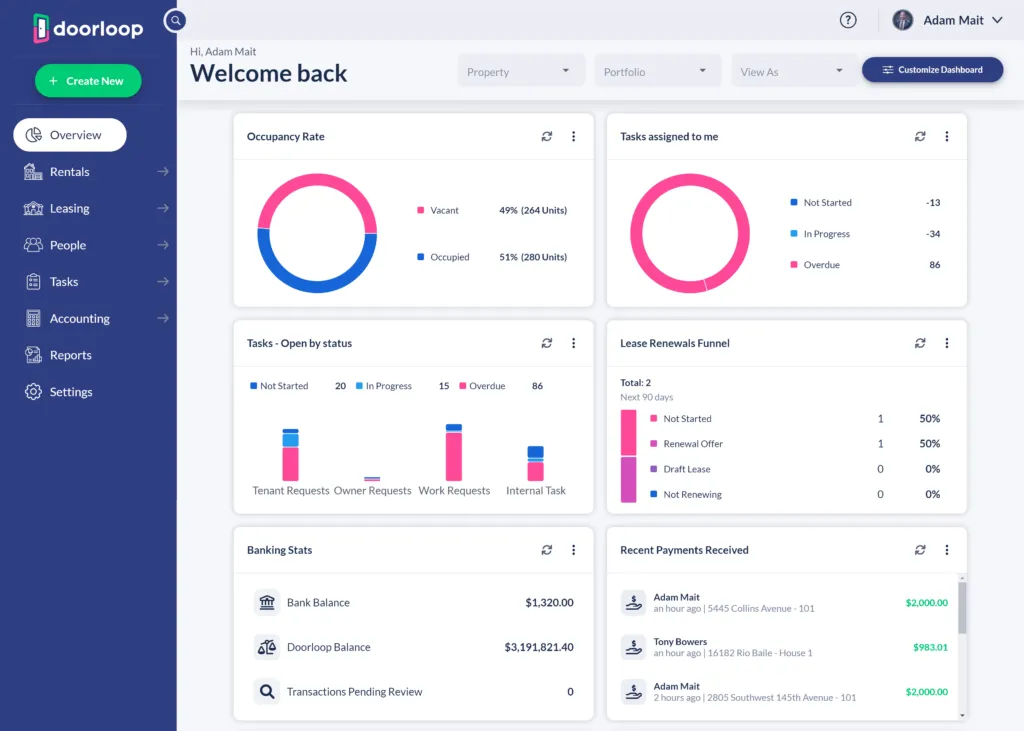
DoorLoop is known for its ease of use and modern interface, making it a good choice if you need a customizable interface.
Along with native accounting, it also integrates with QuickBooks Online, ensuring seamless data sync across apps. Doorloop’s accounting software integration is powerful but can add an extra layer of cost and complexity.
Key features
- Supports accounts payable and receivable, budgeting, and comprehensive financial reports.
- Bank account sync and reconciliation to easily match bank transactions with the software's ledger.
- Manage tenant requests to vendor payments, ensuring maintenance expenses are accurately tracked in the books.
Pricing
Unit-based pricing starting at $69/mo for 10 units. There is no free plan or trial offered.
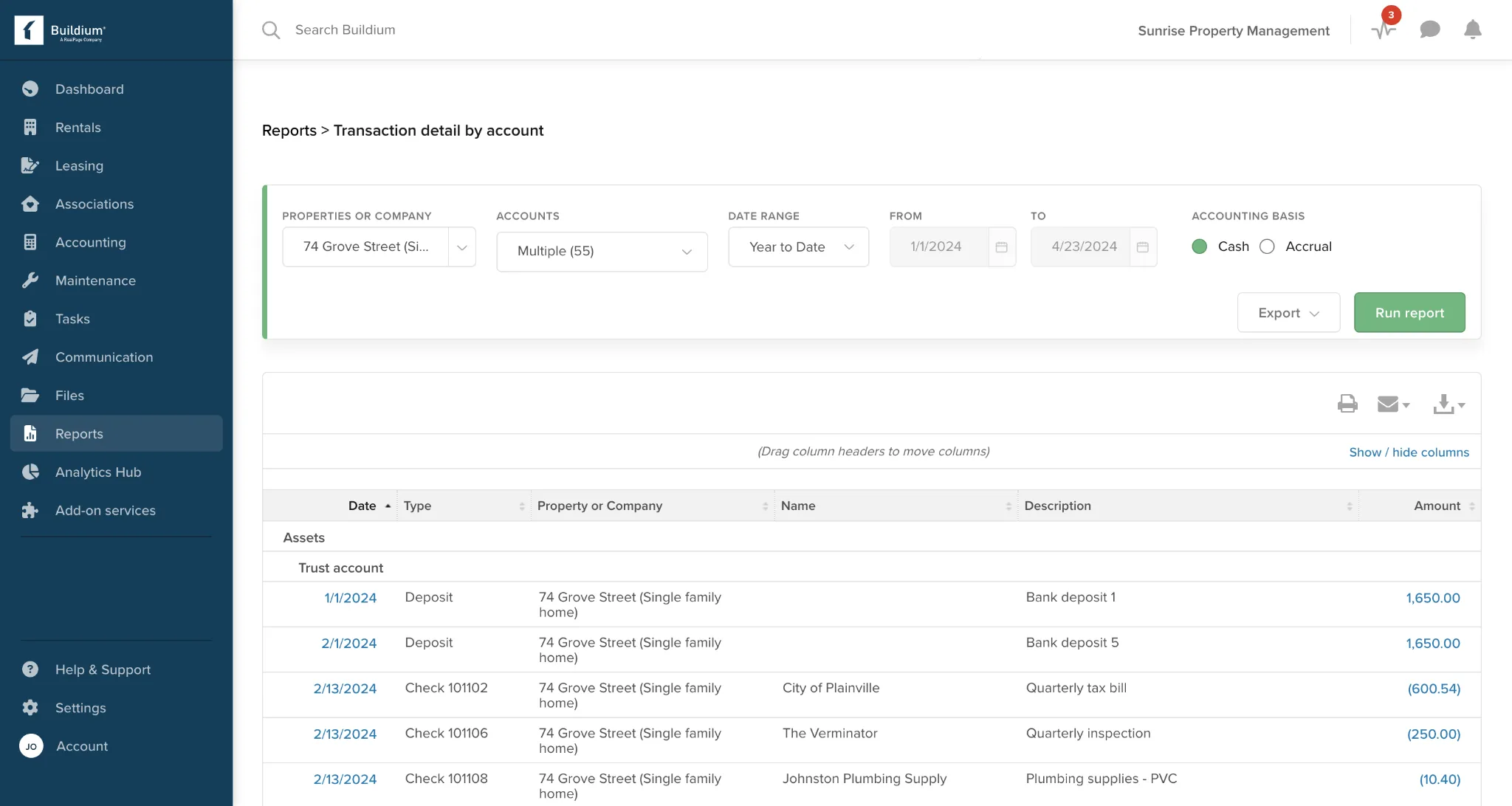
Buildium
Buildium is an enterprise-grade property management solution geared toward investors with larger portfolios. It covers the entire property lifecycle, from leasing to accounting.
Its strength lies in its scalability, but the learning curve and limited accounting features can push you to use multiple apps to get a consolidated view of all your properties.
Key features
- Double-entry accounting features, including accounts payable and receivable, are necessary for professional property management.
- Reconciliation tools to match bank statements with the software's ledger, reducing accounting errors.
- E-filing of 1099 forms simplifies tax preparation for vendor payments.
Pricing
Unit-based pricing with no free trial or plan. The plan starts at $62 per month.
Comparison table: Best integrated real estate accounting software
How to choose the right integrated accounting solution
Step 1: Assess your portfolio and goals
Start by defining your current scale and where you plan to be in five years. If you are a sole proprietor looking to minimize overhead, the best bookkeeping software for sole proprietor landlords will differ from what a commercial firm needs. Also consider whether you need homeowner association accounting software features or if you are focused strictly on residential rentals.
Step 2: Prioritize your integrations
Determine which parts of your workflow are currently broken. If reconciling bank statements is your biggest time sink, prioritize accounting software with robust bank integration or native banking solutions. If you struggle with maintenance coordination, look for property management accounting integration platforms that directly link work orders to expense line items.
Step 3: Evaluate the "true" cost
Pricing models vary wildly, from flat monthly fees to per-unit charges. Be wary of the benefits of integrated accounting software packages that seem cheap up front but charge heavily for essential add-ons, such as ACH transfers or additional users.
Integrated solutions such as Baselane often provide core banking and bookkeeping features at no cost, offering high value for cost-conscious investors.
Step 4: Check for compliance and tax support
Ensure the software supports the specific tax forms you need, such as 1099s for vendors and Schedule E for your personal return. Tools that help you reduce tax on rental income by flagging potential deductions—like rental property repair tax deduction opportunities—can pay for themselves many times over.
The future of real estate accounting: AI automation and beyond
As we move through 2026, integrated accounting systems are becoming increasingly intelligent.
AI bookkeeping software handles 80-95% of routine tasks, such as invoice processing, bank reconciliations, and expense categorization, freeing multi-unit owners to focus on strategy.
Agentic AI acts autonomously—e.g., flagging cash flow risks or optimizing vendor payments based on discounts—while integrating fintech solutions to enable seamless rent-to-ledger flows.
We are also seeing a rise in accounting integrations among property managers using predictive analytics.
- Predictive analytics forecasts dips in rental income or spikes in maintenance costs using historical data and market trends.
- Real-time dashboards replace monthly closes with instant P&L, tax projections, and investor reports.
Unified platforms like Baselane integrate accounting and banking into a single data lake. This means automated 1099s, QBI calculations, and cost seg inputs at scale.
Start your integrated accounting journey
Whether you are managing a few units or a sprawling portfolio, the cost of inaction—measured in lost hours and missed deductions—is far higher than the investment in the right software. A unified platform saves time, reduces errors, and gives you clear, real-time insight into your portfolio’s performance.
Baselane stands out as the best solution, combining banking and bookkeeping on a single platform. With native integration, you eliminate the headaches of scattered bank feeds, manual reconciliation, and last-minute tax stress. Ready to gain clarity into your finances? Sign up for Baselane today!
FAQs
What is the advantage of native banking over bank feeds?
Native banking means your accounting software provides the bank account itself. This eliminates connection drops and sync delays common with third-party feeds, ensuring your financial data is always up to date and accurate.
How does integrated software help with tax season?
Integrated software automatically categorizes transactions as they happen, tagging them to specific properties and tax categories. This allows you to generate a Schedule E report instantly, rather than spending weeks organizing receipts at year-end.
Can I use QuickBooks for rental properties?
Yes, but it requires significant customization to track properties and units effectively. Many investors prefer accounting software that integrates with property management platforms or dedicated real estate banking platforms that handle these nuances out of the box.
How do I automate rent collection and accounting together?
By using a accounting systems that integrate with property management software, you can collect rent payments, manage tenants, and classify transactions for each property or unit. This removes the need to manually enter deposits or check your bank statement for rent checks.
Are accounting integrations for real estate secure?
Yes, reputable platforms use bank-level encryption and secure API connections. Integrating multiple bank accounts across properties securely requires software that supports role-based access and maintains detailed audit trails for all transactions.
.jpg)

.webp)