



As a landlord, keeping track of your rental income, expenses, and property maintenance can be overwhelming. From banking and bookkeeping to rent collection, you need a system that helps you stay on top of your finances effortlessly.
QuickBooks works well for real estate investors who already know a bit about accounting. But honestly, it's not made for most investors who aren't accountants. It's missing key banking and real estate features, costs a ton, and you still have to pay a bookkeeper or accountant to keep everything straight.
This makes it less effective for managing taxes on vacation rental income and other landlord-specific financial needs.
Learn how QuickBooks for landlords falls short on features and expectations, and find alternatives — like Baselane’s all-in-one solution for landlords.
Key takeaways
- According to a Baselane survey, 72% of investors find ROI tracking challenging with QuickBooks. The same study found that 57% of investors struggled to track profitability on QuickBooks.
- Many landlords use QuickBooks because it’s familiar, recommended by accountants, and solves basic bookkeeping needs.
- QuickBooks isn’t designed for property-level accounting; managing multiple properties is cumbersome, rent collection isn’t built in, and reporting for taxes and ROI requires workarounds.
- Baselane is the best QuickBooks alternative for landlords as it combines banking, bookkeeping, rent collection, and tax-ready reporting in one platform designed for rental properties.
- Baselane organizes transactions by property and tenant, simplifies reconciliations, automates Schedule E-ready reports, and reduces errors.
- Baselane handles tenants, leases, and rent payments natively, with an intuitive interface and low learning curve, saving time.
Why landlords choose QuickBooks in the first place
Many landlords don’t choose QuickBooks because it is ideal for real estate. They prefer it because it feels like the safest and most familiar option when they first start managing rental income.
QuickBooks shows up early in a landlord’s journey for a few practical reasons:
- Accountants and bookkeepers frequently recommend it because it is widely supported and easy for professionals to take over later.
- It solves basic accounting needs out of the box, including tracking rental property operating expenses and income, connecting bank accounts, and producing standard profit-and-loss reports.
- Landlords who already run another small business often reuse it, assuming rental income can be managed the same way as consulting, retail, or freelance revenue.
- Online guidance and forums mention it often, which creates the impression that it is the default or “standard” choice for rental bookkeeping.
At the early stage—one property, one bank account, a small number of monthly transactions—QuickBooks can appear to work well enough. Rent comes in, bills go out, and the software records both.
The limitation is not a missing feature. It is a difference in how financial activity is structured.
QuickBooks organizes money around businesses, accounts, vendors, customers, and generalized income and expense categories.
Landlords, on the other hand, need to organize money around properties, units, tenants, leases, security deposits, and property-specific cash flow.
Because QuickBooks does not treat properties or units as first-class financial objects, landlords are forced to rely on workarounds—such as classes, locations, and manual tagging—to recreate a structure the software was never designed to support. That structural mismatch is what leads to confusion, extra work, and reporting uncertainty as soon as a portfolio grows beyond the simplest setup.
To answer, is QuickBooks good for landlords? It’s good if you are a single-property landlord with few transactions and an accountant who fixes problems later. It’s not good for landlords with multiple properties, separate bank accounts per property, complex rent flows (late fees, partial payments, reimbursements), or anyone who wants tax-ready, property-level reports without heavy manual work.
Why QuickBooks for landlords isn’t the best choice
Here are some reasons why you shouldn’t use QuickBooks for real estate investing, especially when it comes to rental property accounting:
Not designed for real estate
QuickBooks is general accounting software and isn’t designed to track or manage rental properties. QuickBooks has Classes and Locations. These translate to properties and units, respectively, and you add tenants as customers to tag rent invoices and payments to specific tenants and properties.
Compared to a real estate accounting software that offers clear property and unit-level accounting, QB setup is troubling for landlords due to the following reasons:
- You must tag every transaction correctly. One missed tag makes your property reports wrong.
- Reports stop being reliable if someone mis-tags or imports bank data without a property field.
- QuickBooks stores transactions in a general ledger, not in a property ledger. That makes property-level cash flow statements and performance metrics hard to get.
Difficult to use for multiple properties
Managing multiple properties in QuickBooks is difficult since you need to manually set up each property separately. Routine tasks like recording rent payments are time-consuming, making it hard to scale efficiently as your real estate portfolio grows.
No native rent collection
QuickBooks also lacks built-in rent reminder systems, online tenant portals, and full-featured rent rolls, which purpose-built landlord software often provides. Lack of native rent collection pushes you to resort to manual rent tracking, which can lead to errors and consume time as your rental properties increase.
Not a user-friendly interface
QuickBooks supports different businesses, so its interface has a crowded layout and navigation that does not align with how landlords think or work. You’ll need to dig deep under generic menus and accounting terminology to find the right option.
- Key landlord actions are spread across multiple screens, such as recording rent, reviewing property performance, reconciling bank accounts, and checking tenant balances, which increases clicks and slows routine work.
- Navigation prioritizes accounting functions over rental workflows, forcing landlords to jump between dashboards, reports, and settings to complete tasks that should happen in a single flow.
Steep learning curve for landlords
QuickBooks uses accounting language and workflows, which creates a steep learning curve. Unless you work with an accountant who manages QuickBooks on your behalf (which again, adds more to the overall cost of using the software), you’ll end up spending hours learning terminology and making one-off fixes that create complexity later.
Expensive
QuickBooks pricing reflects its role as a general-purpose accounting platform, not the actual needs of rental property owners. You might end up paying for the features you don’t use while still lacking core real estate functionality.
Additionally, you’ll often need higher-tier plans ($88/mo but $220/mo after the promotion period ends) to get workflow automation, advanced reporting, and custom fields, even though those plans still do not offer the native property or unit-level accounting you need.
The total cost increases through add-ons and professional help, including payroll features landlords do not need, third-party rent collection tools, and additional bookkeeping or accountant hours to correct structural limitations.
Limited real-estate specific reports
QuickBooks doesn’t provide the level of customization or integrations landlords need, making it hard to create rental-specific reports. There are limited insights on real estate metrics, including occupancy and capitalization rates, and reporting on balance sheets and depreciation reports is lacking.
This makes it less adaptable to the ever-changing demands of real estate management, especially with challenges like rent inflation and tenant turnover.
What landlords actually need from accounting software
Compared to QuickBooks, landlord software, such as a dedicated real estate bookkeeping software or AI accounting software for rental real estate offers tailored solution to help you manage your properties effectively.
Here are the features you need in a dedicated real estate-specific platform.
- Property-first structure: Every transaction is tied to a property or unit automatically so that you can see each property’s performance without extra work.
- Banking that matches rental operations: Manage multiple accounts, track security deposits correctly, and handle transfers without confusing your reports.
- Fast and accurate reconciliations: reconcile bank accounts quickly and ensure your numbers match across properties.
- Tenant-ledgers and payment workflows: Track rent, partial payments, late fees, and security deposits clearly and generate tenant statements with ease.
- Tax-ready reports: create reports that align with Schedule E categories without manual mapping or extra adjustments.
- Automation for routine tasks: Simplify recurring rent collection, bill payments, and categorization, so less time is spent on repetitive work.
- Simple user experience: Use software built with landlord terminology and workflows so you can manage your finances without learning accounting jargon.
The best QuickBooks alternatives for landlords
One of the best QuickBooks alternatives is Baselane, which is designed with landlords and real estate investors in mind. We combine your banking and bookkeeping into one fully-integrated solution, meaning your bookkeeping is taken care of automatically as you bank - this not only saves you from having to track income and expenses manually.
It also saves you money, as your bookkeeper gets all the information they need to maintain your books without charging you their exorbitant fees.
Own your time,
not just your properties
Make your finances work harder, so you don’t have to.


Why Baselane is the best QuickBooks alternative for landlords
Ridiculously easy to use, set up, and affordable
We take pride in Baselane's user-friendliness. You don’t need to learn accounting terminology or spend hours figuring out which option does what. Whether you’re a new landlord or have tried multiple software, setting up your accounts and properties is easy.
You can use Baselane to manage single-family homes, multi-unit apartments, and vacation rentals all in one space and without any fee. Our core products are free to use. But, if you want advanced automation and fast rent payment, we offer Baselane Smart, which costs only $20/mo.
Landlord-specific banking to manage accounts at the property and unit level
Baselane organizes your bank accounts, whether you’re an individual owner or a corporation, the way your properties actually work, so you can see exactly where every dollar is and which property it belongs to.
- Open unlimited checking or savings accounts for specific property, unit, or purpose, such as security deposit, reserves, or operating expenses.
- Move money between accounts and schedule an auto-transfer to ensure your accounts are funded around the clock.
- Reconcile accounts quickly with a clear view of income and expenses for each property.
- See property-level balances in real time, so you always know what’s available for bills, repairs, and reinvestment.
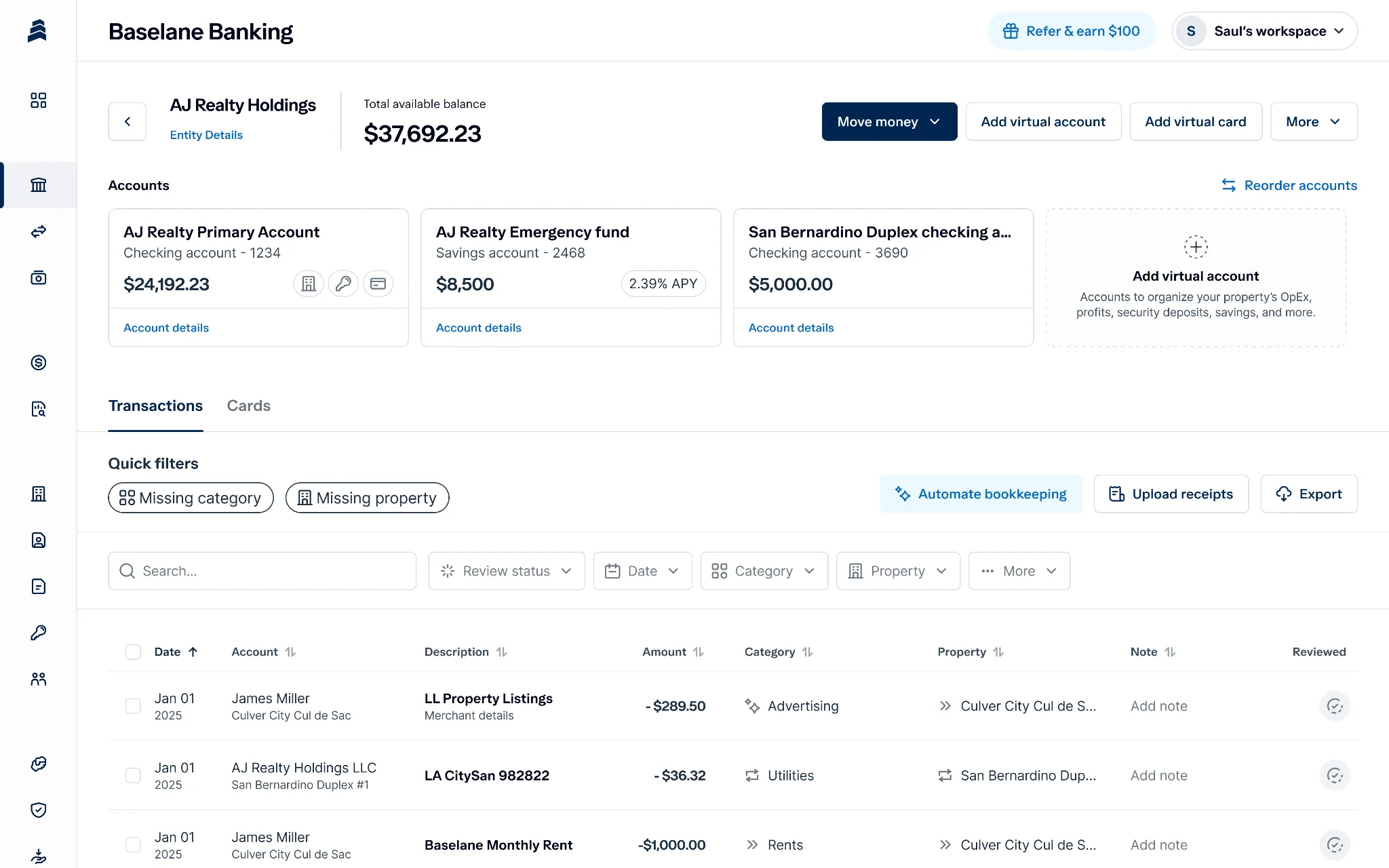
Important: Unlike QuickBooks, which often has connection issues with external banks, Baselane connects reliably with your external accounts and fetches transactions smoothly, making bookkeeping easy.
Automated bookkeeping for Schedule E reports and on-demand tax packages
QuickBooks demands time and effort to make sense of the report. Baselane doesn't. It automates the accounting side and keeps all your financial data organized in a way that reflects how you actually run your rentals. As every transaction is auto-categorized and tagged, you reduce errors and avoid surprises at tax time by having a clean, structured ledger from day one.
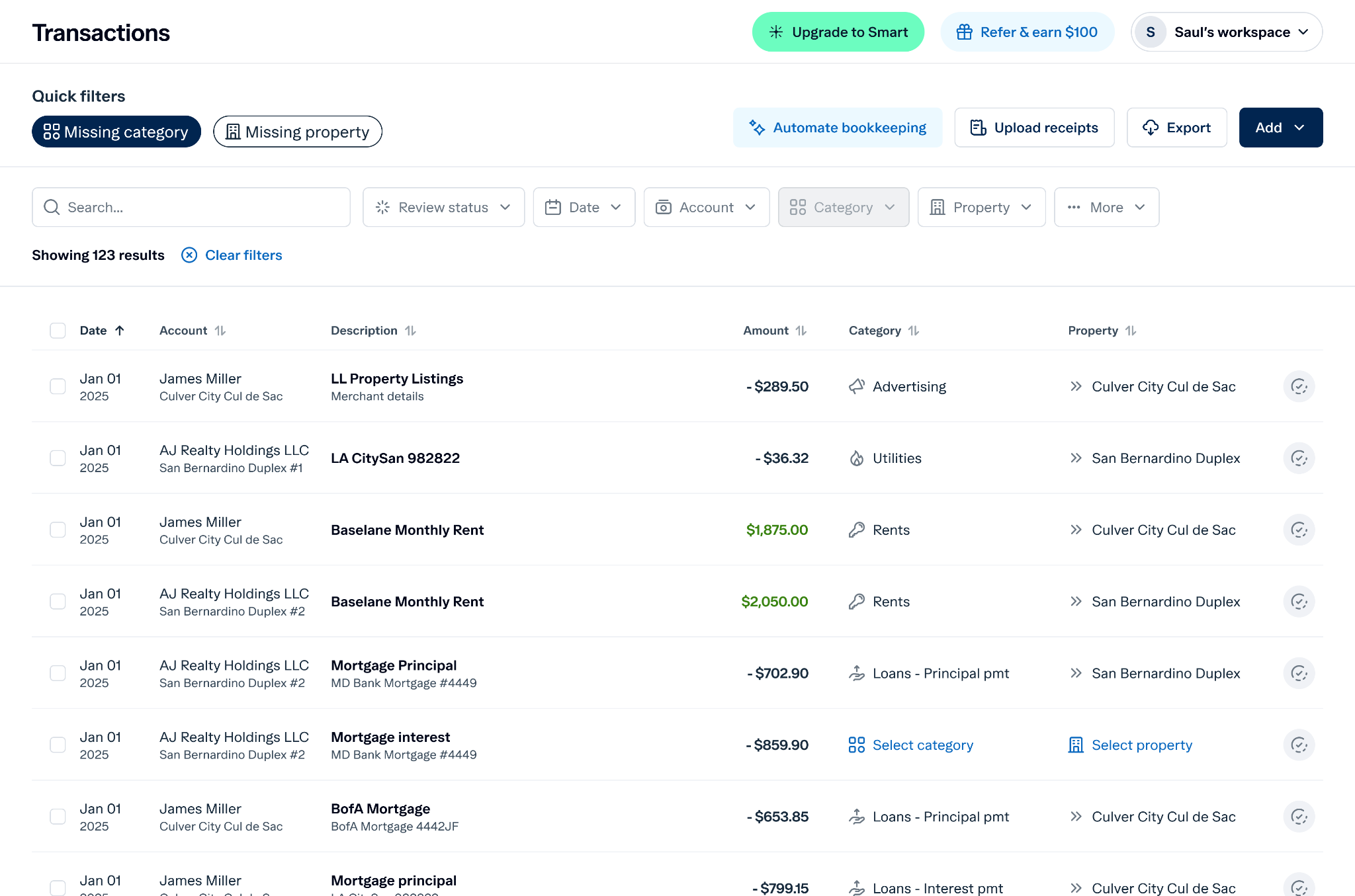
Every transaction is auto-tagged to a Schedule E category, which automatically creates a tax page at the end of the season that you can use to file taxes or share with your CPA.
Rent collection
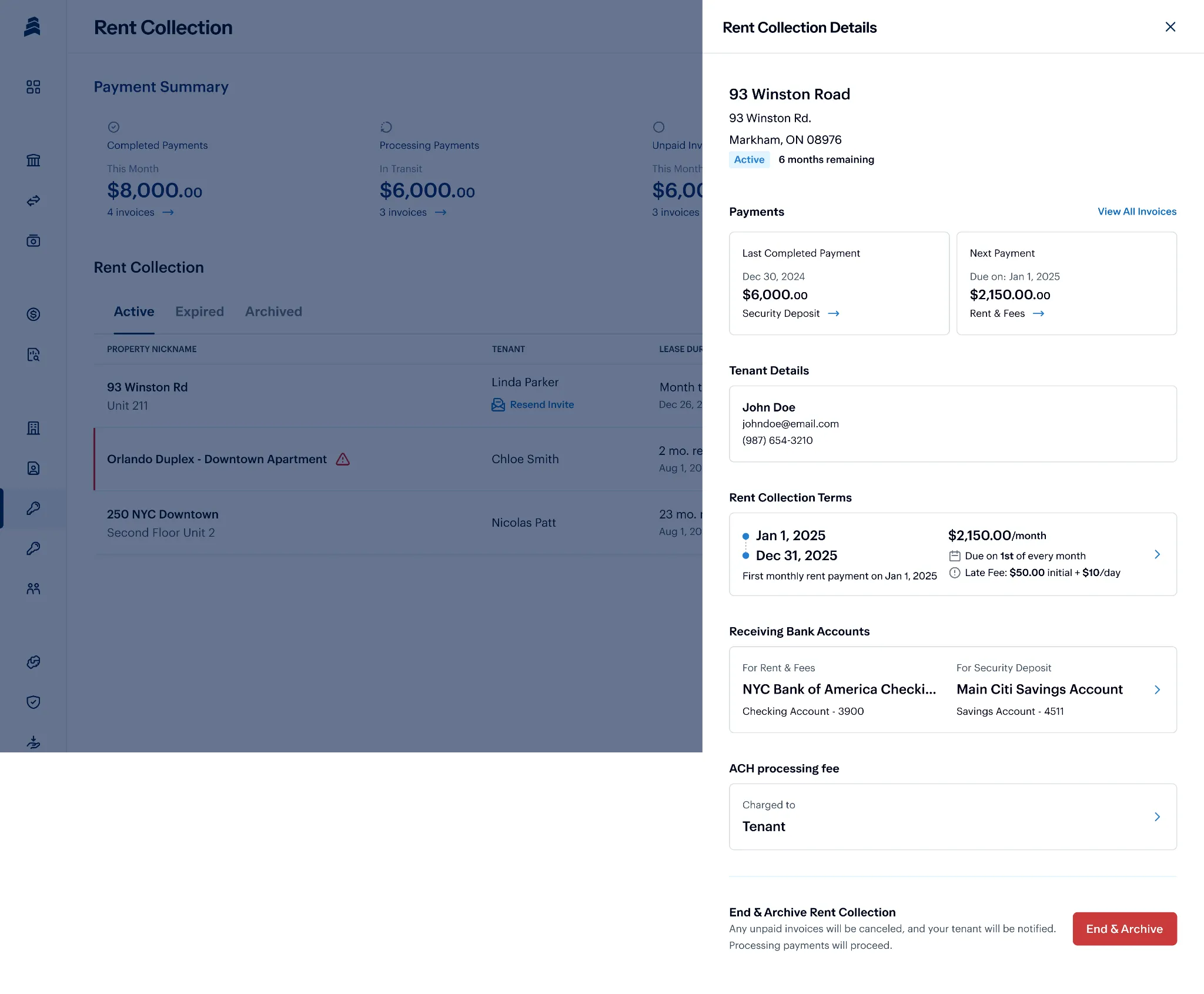
When you use QuickBooks, you need to find a workaround to track rental income and use rent payment software, which adds more costs to your budget. With Baselane, rent collection is built in and is free for you.
You create customer rent invoices for each tenant and rental unit, giving you flexibility to adjust payments. You can add security deposit amount, one-time upfront costs, late fee timeline, and much more.
Rent payments are flexible, too. You can collect via ACH, cards, or wire transfers and tag incoming payments to a specific unit or property, saving you time doing manual reconciliation.
Tenant and lease management
Baselane also shines over QuickBooks with its native tenant screening and lease creation tools. It makes tenant management intuitive and connected to your finances.
- Run screening checks—credit, background, income, and eviction — and store tenant information.
- Create state-specific lease and send to tenants for e-signing.
- Track move-ins, move-outs, and prorated rent without spreadsheets.
- Keep security deposits correctly accounted for, separate from income.
- View tenant information alongside property performance so you always know who owes what and when.

Real estate-specific reporting to analyze property performance
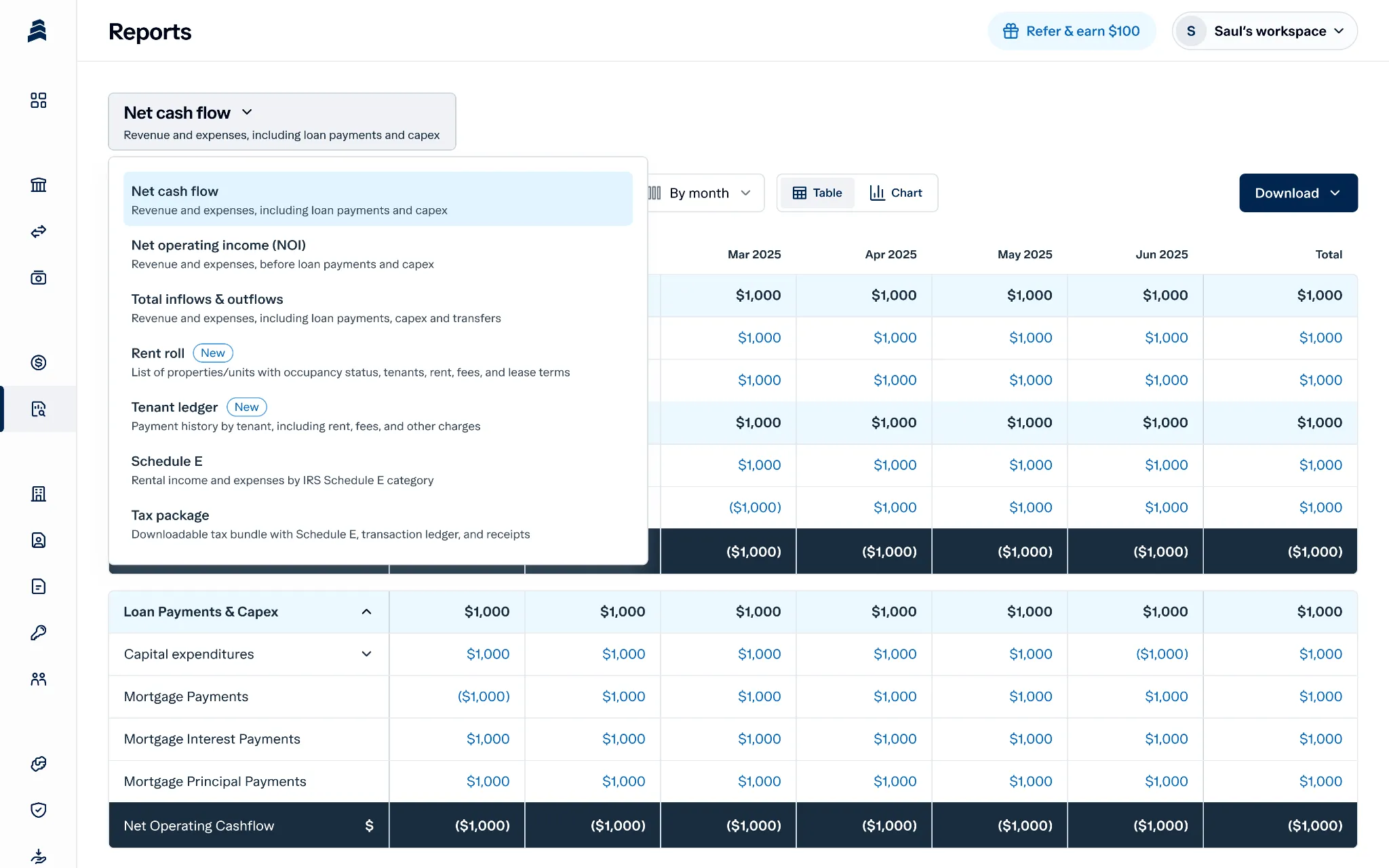
Instead of QuickBooks basic accounting reports, Baselane offers reporting tailored specifically to landlords and rental properties. Get on-demand financial reports at a property and portfolio level covering everything from income statements and net cash flow statements to profit and loss statements and capitalization rates. You can also create custom reports to drill down into the metrics that matter most.
Ready to take control of your rental property finances? Watch a free demo or Sign up for a Baselane account!
FAQs
Can I track multiple rental properties in QuickBooks?
Yes, you can track multiple properties in QuickBooks, but each property must be set up separately, and income and expenses are managed individually. This makes using QuickBooks for landlords time-consuming. Tools like Baselane make property-level tracking simple and tax-ready.
Is there a free version of QuickBooks for rental property owners?
No, QuickBooks does not have a fully free version. New users get a 30-day free trial, after which a subscription is required. In comparison, Baselane is free to use for landlords and property managers.
How much does QuickBooks for landlords cost?
Monthly fees for QuickBooks for real estate investors and landlords range from $17.50 to $235, depending on the plan (Simple Start, Essentials, Plus, or Advanced). Extra costs can come from add-ons or professional support, which can eat into your overall ROI. Use our rental ROI calculator to get true picture of your current returns on investment.
Is QuickBooks good for landlords?
If you’re transferring from a landlord bookkeeping spreadsheet to QuickBooks, QuickBooks for rental properties can work only if you have a very simple setup. But it lacks property-level reporting, tenant management, and Schedule E reporting. For landlords managing multiple units, Baselane is explicitly built to handle these workflows efficiently.
Which version of QuickBooks is best for rental property?
QuickBooks Online Plus is usually recommended for landlords because it allows multiple accounts and Classes/Locations. However, it still does not provide property-first accounting or built-in rent collection and tenant management like Baselane.
What are the best QuickBooks alternatives for landlords?
Baselane is the top QuickBooks alternative for landlords and real estate investors. It combines banking, bookkeeping, rent collection, and tax preparation, making it easier to track expenses, manage tenants, and prepare Schedule E reports.
Can QuickBooks Online for landlords handle tax preparation?
QuickBooks for small landlords generates reports for taxes, but QuickBooks for landlords and property managers does not automatically align with Schedule E categories. Baselane organizes transactions by property and tenant, making tax preparation faster and more accurate.

.webp)

.jpg)