


.webp)


Taxes are, no doubt, the biggest silent cost. Imagine tying up your cash for decades while waiting to deduct a property’s full value. That’s where cost segregation comes in. It’s a tax strategy that accelerates depreciation, reduces your current tax bill, and keeps more money working for you.
Whether you own a single-family rental, a short-term vacation property, or a commercial building, we’ll explain how cost segregation works, who benefits, and how to maximize your tax savings.
Key takeaways
- Cost segregation accelerates depreciation timing, not total deductions. Early-year deductions reduce taxable income and improve cash flow.
- A cost segregation study makes the strategy IRS-defensible by classifying building components and provides detailed depreciation schedules.
- Cost segregation identifies eligible assets; bonus depreciation rules determine how fast they can be written off.
- Timing and property type matter. Early studies, post-renovation, or higher-basis properties yield the biggest tax benefits.
- Work with a CPA and qualified cost seg studies provider to ensure compliance and optimize tax planning.
What is cost segregation?
Cost segregation is a tax strategy that lets you deduct the cost of a property faster by changing how its price is broken down for depreciation. It doesn't change the total amount you can deduct, just when you deduct it.
Standard tax rules depreciate residential rental property evenly over 27.5 years (or 39 years for commercial property). Cost segregation breaks a property into its individual components—such as flooring, lighting, plumbing, specialty electrical, cabinetry, and exterior site work—and assigns each component the depreciation life it actually qualifies for under IRS rules.
Instead of treating the building as one long-life asset, cost segregation identifies parts of the property that qualify as:
- 5-year property
- 7-year property
- 15-year property
These shorter-life assets are then depreciated on their own schedules rather than being lumped into the 27.5- or 39-year category.
Because not every part of a building wears out at the same rate, this reclassification allows you to recognize more depreciation on rental property in the early years of ownership.
Importantly, cost segregation does not increase total depreciation over the property's life. It changes when you take depreciation.
What is a cost segregation study?
Cost segregation is implemented through a cost segregation study, which is what makes the strategy compliant and defensible under IRS guidance.
A qualified firm conducts the study by combining its engineering analysis with tax expertise. The process involves:
- Reviewing construction documents, purchase records, and renovation data
- Analyzing the physical structure of the property
- Identifying and classifying building components based on IRS depreciation rules
- Allocating costs to each qualifying asset category
- Producing detailed reports and depreciation schedules for tax filing support
The study provides the documentation you need to reclassify depreciation and justify the asset reclassification in case of an audit. Without a proper study, accelerated depreciation claims are far more difficult to substantiate and may not withstand IRS scrutiny.
How cost segregation changes depreciation timelines
A cost segregation study reshapes your depreciation schedule by breaking a single long-life asset into multiple asset classes with different recovery periods.
After a study, depreciation is typically divided into the following categories:
- 5-year property: Personal property such as appliances, certain electrical wiring, plumbing serving specific equipment, carpeting, and some millwork.
- 7-year property: Certain fixtures or equipment with slightly longer useful lives, depending on property type.
- 15-year property: Land improvements and site work, including parking lots, sidewalks, fencing, landscaping, exterior lighting, and drainage systems.
- 27.5- or 39-year property: The structural core of the building, including foundation, walls, roof, structural framing, elevators, and central HVAC systems.
Here’s how depreciation works with and without a cost segregation study example:
Assume you purchase a rental property for $1,000,000 (excluding land).
Without cost segregation
- Entire $1,000,000 depreciated over 27.5 years
- Approximate annual depreciation: $36,000
With a cost segregation study
- $200,000 classified as a 5-year property
- $100,000 classified as a 15-year property
- $700,000 remains in the 27.5-year category
The total cost basis stays the same. The difference is that you recognize a larger portion of depreciation earlier in the ownership period, which increases rental property tax deductions and reduces taxable income sooner.
Bonus depreciation and how it amplifies cost segregation
Cost segregation and bonus depreciation are two separate tax strategies that often work together—but they serve different functions.
Cost segregation changes what depreciation bucket an asset is in.
Bonus depreciation changes how fast you can write off specific buckets under current law.
Bonus depreciation lets you expense certain qualifying short-life assets more quickly—sometimes even fully in the first year you place them in service—instead of depreciating them over 5, 7, or 15 years.
Rules change over time—phase-outs, eligibility requirements, and timing constraints matter, and assumptions based on outdated examples can lead to incorrect tax outcomes. For that reason, always treat bonus depreciation as a planning overlay, coordinated with a CPA, not as an automatic or guaranteed result of cost segregation.
The benefits of a cost segregation study
A cost segregation study delivers value in several distinct ways. Below are some of the common cost segregation study benefits:
Improved near-term cash flow
By front-loading depreciation into earlier years, a cost segregation study reduces your current-year taxable income. Lower tax liability means you get more cash available, which you otherwise would’ve paid in taxes. You can use this added liquidity to cover operating expenses, fund renovations or tenant improvements, pay down debt, or reinvest in additional properties.
Reduced taxable income during high-income periods
Cost segregation is particularly effective in years when taxable income is high. Accelerated depreciation deductions can offset rental income or other forms of ordinary income, helping you manage tax exposure during peak earning periods.
Also read: 6 ways to minimize rental property taxes
Better alignment with real estate economics
Cost segregation aligns depreciation with this reality by concentrating landlord tax deductions during the period when capital demands are greatest. Instead of distributing tax benefits thinly over decades, a cost segregation study front-loads depreciation to better match how real estate projects actually function in practice.
Greater flexibility in long-term tax planning
Cost segregation changes the timing of depreciation, giving you more control over tax planning across multiple years. You can coordinate studies with acquisitions or renovations, align depreciation schedules with refinancing or portfolio expansion, and integrate accelerated deductions into broader CPA-led tax strategies.
When to time cost segregation studies for maximum impact
Timing matters because the value of early tax write-offs shifts based on when you run the study.
- Year-one (new acquisitions): Doing a cost segregation study in the first year lets you capture the highest available bonus depreciation for the largest possible first-year deduction.
- Post-renovation: After a major capital improvement (such as a full system upgrade or a major tenant build-out), a new study can reclassify new components and allow partial asset dispositions on removed components to write off their remaining value.
- Before an exchange or sale: A cost seg study will tell you exactly how much your accumulated depreciation is and the potential tax liability, helping you structure your exit.
- Retroactive studies (existing properties): If you’ve purchased a property in the last few years or own an older rental property, a retroactive study pulls missed deductions into the current tax year without amending past returns.
Not every property delivers the same return from a cost segregation study. Prioritize where the early-year depreciation will have the largest impact using a rental property analysis spreadsheet. Generally, this includes properties with cost basis above $150K, renovation-heavy assets, and new acquisitions placed in service.
How cost segregation fits different investment strategies
Short-term investors (flip or ≤3-year hold)
For short-term investors, cost segregation is usually situational rather than standard.
The primary benefit is a strong early-year tax shelter. If an investor has unusually high ordinary income to offset right now—perhaps from other deals, business income, or a one-time liquidity event—accelerated depreciation can reduce near-term tax exposure.
However, the trade-off is significant.
Faster depreciation increases depreciation recapture when you sell the property, and with a short holding period, there’s limited time to enjoy the cash-flow benefit before that recapture event occurs. For many flippers or short-term value-add investors, the numbers simply don’t justify the added complexity.
Cost segregation in this window tends to make sense only when:
- Near-term tax needs are high
- The investor has a clearly modeled exit plan
- A 1031 exchange or similar strategy is part of the disposition plan
Mid-term investors (roughly 3–7 years)
Mid-term investors—commonly following value-add, BRRRR, or stabilization-and-refinance strategies—often sit in the sweet spot for cost segregation. This group typically holds properties long enough to benefit from several years of reduced tax liability, while still planning a defined exit.
Cost segregation is often most effective when coordinated with:
- Major renovations or capital improvements
- Repositioning or operational upgrades
- A clear sale or refinance timeline in the 3–7 year range
In these cases, breaking out rehab and CapEx costs into shorter-life depreciation buckets can significantly improve early-year returns, while still allowing you to plan for recapture well before exit.
Long-term investors (7+ years / buy-and-hold)
Long-term investors are the natural fit for cost segregation. If you own the property for a long time, speeding up the depreciation lets you save more money upfront, which significantly increases your total cash flow over the years. These investors also have far more flexibility in managing or deferring depreciation recapture.
For buy-and-hold owners, cost segregation often supports:
- Long-term cash-flow optimization
- Portfolio-level tax planning
- Strategic use of 1031 exchanges, refinances, or extended holds
The most common approach for this group is to conduct a study in the first year of ownership or immediately after a major repositioning, then integrate the resulting depreciation schedules into long-term planning with a CPA.
Because exit timing is less immediate, long-term investors can treat cost segregation as part of an ongoing strategy—not a one-off tax move.
Also read: Cost Segregation: The Ultimate Tax Strategy for Multi-Property Investors
How to conduct a cost segregation study
Conducting a cost segregation study isn’t something you “try out” on your own.
It’s a formal, engineering-based analysis that needs to hold up under IRS scrutiny, and thus, you need to work with a qualified cost segregation provider, which is also the first step.
Choose the right cost segregation provider
Because the provider sets the foundation for the entire study, this step matters more than anything.
When evaluating a cost segregation firm or team, look for the following:
- Uses IRS‑aligned methodology
- Team has both engineering/construction and tax/CPA expertise
- Holds American Society of Cost Segregation Professionals (ASCSP) certification
- Provides upfront projected tax benefit/payback analysis
- Has transparent, well‑defined pricing (what’s included/excluded)
- Written guarantee to defend findings during an audit
- Has strong references and a reputation for working with landlords/investors
- Comfortable with small to mid‑size properties
- Communicates technical findings in plain language
Provide property records
- Decide if it’s worth it: With your CPA, estimate whether the potential tax savings justify the cost and effort.
- Gather documents: Purchase/closing statements, construction or rehab invoices, rent roll if relevant, blueprints/plans, appraisals, prior depreciation schedules.
- Align expectations: Agree on scope, fee, timeline, and communication (who talks to your CPA, how you’ll review the final report).
The cost segregation study process
After onboarding with a provider, the study typically follows a structured workflow:
- Feasibility review: Quick analysis of the property and your tax situation to confirm it’s a good candidate.
- Site inspection: On‑site or virtual walkthrough, documenting systems, finishes, and site improvements.
- Asset breakdown: Slice the total property cost into buckets (land improvements, short‑life components, long‑life building) and assign each to the proper tax “life.”
- Calculations and report: Run the depreciation math, prepare schedules, and produce a detailed report you and your CPA can rely on for your return.
Implementation: Your CPA updates your depreciation schedules, files any needed forms (e.g., change in accounting method), and claims the accelerated deductions.
Own your time,
not just your properties
Make your finances work harder, so you don’t have to.


Tools to manage depreciation schedules
Once you get the report, that’s when the real work begins—managing depreciation afterward. Using software like Baselane to centralize depreciation schedules makes it easier to track depreciation and ensure consistent carry forwards. Here’s how it works:
- Enter the fixed assets identified in the study (e.g., appliances, flooring, plumbing).
- Assign custom depreciation schedules and methods matching the firm's findings.
- Enter the bonus amount and year to see the immediate year-one tax benefit reflected in your books.
- Track accumulated depreciation, book value, and remaining basis automatically for each asset without manual recalculations.
- Send tax-ready financials to your CPA, including updated depreciation schedules and asset-by-asset basis details.
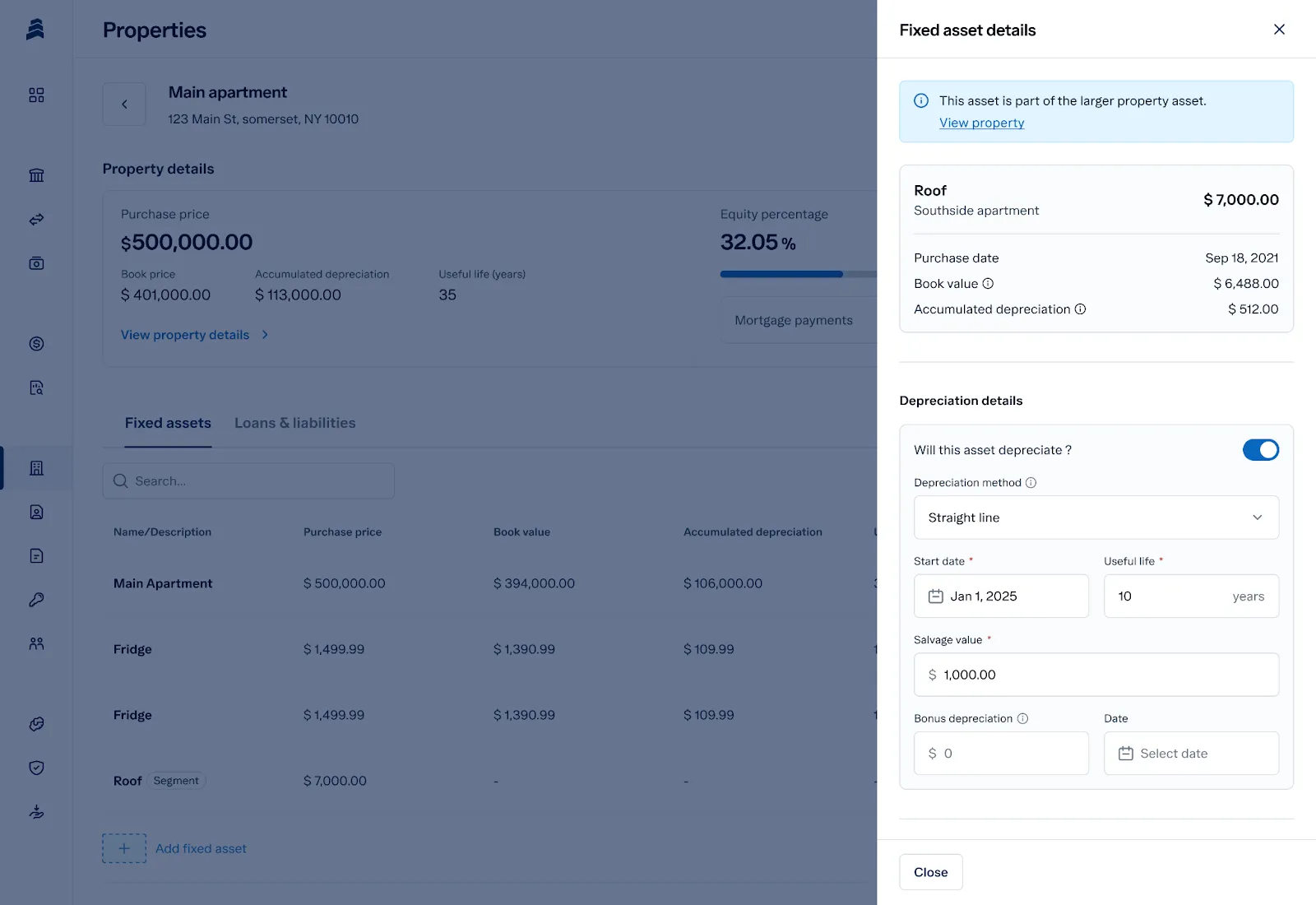
Instead of storing your cost seg report in a PDF or relying on fragmented spreadsheets, Baselane automates depreciation schedules across your portfolio. This is where you can really feel the operational lift.
FAQs
Is cost segregation legal?
Yes, cost segregation is legal. It is a standard tax strategy recognized and guided by the IRS. The IRS even publishes an Audit Techniques Guide (ATG) specifically for cost segregation to instruct examiners on how to review and validate these studies.
How much does a cost segregation study cost?
The cost segregation study pricing varies by property size and complexity. The average cost of a cost segregation study often falls into these ranges:
- Residential (Single-Family/Duplex): $2,500 – $4,500
- Commercial/Multifamily (Under $2M): $4,000 – $7,000
- Large Commercial: Custom quote.
Do I need a CPA for a real estate cost segregation study?
You do not need a CPA to perform the study, as it’s typically done by a specialist firm with engineering expertise. You need a CPA to interpret the cost segregation report and correctly apply the new depreciation schedules to your tax return (Form 1040 and Form 3115).
Is a cost segregation study worth it for single-family homes?
It depends on the value. Is cost segregation worth it for a $100,000 home? Likely not, as the study cost may outweigh the tax savings. However, for single-family homes purchased or renovated for over $200,000, the tax savings often exceed the cost of the study by a significant margin, especially if you plan to hold the property for several years.
Does a cost segregation study trigger an audit?
Filing a cost segregation study on residential rental property using Form 3115 generally won't trigger an audit. However, an aggressive, "DIY," or engineering-data-lacking study raises red flags. Using a reputable firm that follows the IRS Audit Techniques Guide minimizes this risk.
Can cost segregation offset W2 income?
For most long-term rental investors, no losses are passive. But, if you are a designated Real Estate Professional (REP) or if you invest in short-term rentals (like Airbnbs) and materially participate in their management, you can often use the depreciation benefits to offset active W-2 income.
.webp)
.jpg)


.jpg)


