


.webp)


Navigating the IRS rules for rental real estate can be complex, especially when determining whether your activity qualifies for the 20% QBI deduction under Section 199A.
The QBI Safe Harbor for rental property gives you an easy and clear framework to claim the deduction once you meet the set requirements. We’ll discuss Safe Harbor eligibility criteria, tips for meeting the requirements, and suggest tools to use.
Key takeaways
- Safe Harbor establishes bright-line rules to ensure your rental enterprise qualifies for QBI, removing guesswork and minimizing audit risk.
- OBBBA made the QBI deduction permanent and introduced a $400 minimum QBI deduction for eligible taxpayers in 2026, emphasizing the importance of long-term planning for rental portfolios.
- Safe Harbor rules apply at the enterprise level, not property-by-property
- Maintain separate books and records, perform at least 250 hours of qualifying rental services annually, keep contemporaneous records, and attach an annual statement election to the tax return.
- Properties such as personal residences, vacation homes, triple-net (NNN) leases, and self-rentals generally do not qualify for Safe Harbor.
Why does rental real estate need its own "Safe Harbor?"
The IRS never clearly defined when a rental activity counted as a trade or business. It means two portfolios could look nearly identical on paper, yet one could get fully approved for QBI while the other faced disallowed deductions or even audits.
This uncertainty created a gray area, leaving landlords in a constant state of caution. You could spend hundreds of hours managing tenants, repairs, and renovations across multiple doors and still wonder whether all that work actually qualified. The Safe Harbor was created to solve exactly that problem: it gives you a set of rules to follow so that your rental enterprise is treated as a trade or business for QBI purposes, removing guesswork and reducing audit risk
Section 199A permanence & 2026 updates (OBBBA)
Passed in July 2025, the One Big Beautiful Bill Act made the §199A deduction permanent, removing the sunset provision that had previously created uncertainty. While OBBBA didn’t change the mechanics of the Safe Harbor itself, it reinforces why you should care: with QBI here to stay, following Safe Harbor rules isn’t just about a single year—it’s about structuring your portfolio to maximize a permanent, predictable benefit.
OBBBA also introduced a minimum QBI deduction of $400 in 2026 for taxpayers with at least $1,000 of active QBI, and it updated the income phase-in ranges for inflation:
- Single filers: $50,000–$75,000
- Married filing jointly: $100,000–$150,000
These updates make the QBI real estate Safe Harbor strategy even more relevant for ensuring your rental activity qualifies as an active trade or business and for maximizing the deduction across your portfolio.
What is a rental real estate enterprise (RREE)
Rental real estate enterprise (RREE) is the “unit” the IRS uses inside the Safe Harbor rules to decide whether your rental activity is treated as a single trade or business for QBI purposes. It’s one of the most important terms you need to consider, as Safe Harbor requirements apply at the RREE level, not property-by-property.
For the Safe Harbor, a RREE is real estate you own to rent out. This can be one property or several properties grouped together. You can own it directly or through a single-member LLC or similar entity.
Residential and commercial rentals cannot be combined in the same rental real estate enterprise, so most portfolios end up with at least two RREEs if they own both types.
QBI Safe Harbor eligibility requirements
To qualify for the QBI Safe Harbor, your rental enterprise needs to meet four requirements.
1. Keep separate books and records
Your rental enterprise must maintain separate financial records that clearly track income, rental expenses, and deductions. This means you cannot commingle funds with personal accounts or other businesses. You must be able to generate a standalone P&L, cash flow, and net operating income statement for your RREE.
While it’s easy to maintain a separate book for a handful of properties, manually accounting for rental properties can lead to errors and jeopardize your qualification for the Safe Harbor.
One of the best ways to maintain separate books is to use dedicated accounting software for real estate management that helps you:
- Tag the income and operating expenses of the rental properties
- Separate operations for each building or grouping of properties
- Automate depreciation schedules and track CapEx vs. OpEx
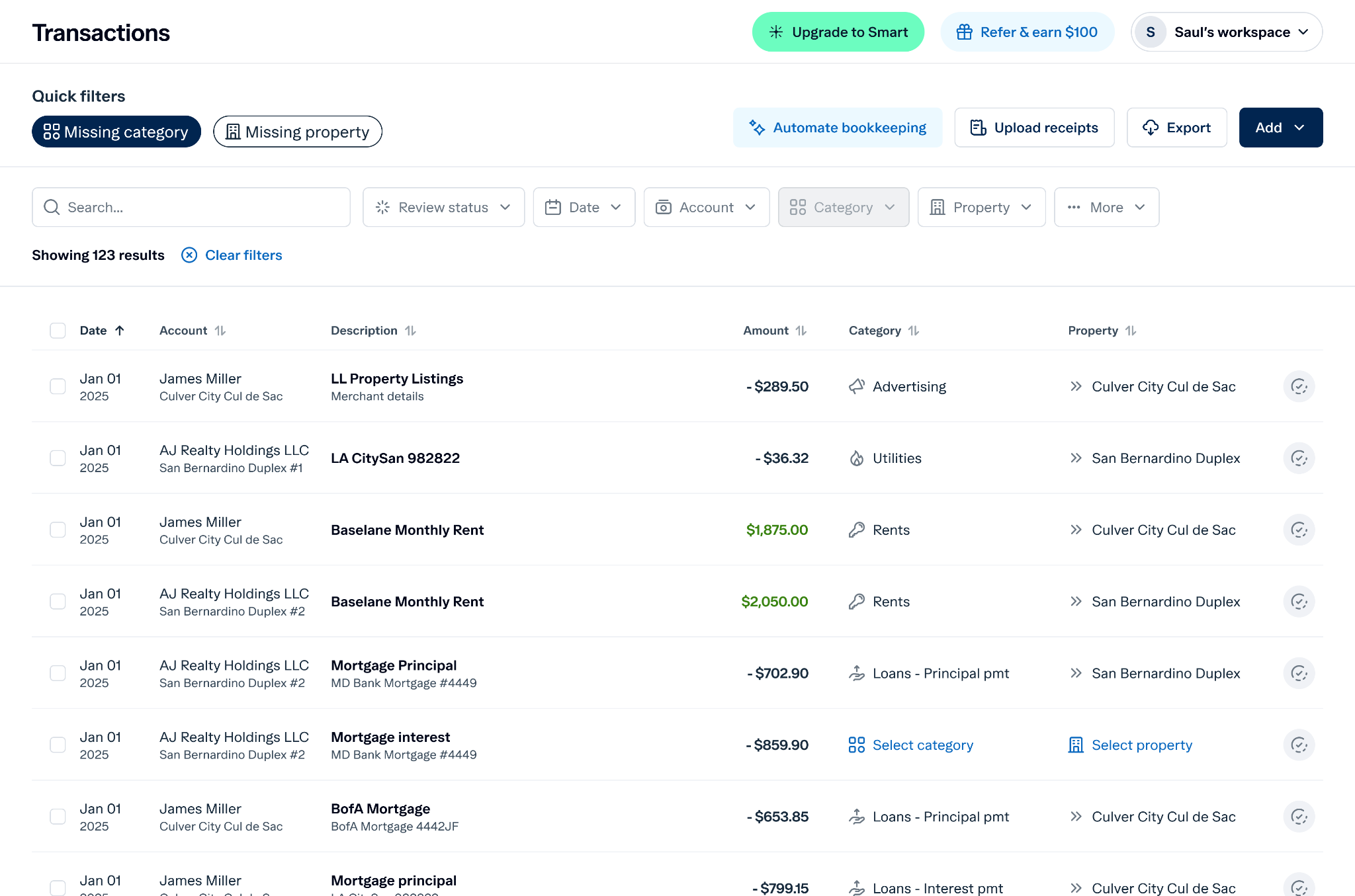
With Baselane, for example, you can create property-level accounts to keep funds organized and automate transaction tagging to the right property and category. It’s one of the easiest ways to maintain your books, generate reports on demand, and see property finances in real-time.
Own your time,
not just your properties
Make your finances work harder, so you don’t have to.


2. Perform at least 250 hours of rental services
To qualify, you need to spend at least 250 hours per year performing qualifying rental services. The good news is that these hours can include services conducted by you, your employees, contractors, or property managers—all count toward meeting this requirement.
Tips for meeting the 250-hour requirement:
- If you own several properties, you can group them as a single enterprise. For example, if you own 10 properties, you don’t need 250 hours per property. You only need 250 hours across all properties.
- Use software, calendars, or task management tools to log hours as they occur. Use our free time tracking sheet to log rental service hours
- If you use property managers, only documentable hours of your oversight and management count toward the total.
It is crucial to understand what counts toward this total. Services performed by owners, employees, and independent contractors all count toward the 250 hours.
3. Maintain contemporaneous records
The IRS requires you to document services as they occur—the hours, description of services, dates, and who performed the services—not recreating them at the end of the year. Here are some tips to meet this requirement:
- Keep detailed notes for each property or building
- Include dates, type of activity, and time spent
- Store invoices, receipts, and email records in a central system
Whether you're operating under a sole proprietorship or managing multiple entities, the right financial tools matter. Compare the best bookkeeping software for sole proprietors and dedicated accounting software for real estate to match your business structure.
4. Attach the annual statement election
To formally elect Safe Harbor treatment, you must attach a statement to your tax return each year, signed by the owner or representative. You can’t elect the Safe Harbor on an amended return unless you have a valid reason for the initial omission.
The statement must include:
- A description (including the address and rental category) of all rental real estate properties included in each RREE.
- A representation that the requirements regarding separate books and records, the 250-hour rule, and contemporaneous records have been met.
- A signature by the taxpayer (or an authorized representative) declaring under penalties of perjury that the statement is true.
Which properties are not eligible for the Safe Harbor
Not every rental property qualifies for the Safe Harbor.
- Personal residences and vacation homes
- Triple-net (NNN) leases, where tenants assume most obligations
- Self-rentals
- Activities overlapping with specified service trades or businesses
The IRS wants to support active, operational rental businesses, not purely passive or passive-income–oriented arrangements. In practice, long-term passive landlords or NNN investors often find the Safe Harbor unhelpful—a “mirage” that doesn’t reflect the reality of their portfolios.
Safe Harbor vs. Section 162 trade or business: Which path is right for you?
One of the most common questions is: Should I take the QBI Safe Harbor or rely on the general rules? The Safe Harbor is not mandatory; it is simply a guarantee. If you fail to meet the Safe Harbor (e.g., you only have 200 hours), you can still claim the QBI deduction if you can prove your rental activity rises to the level of a Section 162 trade or business.
Comparison table: Safe Harbor vs. Section 162
Real-world scenarios: Applying the QBI rental Safe Harbor
To visualize how these rules apply, consider these common investor scenarios:
Example 1: The Active single-family landlord
Sarah owns two rental homes. She manages them herself, handling tenant calls, repairs, and leasing. She spends 5 hours a week on average managing the properties, totaling 260 hours per year. She keeps a detailed log of her activities and maintains separate bank accounts for her rentals.
Verdict: Sarah qualifies for the Safe Harbor by aggregating her two properties into one RREE.
Example 2: The portfolio investor
Mark owns 10 properties managed by a third-party property management company. He spends very little time personally working on the rentals. However, the management company spends over 1,000 hours annually maintaining and leasing the units.
Verdict: Mark qualifies. The hours his "agents" (the property managers) perform count toward the 250-hour requirement. He needs to obtain detailed reports from the management company to satisfy the contemporaneous records rule.
Example 3: The triple-net lease
Lisa owns a commercial building leased to a pharmacy on a triple-net basis. The tenant pays for everything. Lisa spends zero hours on maintenance.
Verdict: Lisa does not qualify for the Safe Harbor. Unless she qualifies under Section 162 (unlikely due to lack of activity), she cannot claim the QBI deduction on this income.
Make your rentals work for you
With Safe Harbor rules in place, you can turn your rental activity into real, predictable tax benefits. Baselane helps you maintain property-level accounts, manage properties, and keep books organized—so qualifying for QBI is simple, automated, and stress-free. Open your account today!
FAQs
Do I qualify for the QBI Safe Harbor?
You qualify for real estate QBI Safe Harbor if you meet three main criteria: you maintain separate books for your enterprise, perform 250 hours of qualifying services annually, and keep contemporaneous records of these hours. You must also attach a signed statement to your tax return that elects the Safe Harbor.
What actually counts as ‘rental services’ toward the 250 hours?
Rental services include activities you, your employees, contractors, or property managers perform to operate your rental enterprise. It includes advertising and marketing, negotiating and executing leases, rent collection, daily operations, maintenance, and managing the property or supervising staff/contractors.
Should I take the QBI Safe Harbor?
Yes, if you meet the requirements, taking the QBI rental real estate Safe Harbor is generally recommended because it provides certainty that the IRS will treat your rental activity as a business eligible for the 20% deduction. Without it, you rely on subjective "facts and circumstances" rules, which carry a higher risk of audit and denial of the deduction.
Can a 1031 house be a safe harbor QBI?
Yes, a replacement property acquired via a 1031 exchange can be part of a QBI Safe Harbor enterprise. You generally carry over the attributes of the old property, but you must ensure the new property (or the aggregated enterprise it belongs to) meets the 250-hour and separate books tests.
What if I don't meet the 250-hour requirement?
If you fail the 250-hour test, you do not qualify for the QBI rental property Safe Harbor, but you are not automatically disqualified from the QBI deduction. You can still claim the deduction if your rental activities qualify as a Section 162 "trade or business" based on the regularity, continuity, and extent of your involvement, though this requires stronger proof during an audit.
Can I change my Rental Real Estate Enterprise (RREE) grouping?
Generally, once you treat properties as a single aggregated enterprise, you must continue to do so in future years unless there is a significant change in facts and circumstances. However, you can add newly acquired properties to an existing enterprise.


.webp)


.webp)


