


.webp)


Managing money for a homeowner association (HOA) isn’t like running a small business or handling personal finances. HOA funds belong to all homeowners collectively, and board members have a fiduciary duty to protect, document, and properly manage those funds.
That’s why HOA bank services exist—and why choosing the wrong bank or account structure can create serious legal, financial, and trust issues.
This guide explains how HOA banking actually works, what services matter most, how to open accounts correctly, and how to choose the best bank or banking platform for your association.
Key takeaways
- Unlike personal or business accounts, homeowner association banking funds belong to all homeowners collectively, and boards have a fiduciary duty to protect, track, and manage them.
- HOAs should maintain at least an operating account for day-to-day expenses and a reserve account for long-term projects, keeping funds distinct to ensure transparency and compliance.
- Multiple signers, limited access for property managers, and read-only access for auditors help prevent misuse while maintaining oversight.
- Baselane offers integrated banking, payments, and reporting, making it easier to manage funds, whereas traditional HOA-focused banks (Alliance Association Bank, First Citizens, Cadence) offer specialized services for larger or professionally managed communities.
Why is HOA banking different from regular banking
HOA banking differs from traditional banking in who owns and controls the money. The homeowners collectively own HOA funds; the board only manages them. This structure changes how HOAs set up bank accounts, grant access, and approve transactions.
Generic bank accounts typically serve a single owner or a small group. HOAs need systems that support rotating leadership, shared authority, and long-term continuity. Board members and management companies change. The money must stay protected no matter who holds office.
Because of this, many mainstream banks reject HOA applications or offer accounts that lack necessary safeguards. When a bank treats an HOA like a standard business, associations miss crucial controls like dual approvals, restricted reserve access, or clear audit trails.
The two core bank accounts every HOA should have
At the heart of HOA banking is the separation between operating funds and reserve funds. This is not a nice-to-have but critical in fiduciary responsibility.
The operating account (for day-to-day cash flow)
The operating account is your community’s checking account, from which you pay routine expenses. Utilities, landscaping, insurance premiums, and day-to-day administrative costs all flow through this account. Because it is used frequently, it requires strong oversight. Without clear approval processes and visibility into transactions, operating accounts become the most common source of misuse or error.
The reserve fund account (for future projects)
Homeowner association reserve fund account holds funds that are collected over time to pay for major repairs and long-term projects—roof replacements, resurfacing, structural work, and other capital expenses that protect property values.
Reserve funds are not meant to be touched casually, and they should never be used to cover short-term operating shortfalls. Mixing reserve money with operating cash blurs accountability and can violate governing documents or state requirements. This account should offer high interest while maintaining necessary liquidity.
Keeping these accounts separate protects both the association and the board members who oversee it. It ensures that long-term funds remain available when needed and that financial reporting remains clear and defensible.
Expert Tip: If your holding reserves exceed the standard $250,000 FDIC insurance limit, look for banks that offer Insured Cash Sweep (ICS) or Certificate of Deposit Account Registry Service (CDARS). These services automatically spread large deposits across a network of banks, granting access to multi-million-dollar FDIC protection while simplifying management.
Who should have access to HOA bank accounts
No single person controls the HOA’s money. Instead, access is shared among a few key roles:
- Treasurer (Board officer): Oversees day-to-day transactions and reconciles accounts.
- President (Board officer): Co-signs major payments and ensures board approval for large expenses.
- Property manager: Handles routine payments, vendor invoices, and dues collection—but cannot move funds without board oversight.
- Accountant/auditor: Has read-only access to review transactions and confirm compliance.
Reserve accounts, in particular, need stricter protection than the operating account. These funds are for long-term projects like roof replacements or major repairs, so access should be limited, and withdrawals must have formal board approval to ensure the money is available when it’s genuinely needed.
How to open an HOA bank account (step-by-step)
Opening an HOA bank account mostly comes down to choosing the right bank, proving the HOA is a legal entity, and documenting who is allowed to handle the money. The process is similar to opening a business account, but with a few HOA-specific steps.
Step 1: Confirm authority and account purpose
The board should formally approve opening the account and define its use. Typical purposes are an operating account for day-to-day expenses and a reserve account for long‑term projects.
- Check your governing documents (CC&Rs, bylaws, or condo trust) for any requirements on where funds must be held, how many signatures are needed, and who can be a signer.
- Record a board resolution authorizing the new account, naming the bank, account types (operating, reserve), and listing authorized signers by title and name.
Step 2: Choose the right HOA banking partner
Not all banks understand HOA needs, so evaluate a few that explicitly advertise HOA or community‑association banking. When choosing a bank, look for low or no monthly HOA fees, strong online banking, ACH capability for dues, dual‑signature or approval controls, and clear statements and reporting.
Ask whether they can set different permission levels (e.g., “view only” for some board members, full transaction rights for treasurer/president) and whether they support things like remote deposit capture and owner online payments.
Step 3: Gather required documents
Banks treat HOAs like business entities and will require proof that the association exists and who is authorized to act for it. Typical documents include:
- HOA’s EIN (federal tax ID) letter from the IRS.
- Articles of Incorporation or organizing documents and a recorded declaration/condo trust showing the association’s creation.
- Bylaws or trust agreement listing the board or trustees and their powers.
- Board meeting minutes or resolution authorizing the account and designating signers.
- Each signer will usually need a government‑issued photo ID and, sometimes, proof that they own a unit if required by the bank.
Step 4: Decide who will be signers and users
Plan who can sign checks, approve transactions, and view the account.
- Common best practice is to have at least two board officers (often president and treasurer) as signers, plus a management‑company representative if you use one.
- For security, many associations require two signatures or two approvals for withdrawals or payments over a certain dollar amount.
Step 5: Schedule the account opening
Once documents and decisions are ready, schedule a meeting with the bank so all authorized signers can appear as required. Bring all entity documents, ID for each signer, and your completed resolutions or minutes.
At the appointment, specify: account names (e.g., “[Community Name] HOA Operating” and “[Community Name] HOA Reserves”), signer rules (dual signature thresholds), and any online banking and ACH options you want enabled.
Step 6: Fund and configure the accounts
After the bank opens the accounts, deposit initial funds, and set up day‑to‑day tools.
- Make your initial deposit (e.g., existing HOA funds from a prior account or startup contributions) and confirm account and routing numbers.
- Set up online banking, user logins and permissions, e‑statements, and any services such as ACH dues, remote deposit capture, and bill pay to vendors.
Step 7: Maintain separation and controls
Once open, treat the HOA account like a business account with strict segregation and oversight.
- Never commingle HOA funds with personal or board‑member accounts; all dues and expenses must run through the HOA’s own accounts.
- Keep regular reconciliations, board review of statements, and documented approval processes for larger expenditures to support audits and transparency with owners.
For associations managing shared funds, comparing the best HOA high-yield savings account options and the best HOA accounting and bookkeeping software can make a meaningful difference in transparency and financial control.
Best banks and banking platforms for HOAs
Here is a look at the best banks for HOA, along with leading banking platforms built to handle community association finances:
1. Baselane
Baselane is a banking and bookkeeping platform for real estate investors and landlords. For HOAs, Baselane works well because it helps boards separate operating and reserve accounts, control who can approve payments, and maintain clear records for homeowners and auditors. In short, it’s built to make HOA banking safer, clearer, and easier to manage.
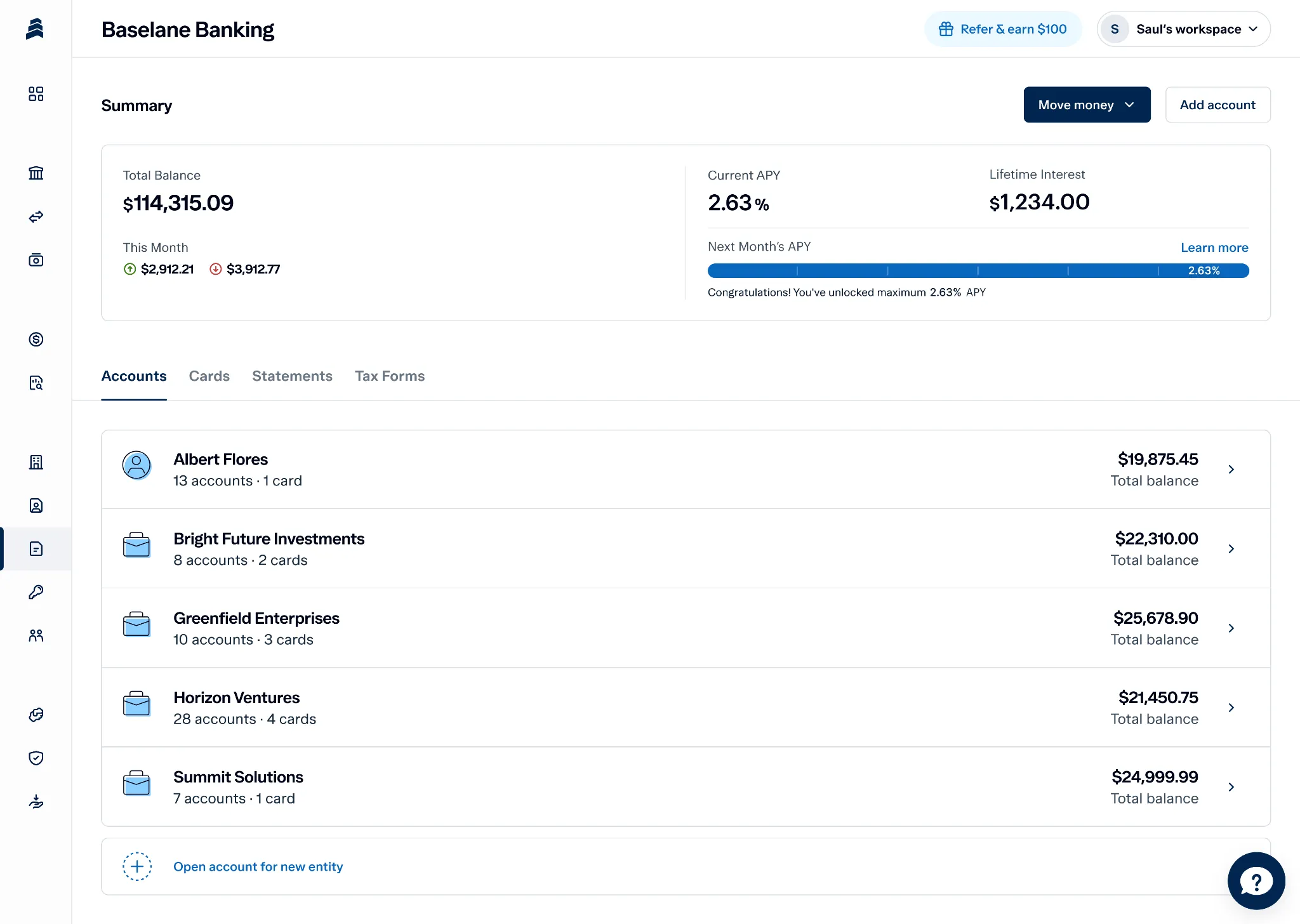
Baselane key features
- Integrated banking: Keep day-to-day cash and long-term funds in separate dedicated accounts, so boards don’t have to worry about mixing money.
- Multiple approvers for payments: Set up workflows so large payments require more than one board member’s approval, reducing risk.
- Online dues collection and automated tracking: Pay payment dues electronically and let our automated bookkeeping track who paid and when.
- Shared access: Invite an accountant, auditor, or an external reviewer to see transactions without the ability to move money, keeping oversight secure and straightforward.
- Real-time reporting and exportable statements: Generate clear financial reports anytime, and make audits and board meetings easier to manage.
Our banking platform charges no monthly fees and has no minimum balance requirements for its core accounts, ensuring the community retains as much of its funds as possible for its operations.
Own your time,
not just your properties
Make your finances work harder, so you don’t have to.


2. Alliance Association Bank (Western Alliance Bank)
Alliance Association Bank (AAB) is widely recognized and highly specialized in the community association industry, often catering to large-scale properties and management firms. It also offers ICS and CDARS for multi-million-dollar FDIC insurance access.
AAB key features
- Automated reconciliation: The Lockbox service provides daily payment and remittance information that you can integrate with your HOA's accounting software.
- Fraud prevention via positive pay: An automated fraud solution that compares presented checks against the list your team issued, preventing unauthorized payments from clearing.
- Online and mobile access: You can access free online banking services for secure cash management anytime, anywhere, including transfers, account inquiries, and mobile banking.
3. First Citizens Bank: Community Association Banking (CAB)
First Citizens Bank offers an extensive Community Association Banking (CAB) division, providing comprehensive deposit and lending solutions, including loans specifically for HOA capital projects. They also facilitate multi-million-dollar FDIC protection using ICS/CDARS.
First Citizen Bank offers robust technology to automate the process of due collection and vendor payment.
First Citizens Bank key features
- Property pay: A secure online payment system that makes it easy for HOA members to pay assessments and amenity fees (like for pool keys or parking passes) using a card or eCheck.
- Lockbox services: Help outsource the paper check collection and processing through high-speed lockbox services.
- Integration: Their First Citizens API connects the bank’s data directly with your community association management software, reducing manual data entry and streamlining reconciliation in one system
4. Cadence Bank: Association services
Cadence Bank provides hands-on support with a dedicated team of association specialists alongside a full range of banking services. Like most banks, they also offer a full range of association-specific accounts, including Association Checking, Money Market Accounts, and Certificates of Deposit (CDs).
Cadence Bank key features
- Insurance access: Offers CDARS and ICS, allowing you to secure multi-million-dollar FDIC insurance coverage through a single bank relationship for large reserve funds.
- Treasury management: They help streamline the collection of homeowner dues and other incoming payments by offering online payment access, ACH, and ExpressDeposit.
- Dedicated association lending solutions: Help you fund major capital projects like roof repairs, paving projects, or plumbing, without depleting reserves.
Choose the right HOA banking partner
Selecting the right financial institution or platform is one of the most important decisions you can make to simplify your HOA finances. It also directly impacts your community's transparency, reserve health, and compliance for years to come.
The ideal partner for your HOA is the one that minimizes manual work, maximizes reserve growth, and integrates seamlessly with your existing reporting needs.
- If your priority is high-volume check processing and a relationship with a large, traditional bank that specializes in HOA lending, consider Alliance Association Bank or First Citizens Bank.
- If your community’s priority is maximizing reserve earnings and simplifying the financial workflow with an integrated tool that offers unparalleled fund separation, an innovative digital platform like Baselane is the clear choice.
Open an account today with Baselane and explore its HOA-specific features to empower your community's financial future.
FAQs
What types of bank accounts do HOAs typically need?
HOAs usually need at least two types of dedicated bank accounts: an operating account for daily income and expenses, and a reserve account to save for future major repairs and replacements. Some may also use money market accounts or CDs for reserves.
What documents are required to open an HOA bank account?
You will generally need the HOA's EIN, Articles of Incorporation or organizing documents, HOA Bylaws, minutes from the board meeting authorizing the account, and identification for the authorized signers.
Who has access to the HOA bank account?
Authorized signers designated by board resolution; property managers typically receive initiate or view-only permissions; auditors receive read-only. Implement positive pay and ACH filters to prevent unauthorized transactions.
What’s the best way to hold large HOA reserves?
Combine a high-yield online savings account for near-term liquidity with a CD ladder (30–60 months) for planned projects; use ICS/CDARS to extend FDIC coverage while managing funds through one bank. Learn how to get a high-yield savings account for your HOA.
What is the best bank account for an HOA?
The best HOA bank offers fee-free bank accounts, high-yield reserves, free online payments, sub-accounts, and tools like positive pay, remote deposit capture, and QuickBooks integrations. HOAs should also check if the bank supports ICS/CDARS for FDIC insurance expansion. Read our guides on how to maximize return by avoiding bank fees.
How do you set up an HOA bank account correctly?
To set up a homeowner association bank account, create two accounts—operating and reserve—then enable online banking, positive pay, ACH filters, and automated bill payment tools for HOA fees due. Many HOAs also add a high-yield savings account or CD ladder for long-term reserves.
Are HOA funds protected by FDIC insurance?
Yes, funds deposited in FDIC-insured banks are protected up to standard limits. For larger reserve balances, services like ICS/CDARS can extend coverage by distributing funds across multiple banks.
.jpg)




.jpg)


