


Every miscategorized transaction across your portfolio is a deduction left on the table — or worse, an audit trigger. For sole proprietors juggling taxes across multiple properties and entities, the margin for error shrinks as the portfolio grows. The best tax software for sole proprietor investors automates year-round bookkeeping, maps transactions to Schedule E categories, and gives you a real-time view of your tax position so you can plan ahead instead of scrambling in April.
Key takeaways
- Specialized software reduces the error rate common in manual spreadsheets (research suggests up to 88% of spreadsheets contain errors), protecting you from IRS scrutiny.
- The best tax preparation starts with year-round automated bookkeeping, not a filing tool used once a year.
- Top-tier platforms automatically tag transactions with Schedule E categories, replacing hours of manual data entry with accurate categorization.
- Look for SOC 2 compliance and end-to-end encryption to keep your financial data secure and audit-ready.
- The deductions captured and penalties avoided by using dedicated software far outweigh the subscription cost — and the software itself is a deductible expense.
What is sole proprietor tax software for real estate investors?
Sole proprietor tax software for handling the nuances of passive rental income reported on Schedule E. Unlike general small business tools that focus on Schedule C (active business income), these platforms are designed for the tax complexity of sole proprietorship real estate operations, including self-employment tax exposure and unlimited personal liability.
Effective tax software for sole proprietor landlords acts as a centralized hub for financial data. It integrates directly with your bank accounts to track income and expenses in real time, ensuring every transaction is captured and categorized correctly.
If you’re evaluating whether a sole proprietorship vs llc for rental property structure is the right fit, these tools provide a clear digital boundary around rental finances. By automating the flow of data from your bank to your tax forms, you gain clarity on your true Net Operating Income (NOI) and ensure accurate reporting for sole proprietorship taxes.
Why sole proprietor investors need dedicated tax and accounting software
While spreadsheets save money initially, they lead to errors as your portfolio grows. This can result in missed deductions, inaccurate depreciation, and manual work, potentially causing you to underreport income or miss out on thousands in valid deductions. Dedicated software mitigates these risks by automating a chunk of bookkeeping and helps you become tax-ready.
Help you maximize tax deductions
The biggest benefit of using tax software is that it helps you maximize your rental property tax deductions and landlord tax deductions. Software ensures you capture every valid expense — from small hardware store runs to major repairs — directly impacting your taxable income.
Helps you capture depreciation accurately and track QBI
Specialized software helps track the cost basis of your property and improvements, ensuring you calculate depreciation on rental property correctly. It also helps you categorize transactions as capital expenses vs. operating expenses, a critical distinction for the IRS.
If you plan to claim a pass-through tax deduction, also known as the QBI deduction for rental property, you need separate books and a real-time record of your finances. Tax software can help you maintain such records and qualify for the QBI safe harbor rental property provision.
Helps you plan your future finances
Dedicated software helps you prepare for potential depreciation recapture tax liabilities if you sell your property after commissioning a cost segregation study. With a clear financial picture year-round, you can engage in proactive tax planning for your sole proprietorship rather than reactive damage control. It’s also helpful to understand bonus depreciation to build a strong foundation in tax strategies.
Helps you reduce costs and boost ROI
The ROI of sole proprietor tax preparation software is often immediate. A single missed $500 deduction costs roughly $120–$150 in unnecessary taxes, depending on your bracket. If the software costs $150 per year but saves you 10 hours of manual data entry and identifies $1,000 in additional deductions, it pays for itself multiple times over. The cost of the software itself is also a tax-deductible business expense.
Key features to look for in a sole proprietor tax software
When evaluating the best sole proprietorship tax software for multiple properties and LLCs, consider whether it is built for your specific workflow.
Automated transaction import and Schedule E categorization
Top platforms integrate directly with your bank accounts to import transactions automatically. More importantly, they should offer auto-categorization based on IRS Schedule E lines (e.g., repairs, management fees, mortgage interest). Baselane uses AI bookkeeping with 120+ categories to ensure granular accuracy for tax time.
Tax-ready reports
Your software must generate more than a generic cash flow statement. Look for one-click generation of NOI reports, Schedule E drafts, and depreciation schedules. These reports should be exportable in formats your CPA can work with directly, reducing the billable hours they spend organizing your data.
Receipt and document management
The IRS requires proof for every deduction claimed. Check if the platform includes a mobile app for capturing receipts on the go and attaching that receipt to the corresponding transaction, creating a permanent, organized record that withstands scrutiny.
Estimated tax payment support
The best tax preparation software for sole proprietor investors is the one that serves as an accounting software for sole proprietor estimates quarterly taxes, calculate obligations based on your actual net income, and help you avoid underpayment penalties.
Multi-property and multi-entity tracking
Even if you operate as a sole proprietor now, your portfolio may evolve. The software should handle multiple properties and potentially different legal entities (like LLCs) under one login, without forcing you to pay for separate subscriptions per unit. Look for sole proprietor accounting software that scales with your operations.
Download our free tax preparation checklist for rental property to identify all eligible deductions for your portfolio and stay organized year-round.
Best tax platforms for sole proprietor investors in 2026
Choosing the right platform depends on your portfolio complexity and how hands-on you want to be with bookkeeping. Here are the top contenders for 2026.
Baselane
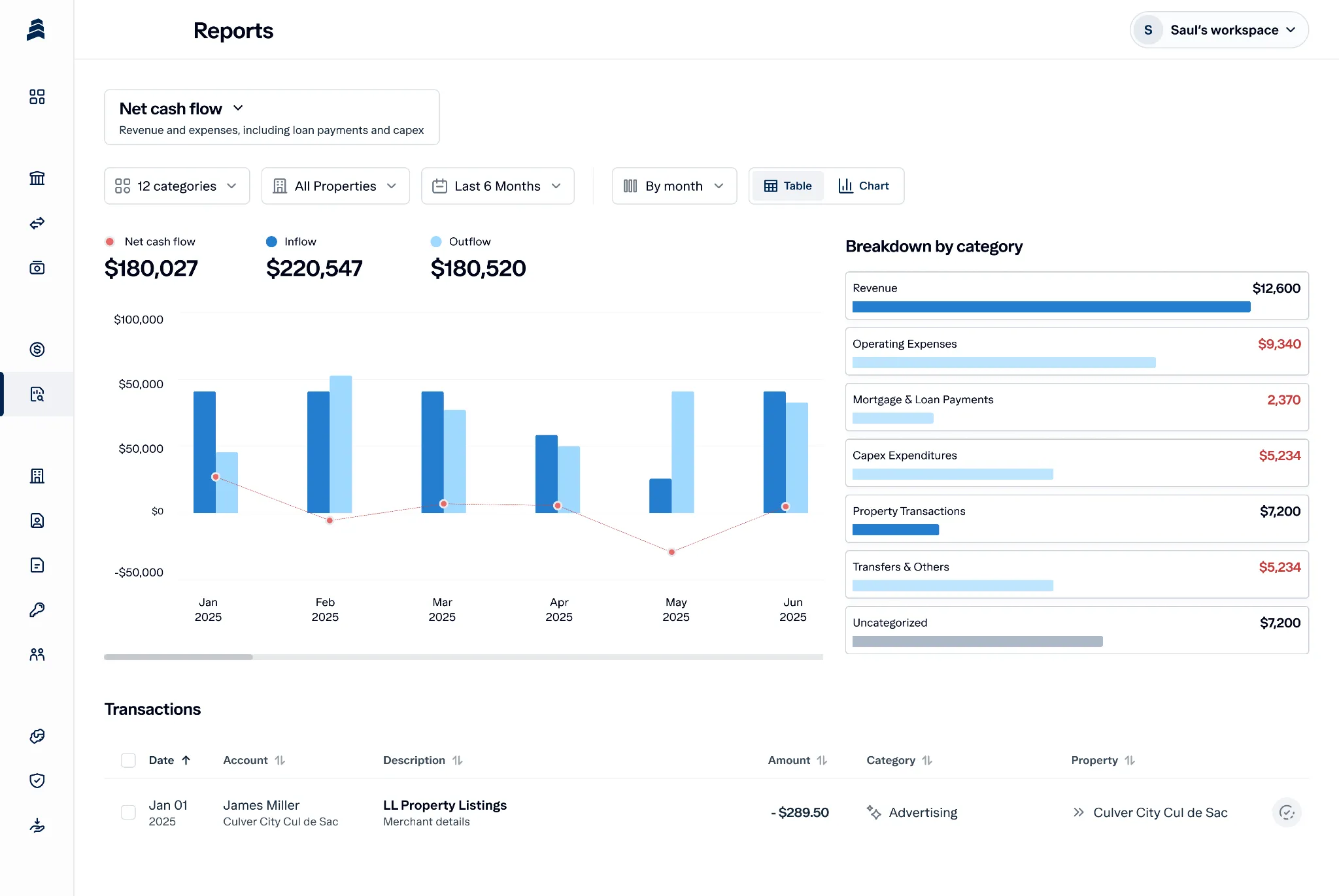
Baselane is an integrated banking platform multi unir property owners and real estate investors, combining banking, rent collection, and automated bookkeeping under one login. By housing your funds and books on the same platform, you eliminate commingling risk at the source — a critical advantage for sole proprietors who need clean property or unit-level separation.
Key features
- AI-driven transaction categorization with 120+ Schedule E categories;
- Downloadable tax package with Schedule E reports and transaction ledgers.
- Unlimited property-specific checking and savings accounts for entity and purpose-based fund segregation.
- Consolidated ledger that syncs banking, rent collection, and external accounts for real-time financial visibility.
Pricing
- Baselane Core: $0/mo with access to banking, bookkeeping, and reporting with no monthly account fees or minimum balance.
- Baselane Smart: $20/mo with access to advanced auto-tagging rules, 2-day rent deposits, shared access, and auto-receipt matching.
During tax season, Baselane’s bookkeeping literally saved me hours. I used to scramble to gather receipts and transaction records from different places — now it’s just a couple clicks and I’m done. ~ LeRoy Blaschko, 30+ properties
Own your time,
not just your properties
Make your finances work harder, so you don’t have to.


Stessa
Stessa is a popular choice for investors focused on asset performance tracking and reporting. It offers robust features for tracking properties and generating tax-ready financial reports, though it lacks integrated banking, requiring external bank connections that can sometimes lag or disconnect.
Key features
- Schedule E-ready financial reporting and property performance dashboards
- Bank and credit card import for automated transaction tracking
- Portfolio-level NOI and cash flow analysis
Pricing
Free core; paid plan starts at $12/mo
Landlord Studio
Landlord Studio takes a mobile-first approach, making it well-suited for investors who handle property operations on the go. It excels at receipt digitization and mileage tracking. However, reporting capabilities can be limited on the free tier, and costs scale with the number of units.
Key features
- SmartScan receipt capture with auto-categorization
- Mileage tracking for deductible property visits
- Schedule E and profit-and-loss report generation
Pricing
Free plan available. Paid plans start at $12/property for up to 3 units.
REI Hub (via TurboTenant)
REI Hub offers double-entry accounting designed for real estate, often accessed through TurboTenant. It provides strong fixed asset tracking and property-level tax packet exports. The accounting rigor is solid, though the interface has a steeper learning curve than more streamlined tools.
Key features
- Double-entry accounting with property-level tax packet exports
- 1099 tracking and fixed asset management
- Rule-based transaction categorization
Pricing
Plans start at $9/month for up to 3 units.
TurboTax Premier
TurboTax is the industry standard for filing, but it is not a year-round accounting solution. It excels at guiding you through the actual tax return and checking for errors. For the best results, pair a filing tool like TurboTax with a QuickBooks alternative or specialized real estate accounting software to handle daily bookkeeping throughout the year.
Key features
- Guided Schedule E and Schedule C filing with error-checking
- AI-powered deduction identification
- Live expert help services available in some plans
Pricing
$139 for federal, plus about $64 per state return in 2026
H&R Block Premium
Similar to TurboTax, H&R Block offers robust filing capabilities for best tax software for landlords. Their Premium and Small Business versions support Schedule C and E, making them suitable for sole proprietors. However, they rely on you having accurate data to input — reinforcing the need for strong accounting software year-round.
Key features
- Schedule E and Schedule C support with expert guidance
- AI assistance for identifying deductions and categorizing income
- In-person and virtual expert support options
Pricing
Premium & Business versions typically cost $110-130 plus per-state fees.
Comparison table: Top tax software for sole proprietor investors
How AI is changing tax software for sole proprietor investors
Artificial Intelligence is moving beyond basic automation into predictive financial management for real estate investors. According to RSM US, 63% of tax professionals and firms are already leveraging Generative AI for tax preparation. For investors, this means software can now analyze transactions and assign them to the correct Schedule E line item with high accuracy, reducing the time spent on manual tagging.
Current AI tools can analyze spending patterns to flag potential duplicate transactions or missed deductions that a human eye might overlook. Real-time financial insights allow investors to see their estimated tax liability throughout the year, enabling proactive tax planning sole proprietor strategies rather than year-end surprises.
As the technology advances, expect the best tax software sole proprietor solutions to offer predictive analytics — forecasting repair costs, vacancy impacts, and rental property operating expenses on your tax position.
Common tax mistakes sole proprietor investors make
Even experienced investors fall into tax traps that dedicated software helps avoid.
- Commingling funds: Mixing personal and rental funds is the most common mistake. It makes audits difficult and can pierce the corporate veil if you have one. Baselane's integrated banking naturally prevents this by keeping your rental funds in dedicated accounts.
- Missing deductible expenses: Forgetting to log mileage or a $50 repair receipt can cost hundreds in lost deductions over a year.
- Incorrect estimated taxes: Failing to calculate estimated tax payments for sole proprietor liabilities accurately leads to underpayment penalties. Software provides the visibility into net income needed to make precise sole proprietor estimated tax payments each quarter.
- Confusing Schedule C and Schedule E: Sole proprietors must report rental income on Schedule E (passive), not Schedule C (active business), unless they provide substantial services.
- Poor record-keeping: In an audit, the burden of proof is on you. Digital record-keeping with automated receipt matching keeps you audit-ready at all times.
How to choose the right sole proprietor tax software
Selecting the best sole proprietor tax software requires matching your operational needs against platform capabilities. Here is what to prioritize.
- Evaluate scalability: Ensure the platform grows with your portfolio. A free tier might cover a handful of properties, but does it become prohibitively expensive as you add units?
- Prioritize tax-specific features: Does the software map directly to IRS Schedule E? Can it handle 1099 tracking? General expense trackers are typically insufficient for real estate-specific sole proprietor tax preparation.
- Assess data security: Your financial data requires protection. Verify that the provider uses end-to-end encryption, maintains SOC 2 compliance, and has clear security protocols.
- Consider integrations: The right tools work with your existing setup. Look for integration with your bank accounts, property management software, and CPA workflows.
- Test the interface: Choose an interface that is intuitive and offers a mobile app for managing finances from the field.
Often, tax tracking and reporting are offered as a built-in feature in some of the best accounting software for rental properties. If you’re looking for an all-in-one platform, this guide is worth a read.
Get tax ready with Baselane
The right sole proprietor tax software turns your financial data from a year-end headache into a year-round strategic advantage. By replacing manual processes with automated categorization, real-time reporting, and audit-ready documentation, you reclaim hours of time and capture deductions that directly improve your bottom line.
Baselane integrates banking, rent collection, and AI-powered bookkeeping into one platform, giving you a unified financial picture across every property and entity. Sign up today to get your books ready for the tax season.




FAQs
What is the best tax software for a sole proprietor real estate investor?
The best tax software for sole proprietor real estate investors combines automated bank imports with specific Schedule E categorization and year-round bookkeeping. Baselane is a leading choice because it integrates banking and bookkeeping, ensuring every transaction is captured, categorized, and ready for tax time without manual effort.
How does tax software for sole proprietor investors work?
Tax software for sole proprietor investors automates the process of collecting financial data year-round. It tracks income and expenses, categorizes them according to IRS tax lines (like Schedule E), and generates reports that can be uploaded to filing platforms or provided to a CPA for the final return.
Can I deduct the cost of my tax software?
Yes, the cost of software used to manage your rental business and prepare your taxes is generally a tax-deductible business expense. You can typically deduct this cost in the year you pay for it, lowering your overall taxable income.
Is specialized software better than a spreadsheet for sole proprietor investors?
Specialized software is significantly more reliable because it automates data entry, reducing the error rates common in spreadsheets. It also provides audit-ready receipt storage, automated reports, and enhanced security that a spreadsheet cannot offer.
How can I calculate estimated taxes as a sole proprietor investor?
You can use a sole proprietor estimated tax calculator approach by tracking your NOI quarterly. Using real estate accounting software gives you real-time profit visibility, which you can then multiply by your estimated tax rate (self-employment tax plus income tax bracket) to determine quarterly payments. The right accounting software for sole proprietors estimates quarterly taxes and removes the guesswork from this process.
What is the difference between Schedule C and Schedule E for sole proprietors?
Schedule C reports active business income, while Schedule E covers passive rental income. As a sole proprietor, your rental income typically belongs on Schedule E unless you provide substantial services (like a hotel or short-term rental with concierge).
What should I look for in small business tax software as a sole proprietor?
The best small business tax software sole proprietor options should include automated Schedule E categorization, receipt management, multi-property tracking, and exportable tax reports your CPA can use directly. Integrated banking is a significant advantage, as it eliminates the data gaps that occur when syncing external accounts.
.jpg)



.jpg)