.webp)


Opening a business bank account for a C-Corp involves more documentation and compliance steps than setting up accounts for other entity types in real estate. This guide covers C-Corp bank account requirements and highlights the best bank account options built to support multi-property real estate operations.
Key takeaways
- Real estate investors use C-Corps primarily for operating companies rather than holding entities due to favorable corporate tax treatments.
- You’ll need articles of incorporation, EIN, identity proof, corporate bylaws, ownership information, and a board resolution to open a bank account for C-Corp entities.
- FinCEN beneficial ownership rules introduce specific compliance exemptions for US domestic entities opening new accounts.
- Digital banking platforms expedite the account opening process compared to traditional banks.
- The best bank accounts for C-Corp offers multi-entity support, property-level accounts, high APY, integrated bookkeeping, and real-time reporting.
What is a C-Corp bank account?
A C-Corp bank account serves as a dedicated financial vehicle for the operations of a registered C-Corporation. This legal separation ensures that corporate funds never mix with your personal assets or other business entities in your rental portfolio. Maintaining this firm boundary remains critical for meeting corporate compliance standards and preserving your liability protection.
You need to route all corporate revenues and operating expenses through a dedicated bank account to validate your entity's legal existence. Failing to maintain this financial isolation allows courts to pierce the corporate veil during legal disputes.
A properly structured business bank account for C-Corp entities acts as the central hub for all organizational cash flow. Your chosen banking institution monitors this account to satisfy federal reporting requirements and internal corporate governance policies. Real estate owners rely on these accounts to manage payroll and vendor payments safely away from their actual physical assets.
Why real estate investors use C-Corps
Most real estate investors avoid holding rental properties directly inside a C-Corp because the entity structure exposes rental income to double taxation. Instead, investors place physical real estate assets in LLCs while the C-Corp serves as the active operating entity—a property management company, a flipping operation, or a centralized management layer that owns nothing but runs everything.
The operating entity handles W2 payroll, employee benefits, and office expenses independently of the property holdings. This separation allows property owners to isolate high liability activities from their wealth-holding entities to reduce risk exposure. The best business structure for multiple rental properties often involves nesting several LLCs under a single C-Corp that manages operations across all of them.
The C-Corp structure also unlocks specific rental property deductions and landlord tax deductions at the operating level, independent of the real estate itself. Keeping rental properties accounting consolidated at the corporate layer, rather than distributed across individual LLCs, requires purpose-built property portfolio management software that can handle multi-entity reporting at scale.
How to open a bank account for a C-Corp with multiple members
Real estate operating companies frequently involve multiple investing partners who require varying levels of access to company funds. Navigating the process of opening a bank account for a C-Corp entity requires clear internal controls and documented corporate governance. Your board resolution must explicitly name every partner who will hold signing authority on the account.
Prerequisites: Make sure the C‑Corp is “bank‑ready”
- Confirm your C‑Corp is properly incorporated in the state where it will operate (Articles of Incorporation filed and approved).
- Obtain an EIN from the IRS; this is required for any business bank account and will be used for tax reporting on rental income and expenses.
- Adopt corporate bylaws and pass a board resolution authorizing the opening of the bank account and naming the initial signers (typically officers or key shareholders).
Choose the right bank and account structure
- Compare traditional banks, digital banks, and real estate banking platforms with business banks in terms of fees, transaction limits, and multi‑property cash‑flow support.
- Decide whether you want a single operating account for the C‑Corp or separate accounts per property or project to keep cash flows distinct.
- Confirm the bank supports commercial/real‑estate‑use accounts and can integrate with your accounting or property‑management software if needed.
Gather documents to meet the C-Corp bank account requirement
Gather all the following documents before attempting to open a C-Corp bank account structure, as financial institutions use these to verify the legal existence and ownership structure of your corporation.
- Certificate of Incorporation or Articles of Incorporation.
- An EIN (Employer Identification Number) issued by the IRS.
- Corporate bylaws detailing the internal operational rules of your company.
- A signed board resolution authorizing the account opening and designating the authorized signers.
- Government-issued identification for all authorized signatories and beneficial owners.
- The official business address and primary contact information.
- Detailed ownership information to satisfy federal FinCEN compliance laws.
Set up authority and access for real‑estate operations
- Decide which shareholders will be signers (e.g., only officers, or all key investors) and what their authority limits are for deposits, withdrawals, and online transfers.
- Clarify whether large disbursements require dual signatures or follow a written approval process aligned with your investment partnership agreement.
- Turn on online banking, multi‑factor authentication, and automated feeds so you can track rent deposits, mortgage payments, and expenses in real time.
Federal regulations largely govern C-Corp bank account requirements. FinCEN recently updated beneficial ownership reporting rules, and as of March 2025, most US domestic entities, including C-Corps, are exempt from reporting under the Corporate Transparency Act (FinCEN, 2025). This exemption simplifies federal compliance for establishing real estate corporate banking.
Selecting the best business bank accounts for partnerships ensures that all active owners maintain appropriate financial visibility. Establishing a bank account for multiple users prevents severe operational bottlenecks when partners manage distinct geographic markets. Clear permission controls protect the corporate assets while empowering your team to execute daily operations efficiently.
Best bank accounts for C-Corps in real estate 2026
Finding the best bank for real estate investors to open a C-Corp account means prioritizing portfolio organization over generic business features. Here is a detailed look at the best business bank accounts for C-Corps managing real estate portfolios.
Baselane
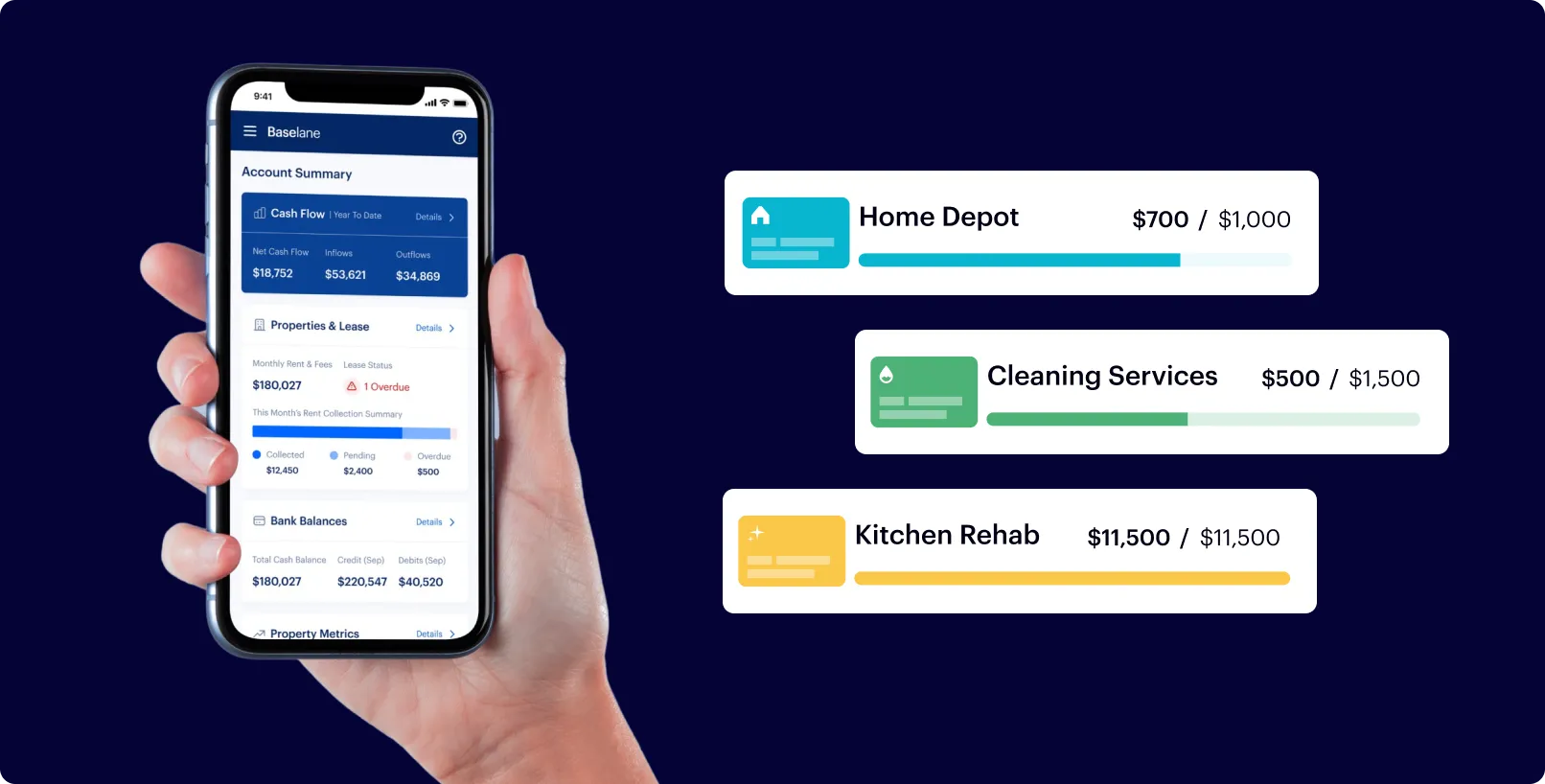
Baselane is an all-in-one financial management platform that helps property owners consolidate landlord banking and bookkeeping under a C‑Corp entity and manage multiple corporate entities and subsidiary LLCs from a single login.
You can open unlimited checking and savings accounts for each business entity with no monthly fees or minimum balances and separate funds by property, division, or cost center. Assign virtual debit cards to employees or managers with customizable spend limits, and tag each card transaction to a specific account or category, eliminating the need for manual month-end reconciliation.
Set auto-transfer rules to move funds directly between your C-Corp operating account and subsidiary LLC accounts for management fee distributions, capital calls, or expense reimbursements. Automate bookkeeping by setting auto-tag rules to categorize transactions as they happen and create custom categories to match the Schedule C reporting for your operating entity.
As banking and bookkeeping live under one login, you get real-time property-level cash flow and profitability insights so you can make informed decisions on distributions, capital allocation, and operating costs without waiting for month-end closes.
Now I have a dedicated account and debit card for each property, making it easy to track income and expenses instead of spending hours figuring out which transactions belong to which property. ~ Phillip Munoz, 11 properties, LTR and STRs
Own your time,
not just your properties
Make your finances work harder, so you don’t have to.


Relay

Relay is a business banking platform for small businesses that offers multi-account organizations and managed team spending. You can open up to 50 business checking accounts (on its highest paid tier), 2 savings accounts, and issue 50 physical or virtual debit cards per entity. Relay charges 0 in monthly fees and requires absolutely no initial deposit to open your accounts, but you’ll need to be on one of its tiers, ranging from $0 to $120/month.
You can use Relay’s multi-account structure to separate general operating expenses from payroll within your C-Corp. Relay offers basic online cash flow features and integrates with accounting tools like QuickBooks and Xero. But it doesn’t provide built-in bookkeeping, real estate-specific reporting, or any integrated rent processing features.
Bluevine

Bluevine is an online business banking platform tailored to small businesses that’s known for its high-yield checking. Bluevine Business Checking currently offers a 1.3% APY (up to 3.7% on savings account) and charges $0-$95 in monthly fees. To unlock the highest APY and waive the fee, you’ll need to meet a balance requirement of $20,000 to $100,000 ($0 for the free plan).
It functions well as a general banking platform to hold your C-Corp funds, but it lacks specialized features like built-in bookkeeping, rent collection, and property-level reporting.
Chase Business

Chase Business offers traditional banking solutions with extensive in-person branch access across the country. The Chase Business Complete account currently carries a $15 monthly maintenance fee. The bank waives this fee if your corporate account maintains a minimum $2000 daily balance.
Like other brick-and-mortar banks, Chase provides a broad range of services, including localized payment processing and business credit lines. Chase operates over 5000 branches nationwide, which is beneficial if you frequently deposit physical cash or paper checks. The corporate application process typically requires an in-person visit to a branch with physical corporate documents, which can be a drawback if your partners are not based in the same state or city.
Bank of America

Bank of America is another full-service traditional banking option for large real estate corporate entities. Their standard business checking accounts typically require a $100 initial deposit and carry a variable $16 monthly fee, which is waivable if you maintain a minimum balance of $5,000. Bank of America offers robust digital banking services and CRE loans alongside its massive physical branch network.
Compared to digital banking platforms, Bank of America offers low APY on savings accounts (up to 0.04%), which means your funds might not earn you enough, no matter how much your reserves grow. Bank of America follows strict corporate application requirements demanding extensive identity verification.
Comparing top C-Corp banking accounts in 2026
Using real estate financial software with integrated banking provides a centralized view of your banking operations and offers real-time cash flow insights across your entire portfolio. When evaluating your options, also consider integrated accounting software that maps directly to their live bank data without manual entry.
How to choose the right bank account for your C-Corp
The best bank account for a C-Corp operation depends entirely on your portfolio scale and operational complexity. Here are the key features to look for when evaluating a banking partner for your real estate C-Corp.
- Account structure: Confirm the institution supports multiple accounts across entities with low or no account maintenance fees. Properly setting up multiple bank accounts for landlords ensures each asset stays financially isolated.
- Cash Management: High APY on idle cash reserves (security deposits or tax savings) is essential for maximizing returns.
- Payment infrastructure: Look for native support for rent collection by bank transfer and receiving rent by wire transfer — particularly important when managing commercial tenants. US Bank (2025) notes that 51% of companies are adopting instant payments across their workflows, making this table stakes for competitive operations.
- Entity-level visibility: Each property or LLC should have its own ledger view. Without it, month-end reconciliation becomes an administrative liability.
- Team access controls: Assess whether your management team requires role-based or localized financial access across accounts, and if the banking platform supports that.
- Accounting integration: The best landlord accounting software connects directly to your banking layer. Check if the platform integrates with your accounting tool or offers built-in bookkeeping for an accurate picture of rental property cash flow.
- Rent collection compatibility: Confirm if the provider offers rent collection tools or integrates with a rent payment solution to streamline rent deposits.
Bottom line
As your entity structure grows, so does the complexity of keeping corporate finances organized across operating companies and holding LLCs.
Baselane gives you entity-level account separation, high [v="apyvalue"] APY² on savings accounts, and real-time financial reporting, without stitching together multiple tools.
Open your C-Corp account on Baselane and bring your entire entity structure under one platform.
FAQs
Can a real estate C-Corp open a bank account online?
Yes, many modern banking platforms allow real estate C-Corporations to open accounts entirely online. You need to upload digital copies of your corporate documents and government-issued identification for all beneficial owners. Traditional financial institutions may still require your authorized signers to visit a physical branch to verify documents.
What documents are needed to open a C-Corp bank account?
Financial institutions require your state-approved Articles of Incorporation, EIN, signed board resolution that officially authorizes the account and identifies the permitted signers. Most banking platforms also request your corporate bylaws and personal identification for all beneficial owners.
Can entity members both be signatories on a C-Corp bank account?
Multiple members or partners can absolutely act as authorized signatories on C-Corp accounts. The corporate board resolution must explicitly grant financial authority to each individual operating partner. Banking platforms use your corporate bylaws to establish appropriate spending limits and transaction approval workflows.
Do I need a separate bank account for each property under my C-Corp?
For optimal financial tracking and to protect the corporate veil, best practices mandate the use of separate checking accounts or ledgers for each property under your main corporate entity. A specialized banking platform can facilitate this separation, simplifying tax preparation and preventing commingling risks.
Does Baselane support C-Corp entities?
Yes, Baselane fully supports C-Corporations operating actively in the real estate business. You can manage multiple corporate entities and subsidiary LLCs under a single login by opening dedicated accounts for each entity or property, automating bookkeeping, and sharing access with members.
What is the best bank account for a C-Corp in real estate?
Baselane is the top banking platform for C-Corp real estate investors, offering entity-level banking and bookkeeping with real-time cash flow insights, no monthly fees, or minimum balances. Standard business banks like Bluevine or Relay lack the specific real estate and complex entity-level separation tools C-Corps require.