



Managing finances across multiple properties and LLCs means logging into a state bank for one property, a local credit union for another, and an external high-yield savings account for reserves, just to get a complete picture of your portfolio. Such fragmentation leads to limited financial visibility. A bank account dashboard consolidates your accounts, transactions, and reporting into a single view, so you can track property-level performance and make strategic investment decisions without the friction of multiple logins.
This guide covers what to look for in a dashboard and which platforms best handle the complexity of a real estate portfolio.
Key takeaways
- A bank account dashboard aggregates data from checking and savings accounts and cards into one view, eliminating the need to toggle between multiple banking apps.
- Integrating a HYSA dashboard allows you to manage capital reserves efficiently, ensuring idle cash earns maximum interest while remaining visible alongside operating funds.
- Modern dashboards use read-only API connections and tokenization to securely aggregate data without exposing login credentials.
- Real-time visibility into real estate reports like Net Operating Income (NOI) and cash flow helps quickly identify underperforming assets and find opportunities for reinvestment.
What is a bank account dashboard?
A real estate bank account dashboard aggregates, organizes, and analyzes data from disparate sources. It pulls real-time data from operating checking accounts, security deposit holding accounts, and high-yield savings into one place. According to FFNews, 42.5% of users manage rental property finances across multiple apps due to missing features in single platforms, a fragmentation that is particularly acute for business owners.
A true multi-bank account dashboard solves this by leveraging technology to treat your entire portfolio as a cohesive business entity rather than a collection of isolated accounts. Instead of manually updating spreadsheets or reconciling paper statements, the dashboard synchronizes transaction data automatically. This shift from manual oversight to automated aggregation allows investors to focus on asset management rather than administrative data entry.
For multi-unit investors, the dashboard serves as the single "source of truth." It bridges the gap between banking and bookkeeping, providing a real-time ledger that reflects the financial health of every unit and LLC. By centralizing this data, you reduce the risk of missed payments, overlooked expenses, and commingled funds, ensuring your portfolio remains compliant and profitable.
Key features of a financial dashboard for real estate investors
When evaluating bank aggregation dashboard tools, look for the following features.
Multi-bank & multi-account aggregation
The core function of a financial dashboard for multiple bank accounts is to communicate with various financial institutions simultaneously. Through secure API connections, these dashboards pull transaction history and bank balance data from external banks and credit cards. This is critical, especially when you keep operating funds in one institution for local branch access while holding capital reserves in a separate high-yield savings online account.
An effective bank aggregation dashboard ensures that when a tenant pays rent into a legacy account, or a contractor is paid from a new operating account, both transactions are instantly visible.
By using a rental property financial dashboard that links to external bank accounts, you can maintain your existing banking relationships while upgrading your rental management system. This flexibility allows you to set up multiple bank accounts for different properties or entities or without losing the ability to view your total liquidity at a glance.
Property-specific tracking & bookkeeping
Look for a specialized landlord bank account dashboard that allows you to create subaccounts for each unit, property, or LLC, ensuring that income and expenses are correctly separated and attributed correctly. This structure is essential for accurate accounting for rental property and prevents commingling of funds between personal and business funds.
Modern banking platforms take this a step further by integrating automated bookkeeping rules that align with Schedule E categories. When you import transactions from an external bank, the system automatically tags it to the correct tax category. Such automation transforms your dashboard from a passive viewing tool into an audit-ready financial record, replacing generic property management spreadsheets.
Cash flow & profitability analysis
A robust dashboard turns raw transaction data into actionable metrics, offering real-time rental property cash flow statements and profit-and-loss (P&L) reports.
Look for dashboards that automatically calculate key performance indicators (KPIs) such as Net Operating Income (NOI), Cap Rate, and Cash-on-Cash return. Having real-time access to property-level metrics allows you to spot trends early—such as high maintenance costs in a specific unit—before they impact your profit margins. This level of insight helps you make strategic decisions about refinancing, renovating, or divesting an underperforming asset.
High-yield savings account (HYSA) integration
A HYSA dashboard is essential for managing capital reserve funds, tax savings, and security deposits. By using a HYSA dashboard's external bank-linking feature, you can view your high-yield balances alongside your operating funds, ensuring you always have adequate liquidity for emergencies while maximizing interest income.
Many investors use a "hub and spoke" model, where they collect rent in operating accounts and put excess cash into a high-yield savings account. A dashboard that supports external bank linking allows you to monitor these transfers and verify that your reserves are meeting your targets.
To understand how interest earnings compound, review how APY works in the real estate business.
Learn how to open high-yield savings accounts and how to structure rental property bank accounts.
Security, privacy, and trust
The primary hesitation investors have with apps that aggregate HYSA and external accounts is security. It is crucial to understand that modern dashboards utilize "Open Banking" standards and secure APIs (Application Programming Interfaces) rather than storing your bank login credentials. When you link an account, you are typically granting a secure, read-only token to the dashboard provider, often facilitated by trusted intermediaries like Plaid or Yodlee.
These connections use bank-grade encryption and do not allow the dashboard to initiate unauthorized withdrawals. This read-only access ensures that while you can view your balances and transactions for bookkeeping, your funds remain secure within their originating institutions. Furthermore, features like Multi-Factor Authentication (MFA) and data tokenization add layers of defense against unauthorized access.
Reputable dashboard providers partner with FDIC-insured banks to hold funds, ensuring that your deposits are protected up to legal limits ($250,000 traditionally, though platforms like Baselane offer up to $3M via sweep networks). Understanding these digital banking benefits and security protocols is essential for moving away from manual tracking with confidence.
Alerts, notifications, and risk management
Customizable alerts can notify you of critical events, such as a tenant's rent payment clearing, a balance dropping below a specific threshold, or an unusually large expense hitting an account. These notifications allow you to react immediately to potential issues rather than waiting for a monthly statement.
Beyond daily transactions, advanced dashboards help manage risk by tracking debt service obligations against incoming rent. By visualizing your Loan-to-Value (LTV) ratios and debt service coverage across the portfolio, you can ensure you remain compliant with lender covenants. This transparency helps you mitigate risks in a volatile market.
Choosing the best bank account dashboard for your rental properties
Choosing the right dashboard depends on your portfolio's complexity and long-term goals. While a simple aggregator works for a single rental, a multi-unit portfolio needs a real estate investor's financial dashboard with real-time reporting, automated workflows, and high security.
Evaluation Checklist:
- Connectivity: Does the platform link external bank accounts and credit cards, so transactions from all your accounts appear in one dashboard?
- Specialization: Is it built for real estate or is it a general business tool that requires manual setup to handle rental finances?
- Yield: Does the platform offer built-in high-yield savings accounts, or does earning interest on reserves require a separate account at another institution?
- Cost vs. value: What are the monthly fees at your portfolio size, and does the time saved on bookkeeping, reconciliation, and tax prep justify them?
- Scalability: Can you add properties, entities, and accounts without hitting limits or upgrading to a higher-cost plan?
Below is a comparison of leading solutions for real estate investors.
Comparison table: Top bank account dashboards for real estate investors
Own your time,
not just your properties
Make your finances work harder, so you don’t have to.


How Baselane empowers investors with the best bank account dashboard
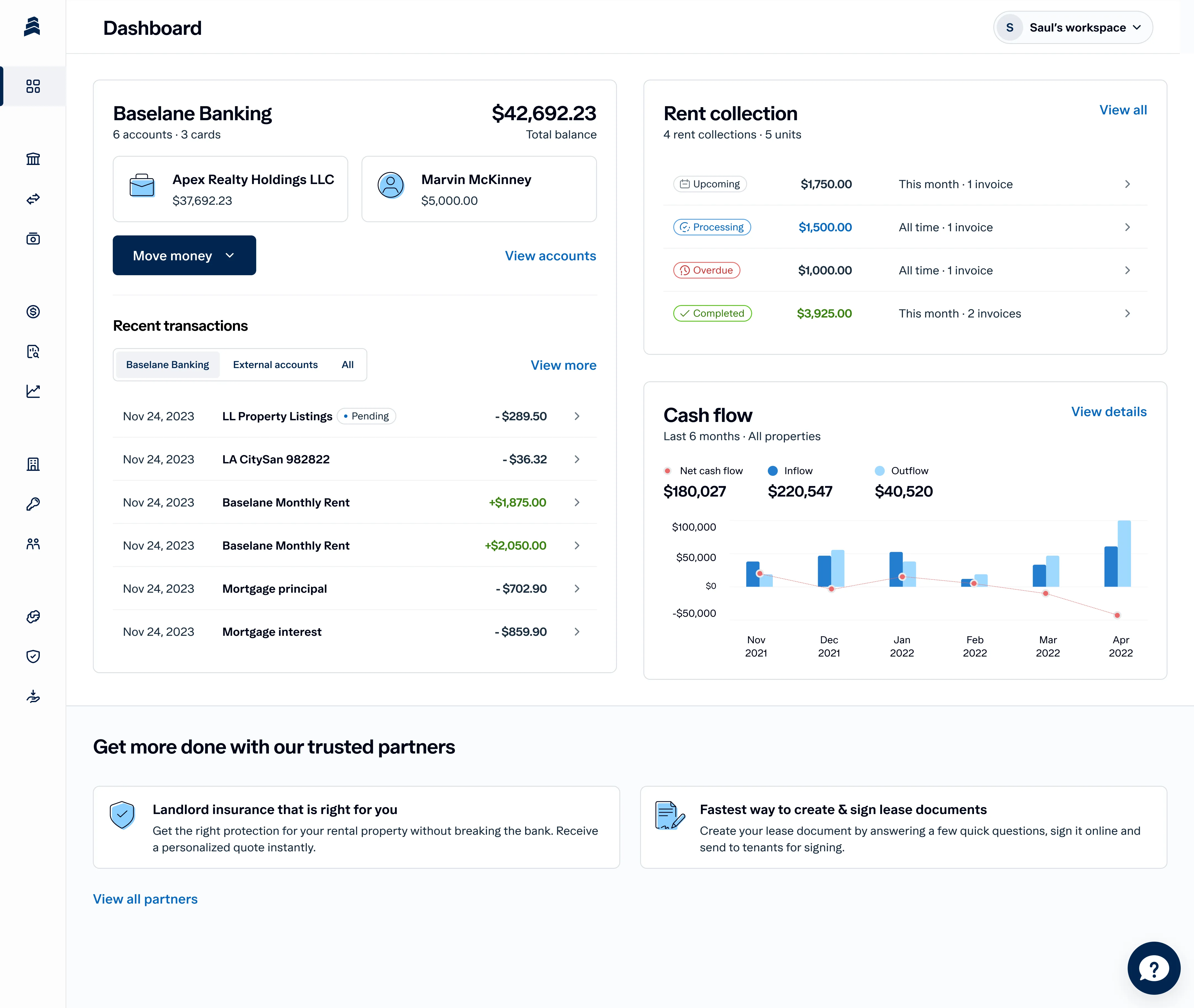
While many banking platforms auto-sync external bank feeds and offer visibility, Baselane goes a step further. It offers integrated banking and bookkeeping under a single login across all entities and properties, while also syncing up to 24 months of transactions from external bank accounts and credit cards.
Baselane solves the "fragmentation" problem through high-level consolidation and offers instant visibility into your properties’ performance from a single dashboard.
You can open unlimited checking and savings accounts for each property or purpose, and transactions are tagged automatically by property and category as soon as they hit the accounts. This structure reduces tax prep time and eliminates the risk of missing key tax deductions.
Instead of switching between apps to piece together how your portfolio is performing, you see property-level cash flow, rent payment status, and account balances across your portfolio the moment you log in.
How to set up a multi-bank account dashboard with Baselane
Transitioning to a centralized dashboard is a strategic move that pays dividends in saved time and financial clarity.
- Create your entity structure: Open a Baselane account under the correct entity type (sole proprietor or LLC). Add a checking account for each property and create subaccounts for rental property expenses, CapEx reserves, and security deposits.
- Connect external accounts: Link external bank accounts and credit cards via Plaid. This pulls in up to 24 months of historical transactions and enables transfers directly from the dashboard.
- Establish savings buckets: Create dedicated high-yield savings accounts for security deposits and CapEx funds. Each account earns interest and is FDIC-insured up to [v="fdic_short"]¹ through Thread Bank's sweep network.
- Automate rent and bookkeeping: Set up rent collection for your tenants. As payments arrive, use the automated rules to tag them to the correct Schedule E categories, ensuring your books are always up to date.
Advanced bank account management dashboard strategies & future trends
As AI technologies evolve, bank accountant dashboard tools are becoming capable of forecasting cash flow shortages and suggesting optimization strategies. According to ULI, AI is moving into real estate specifically for asset selection and management.
Advanced dashboards will soon leverage Open Banking data to offer "smart" suggestions, such as recommending a refinance based on current rates and your specific LTV, or highlighting an expense category that is trending higher than the market average. Integrating AI accounting software capabilities into your dashboard will transform it from a retrospective reporting tool into a proactive financial advisor.
Investors who adopt these platforms that allow external bank account linking for HYSA dashboard integration today are positioning themselves to leverage these future capabilities. By having structured, historical data already in place, you will be ready to use AI-driven insights to scale your portfolio with precision.
Bottom line
A dedicated bank account dashboard resolves the fragmentation challenge of using multiple banking tools by centralizing your financial data, automating the tedious work of bookkeeping, and optimizing your cash reserves.
Baselane offers a real-time dashboard-level view of your property finances through its integrated banking and bookkeeping for all entities under one login. Create your account today and remove mental overhead through dedicated banking dashboards.
FAQs
What are the best practices for integrating bank account data into a dashboard?
Use a platform that connects via a secure API, such as Plaid, supports read-only access, and automatically syncs transactions. The fewer manual imports you need, the more reliable your portfolio view will be.
Is it safe to link external bank accounts to a dashboard?
Linking accounts is generally safe when using reputable platforms that use "read-only" access and bank-level encryption standards. Services like Plaid tokenize your data, meaning the dashboard never sees or stores your actual banking login credentials, preventing unauthorized withdrawals.
How does a dashboard help with tax preparation?
A specialized dashboard automatically categorizes transactions according to IRS Schedule E categories (e.g., repairs, utilities, management fees). This automation produces accurate, property-level financial reports, significantly reducing the time and cost associated with organizing records for your CPA at tax time.
Can I manage high-yield savings accounts on a dashboard?
Yes, advanced dashboard bank account platforms allow you to integrate HYSA dashboard features, enabling you to track capital reserves and security deposits that earn interest.
Can you link an external bank to a HYSA dashboard?
Yes, you can. Baselane lets you connect external bank accounts and credit cards, along with built-in high-yield savings accounts, so your finances appear on a single dashboard.
Do fintech platforms with HYSA dashboards support external bank linking?
Most do. Look for the best HYSA dashboards with external bank account integration that use open banking integrations rather than credential-based logins. These sync more reliably and give you real-time balance and transaction data across all your accounts.